Milo Is Back in Britain: The First Amendment Didn’t Follow Him Home
Written by Peter Boykin on August 29, 2026






Milo Is Back in Britain: The First Amendment Didn’t Follow Him Home
Go Right News Shared by Peter Boykin
American Political Commentator | Citizen Journalist | Activist | Constitutionalist for Liberty
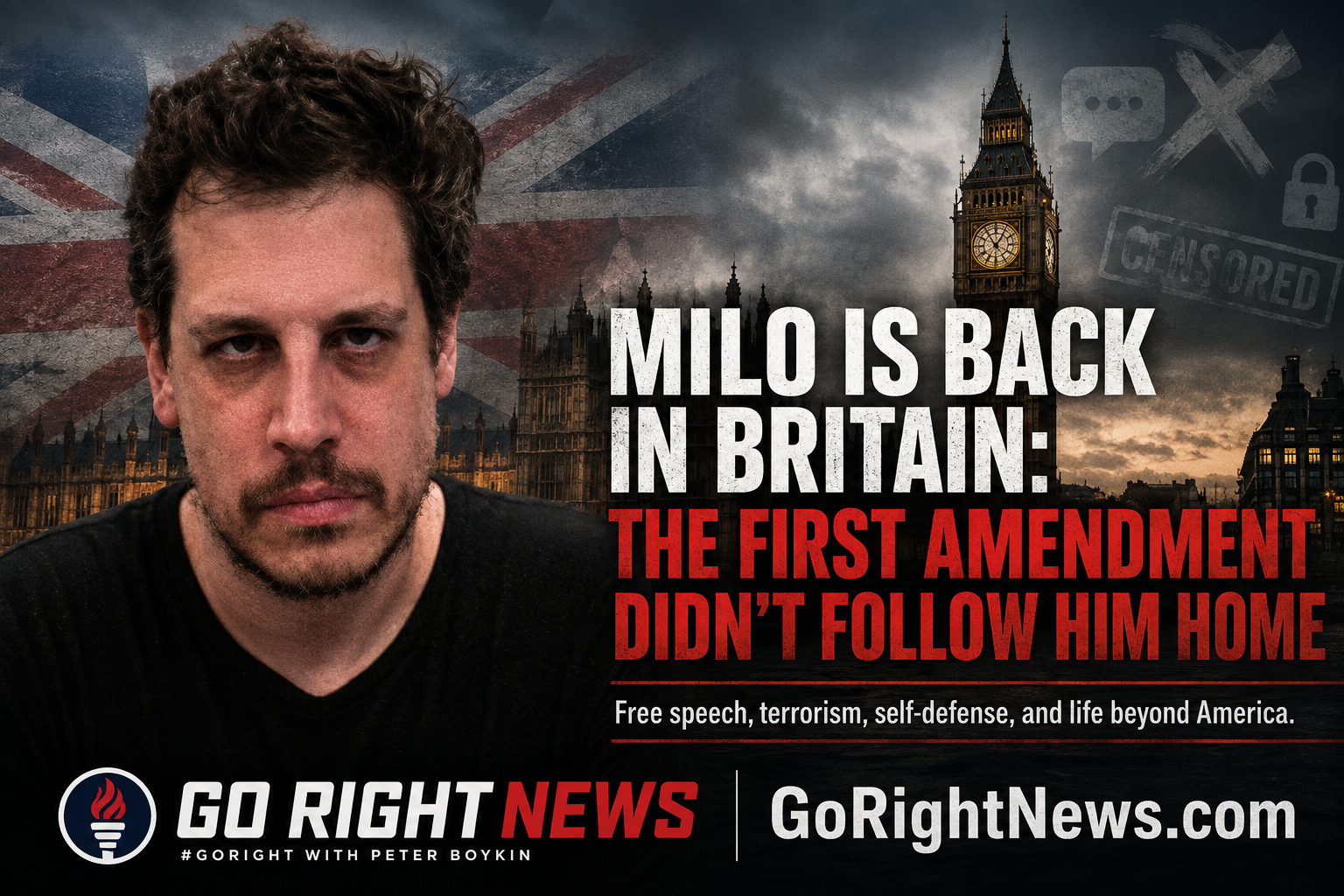
Milo Is Back in Britain: The First Amendment Didn’t Follow Him Home
Milo Yiannopoulos built much of his career testing the limits of American free speech. After deportation, he is now living under a very different legal system, one confronting terrorism, immigration, online speech, and personal defense without America’s constitutional guardrails.
By Peter Boykin
GoRightNews.com
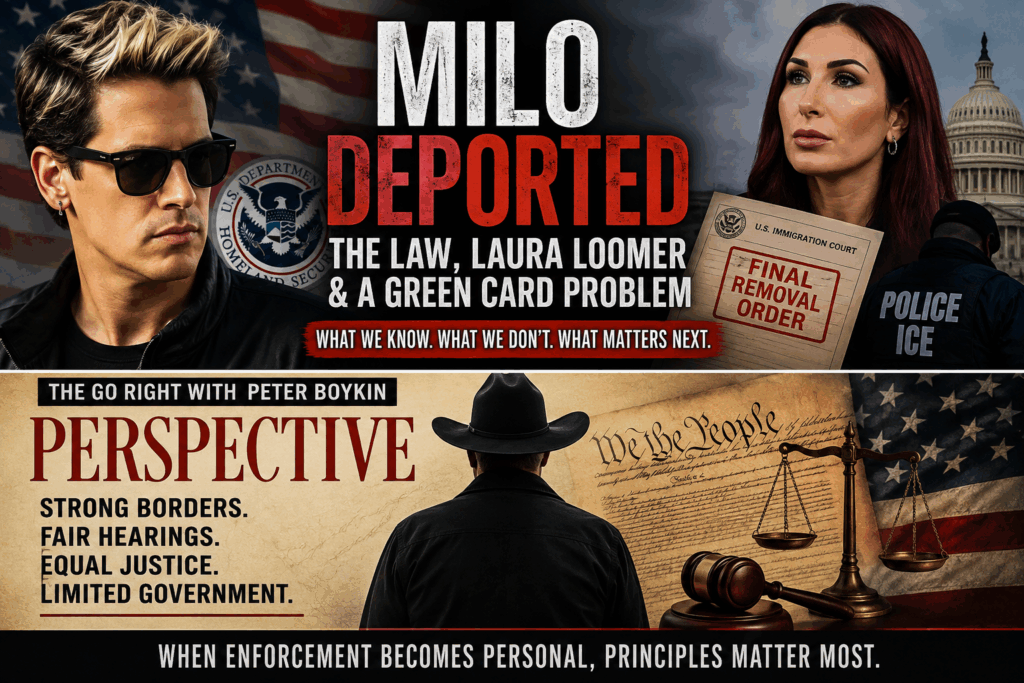
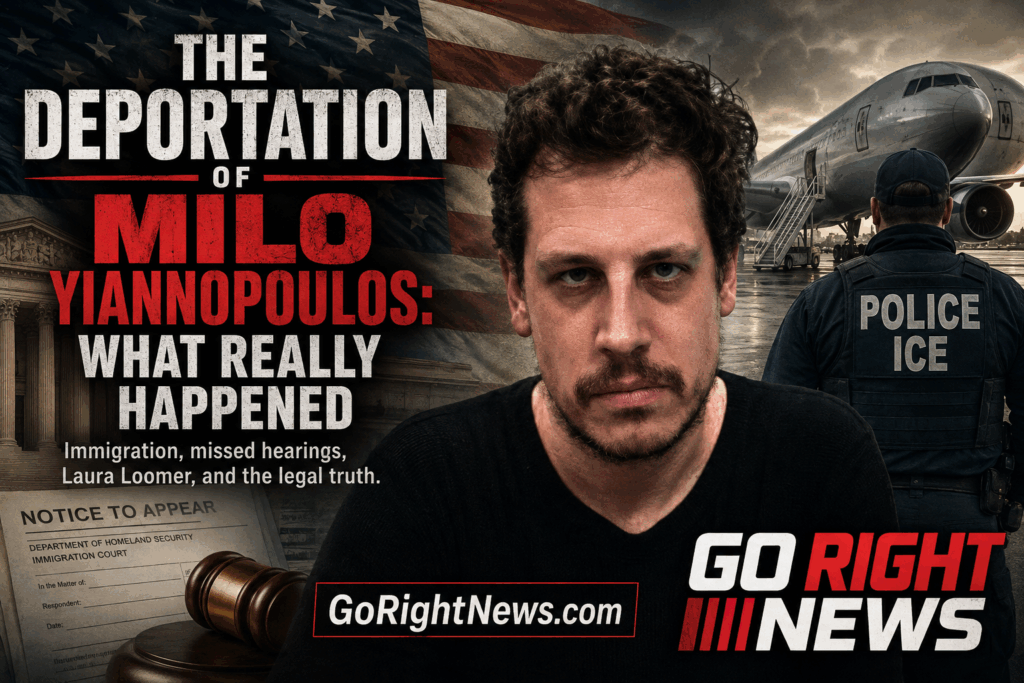
Milo Yiannopoulos has been deported from the United States and returned to the United Kingdom.
That fact opens another story that may ultimately be more interesting than the deportation itself.

Milo spent much of his American political career deliberately testing the boundaries of acceptable speech. He offended people. He provoked people. He attacked political correctness. He antagonized the Left, eventually alienated plenty of people on the Right, and made criticism of Islam and immigration central parts of his public persona.
Now he has been returned to a country where freedom of expression exists, but where the legal boundaries surrounding speech are significantly different from those in the United States.
The irony is difficult to miss.
Milo spent years warning about Britain.
Now Britain is home again.
The Department of Homeland Security says Yiannopoulos legally entered the United States in May 2019, overstayed his authorized admission, failed to appear for an immigration hearing, received a final removal order on July 22, and was deported to Britain following his August 27 arrest at Louis Armstrong New Orleans International Airport. (Reuters)
Whatever eventually emerges concerning that missed hearing, his marriage, his immigration attorneys, or Laura Loomer’s efforts to report him to federal authorities, the immediate reality is simple.
Milo is no longer speaking from America.
And the First Amendment does not travel with him.
America Protects Offensive Speech Precisely Because It Is Offensive
Americans sometimes talk about the First Amendment as though it simply means “free speech.”
It is considerably stronger than that.
The First Amendment restricts what the American government may do to speech, particularly when government dislikes the speaker’s viewpoint.
That protection is not unlimited. True threats, defamation, fraud, obscenity, incitement, and certain other narrowly defined categories may fall outside constitutional protection. (Constitution.gov)
But American courts have erected an extraordinarily high barrier before political advocacy becomes criminal incitement.
Under the Supreme Court’s Brandenburg v. Ohio standard, advocacy of violence or lawbreaking generally cannot be prohibited merely because it is ugly, radical, or inflammatory. It must be directed toward producing imminent lawless action and be likely to actually produce it. (Constitution.gov)
That distinction has protected speakers across the political spectrum.
America does not have a constitutional right to never be offended.
It has something much more important.
It has a constitutional restriction on government’s ability to silence people because their ideas are offensive.
That has been the legal environment in which Milo operated for much of his public career.
Britain works differently.

Britain Has Free Speech, But It Is A Qualified Right
It would be incorrect to say the United Kingdom has no freedom of speech.
It does.
Article 10 of the European Convention on Human Rights protects freedom of expression, and British prosecutors themselves recognize that protection.
In fact, current Crown Prosecution Service guidance explicitly says Article 10 protects expression that “offends, shocks, and disturbs.”
The CPS also instructs prosecutors that speech should not be prosecuted simply because it is offensive, shocking, disturbing, satirical, rude, unpopular or unfashionable. Interference with expression must be necessary and proportionate. (Crown Prosecution Service)
That is significant.
Britain is not some speechless dictatorship where criticizing the government automatically leads to prison.
But Article 10 is a qualified right.
That creates considerably more room for Parliament and British courts to regulate expression than the First Amendment ordinarily permits the American government.
And Britain’s communications laws demonstrate the difference.
Something Milo Posts On X Can Potentially Become A Criminal Matter
British law still allows prosecution for certain electronic communications considered “grossly offensive,” indecent, obscene or menacing.
Current CPS guidance says Section 127 of the Communications Act can apply to messages sent through public electronic communications networks, including the internet and social-media platforms. Merely posting or reposting something can satisfy the act of sending a communication in some circumstances. (Crown Prosecution Service)
There is an important safeguard that should not be overlooked.
British courts have said something must be grossly offensive, not merely offensive. Even something in “shockingly bad taste” is not automatically criminal. Prosecutors are specifically instructed to consider freedom of expression before bringing a case. (Crown Prosecution Service)
Still, compare that legal test with America’s.
The American constitutional starting point is generally that government cannot punish protected speech simply because reasonable members of society consider it deeply offensive.
Britain actually has a criminal category involving communications deemed grossly offensive.
That is not a minor philosophical distinction.
For someone like Milo Yiannopoulos, it could become extremely practical.

Britain Has Already Had Its Own Culture-War Arrests
This isn’t merely a theoretical concern.
In 2025, Irish comedy writer Graham Linehan was arrested at London’s Heathrow Airport over X posts concerning transgender issues. Police said they were investigating suspected incitement to violence.
His arrest triggered a major free-speech controversy.
Britain’s senior police leadership subsequently acknowledged that officers were being placed in what Commissioner Mark Rowley described as an extraordinarily difficult position, forced to distinguish criminal communications from contentious political expression amid what he called “toxic culture wars.” (ThePrint)
An arrest, of course, is not a conviction.
And speech that genuinely threatens or incites violence can also lose constitutional protection in America.
But the controversy demonstrated something Milo now needs to understand personally:
Posting something from Britain is legally different from posting the same political provocation while sitting in America.
Being on X does not place a British resident inside American constitutional jurisdiction.
An American audience does not magically extend the First Amendment across the Atlantic.
The Online Safety Act Adds Another Layer
Britain has also been implementing its Online Safety Act.
Much of the political rhetoric surrounding that law oversimplifies what it actually does.
The statute primarily imposes duties on social-media companies, search providers and other covered online services. Platforms must assess risks, protect users against illegal material, maintain reporting procedures and remove illegal content once identified. (www.ofcom.org.uk)
The law also created specific communications offenses, including offenses involving knowingly false communications intended to cause non-trivial harm and threatening communications.
Meanwhile, older provisions dealing with grossly offensive communications remain available in certain circumstances. (Crown Prosecution Service)
Supporters argue these laws protect children, victims and society from genuinely dangerous online conduct.
Critics argue that forcing technology companies to determine what content crosses complicated legal boundaries creates incentives to remove too much lawful speech.
Even X has publicly argued that implementation of Britain’s Online Safety Act risks suppressing legitimate expression through over-censorship. (Reuters)
That debate is now Milo’s debate in a very direct way.
Milo Warned About Radical Islam. Britain Says There Is A Real Threat, But Words Matter
Milo has made sweeping statements about Islam and Britain throughout his career.
Some were deliberately provocative.
Some treated Islamism, Islam and Muslims as though those terms were interchangeable.
They are not.
There is nevertheless an important fact that should not be hidden simply because the subject is politically uncomfortable.
The British government itself says Islamist terrorism remains the country’s primary terrorist threat.
The Home Office said precisely that in its August 2026 Prevent factsheet. (Home Office Media)
Britain’s Joint Terrorism Analysis Centre has also raised the country’s national terrorism threat level to SEVERE, meaning an attack is considered highly likely. MI5 says the deteriorating threat picture has involved both Islamist terrorism and rising extreme-right terrorism, while Islamist terrorism remains the primary threat. (MI5)
Government risk assessments have estimated Islamist terrorism accounted for about 67 percent of UK terrorist attacks since 2018, while extreme-right terrorism accounted for about 22 percent. (GOV.UK)
Those are legitimate facts.
They should be discussed.
They should not be censored because somebody worries that acknowledging Islamist extremism might offend someone.
But there is an equally important distinction.
Radical Islamists are not synonymous with British Muslims.
A Muslim neighbor peacefully practicing his religion is not ISIS.
Someone criticizing Islamist ideology is not automatically attacking every Muslim.
Likewise, condemning Islamic terrorism should not become permission to assign collective guilt to millions of people based simply upon their religion.
A serious free society ought to be capable of saying both things simultaneously.
Radical Islamist terrorism presents a documented security threat.
Collectively branding ordinary Muslims as terrorists is neither accurate nor necessary to confront it.
There Is Also An Apparent Contradiction In Britain’s Own Extremism Numbers
Britain’s latest Prevent statistics provide another interesting wrinkle.
For the year ending September 2025, extreme-right concerns accounted for about 20 percent of Prevent referrals, while Islamist concerns accounted for about 8 percent.
Among people ultimately adopted as Channel cases, extreme-right concerns represented 42 percent and Islamist concerns 12 percent. (GOV.UK)
At first glance, someone could use those numbers to argue that the extreme right is Britain’s larger terrorist threat.
But that is not what Britain’s security agencies say.
The government itself acknowledges that Prevent referral statistics do not perfectly correspond with the national terrorism threat picture. A Prevent referral is a safeguarding intervention, not a terrorist conviction, and the Home Office continues to describe Islamist terrorism as Britain’s primary terrorist threat. (Home Office Media)
That distinction is exactly why political discussions about Islam, migration and extremism need more precision rather than less speech.
Facts should defeat exaggeration.
Censorship should not replace facts.
Then There Is Self-Defense
Milo is also returning to a country with an entirely different philosophy about weapons and personal defense.
Again, the simplistic claim that Britons cannot defend themselves isn’t correct.
British government guidance explicitly states that citizens may use reasonable force to protect themselves or others when a crime is taking place in their homes.
They do not have to wait until an intruder attacks first.
They may even use an available object as a weapon in the heat of the moment.
What they generally cannot do is continue attacking once the threat has ended or pre-plan traps for an intruder. (GOV.UK)
So there is a right of self-defense.
But there is nothing comparable to America’s Second Amendment.
Firearms possession requires government certification. Applicants must satisfy police requirements, and certain weapons are prohibited outright. (GOV.UK)
Even defensive sprays that millions of Americans might casually consider ordinary personal-protection devices are treated dramatically differently.
UK firearms guidance specifically identifies CS spray, Mace and OC pepper spray as prohibited weapons under firearms legislation. (GOV.UK)
That illustrates the difference between the two countries better than almost anything else.
Britain says you may defend yourself.
The government simultaneously retains substantial authority over what you may possess to accomplish that defense.
America begins with a constitutional provision saying the right of the people to keep and bear arms shall not be infringed, even though courts continue fighting over exactly how far that protection extends.
Those are fundamentally different legal cultures.
Milo Can Still Talk To America
Being deported doesn’t erase Milo from American politics.
He can still write articles.
He can still appear remotely on American podcasts.
He can still post on social media.
He can still criticize Donald Trump, Laura Loomer, ICE, Muslims, Democrats, Republicans, me, you or anybody else who attracts his attention.
Nothing about deportation automatically removes someone’s ability to participate in American political conversation from overseas.
But his physical location matters.
If Milo sits in Britain while posting, British law applies to conduct within British jurisdiction.
The First Amendment constrains the American government.
It does not order British police, Parliament or British prosecutors to follow American constitutional law.
That may become particularly relevant for a political provocateur whose career was built partly around discovering exactly where society’s boundaries were and walking right up to them.
America’s boundary and Britain’s boundary are not located in the same place.
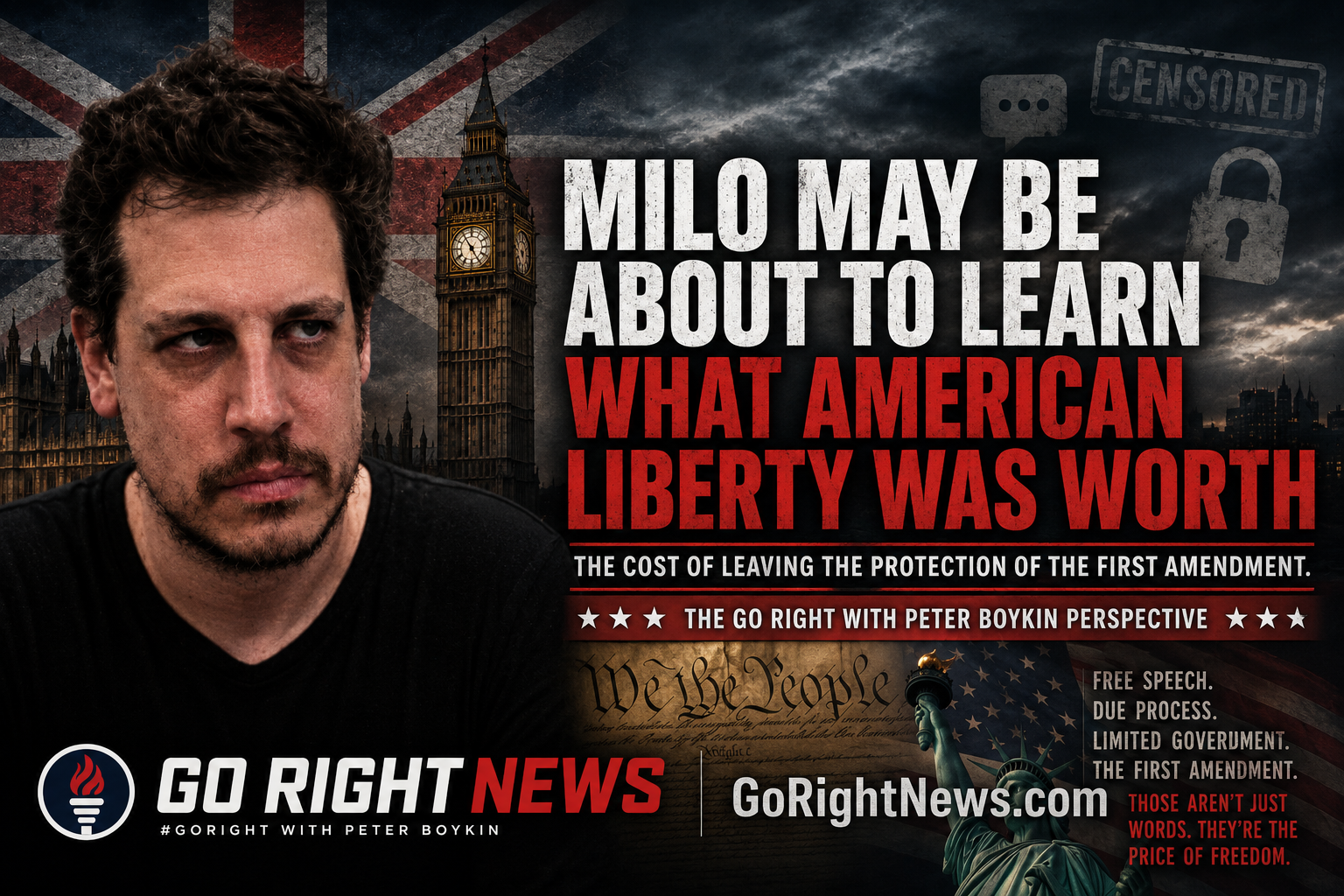
Milo May Be About To Learn What American Liberty Was Worth
The Go Right with Peter Boykin Perspective
There is something strangely fitting about this story.
I have defended free speech for years, including at the Demand Free Speech rally in Washington where Milo and Laura Loomer were once standing on the same side of that fight.
Milo and I certainly haven’t always agreed.
Eventually he blocked me on X.
So what?
Getting blocked is not oppression.
Being insulted isn’t oppression.
Having someone say something offensive isn’t automatically oppression.
I don’t need Milo to like me before I defend his right to speak.
And I don’t need to agree with everything he says before I become concerned about governments deciding which political opinions are acceptable.
That is exactly what freedom of speech is supposed to mean.
If freedom only protects agreeable speech, it isn’t freedom. It is permission.
Milo has made comments I think were obnoxious.
He has said things I would argue against.
He has said things about entire groups of people that I would not say myself.
My answer to him is more speech.
Tell him he’s wrong.
Debate him.
Mock him.
Fact-check him.
Expose hypocrisy when it exists.
But when government gets involved, constitutionalists should ask a different question:
What power are we giving the state, and what happens when that power is eventually used against us?
Britain provides Americans with a useful comparison.
The United Kingdom is a democracy.
It has elections.
It has courts.
It has newspapers fiercely critical of government.
It recognizes freedom of expression.
It recognizes self-defense.
But those liberties exist inside a substantially different legal framework.
Britain’s right to expression can be balanced against other interests.
America’s First Amendment is a direct restriction on government power.
Britain allows reasonable self-defense while heavily regulating the tools someone may possess.
America constitutionally recognizes a right to keep and bear arms.
Those differences matter.
And they matter even more when a country faces legitimate security threats.
Britain does have a serious Islamist terrorist problem.
That isn’t a right-wing conspiracy theory. Britain’s own government says Islamist terrorism remains its primary terrorist threat.
At the same time, Britain faces extreme-right terrorism, other radicalization threats and complicated immigration pressures.
The constitutional question is what government does in response.
You can fight terrorism without surrendering liberty.
You can enforce borders without abandoning due process.
You can prosecute genuine threats without criminalizing unpopular opinions.
You can protect Muslim citizens while aggressively confronting radical Islamists.
You can protect gay citizens while allowing religious conservatives to criticize homosexuality.
You can protect Christians while allowing atheists to ridicule Christianity.
You can protect transgender Americans while permitting criticism of gender ideology.
That is what a genuinely pluralistic society requires.
The answer cannot be:
“Speech is free as long as authorities consider it responsible.”
That puts government in charge of defining responsible speech.
America took a different path.
Our Constitution assumes that government itself can become the threat.
That is why we don’t merely enumerate things citizens may do.
We place restraints on what government may do to citizens.
Milo Yiannopoulos may now get an unusual firsthand education in the difference.
For years he operated inside the broad protection of America’s First Amendment while criticizing a Britain he viewed as increasingly hostile to controversial speech.
Now he has been involuntarily returned to Britain at a moment when terrorism is at a SEVERE national threat level, debates about immigration and Islam are intensifying, online speech is increasingly regulated, and the country continues wrestling with the boundaries between offensive expression and criminal communication.
Maybe Milo tones himself down.
Knowing Milo’s history, maybe he does the opposite precisely.
Either way, his next chapter could become an unexpected test case in a much bigger debate.
Not simply whether Milo Yiannopoulos deserves free speech.
But whether any right deserves to be called a right when government decides how much of it you are permitted to exercise.
That question extends far beyond Milo.
And Americans would be wise to pay attention.
Milo Yiannopoulos has been deported to Britain, but the First Amendment did not go with him. His return exposes striking differences between American and British protections involving offensive speech, online expression, terrorism, radical Islam, firearms, and self-defense. The question is bigger than Milo: how much liberty should government be allowed to regulate in the name of public safety?
Milo Yiannopoulos, Free Speech, First Amendment, United Kingdom, Britain, Laura Loomer, Immigration, Deportation, ICE, Online Safety Act, Radical Islam, Islamist Terrorism, Second Amendment, Self Defense, Freedom of Expression, Article 10, Constitution, Civil Liberties, Go Right News, Peter Boykin, Constitutionalist For Liberty
Sources
Reuters: Milo Yiannopoulos deported to the UK
U.S. Constitution Annotated: First Amendment incitement doctrine
Crown Prosecution Service: Communications Offences guidance
Ofcom: Online Safety Act illegal-content duties
MI5: Current UK terrorism threat level
UK Home Office: Prevent Programme Factsheet 2026
UK Government: Latest Prevent statistics
UK Government: Reasonable force against intruders
UK Government: Firearms licensing guidance
Call to Action
For daily commentary grounded in liberty, justice, constitutional values, and common sense, visit
GoRightNews.com.
Subscribe to Go Right with Peter Boykin on
Rumble,
YouTube,
Spotify,
Apple Podcasts,
Amazon Music,
and
Spreaker.
Follow #GoRight with Peter Boykin across the major platforms.
Support the Platform
Go Right News is independent media. If you support commentary that holds power accountable and defends constitutional liberty, consider helping keep the platform going.
Donate through
Cash App $GoRightNews
or visit
GoRightNews.com Donations.
Stay informed. Stay free. It is time to #GoRight.
#GoRight: More Than Politics, A Way of Life
At Go Right News, we know many people judge the headline before reading the facts. That is why we focus on context, accountability, and constitutional principles instead of outrage for outrage’s sake.
We lean right, but we are not here to defend hypocrisy, extremism, or double standards from any side. We stand for truth, liberty, personal responsibility, and the rights of We the People.
#GoRight is not just about politics. It means doing right, thinking right, being right, and voting right. It is a call to build, not destroy. It is about working toward a better future together.
Official Links
Web:
GoRightNews.com |GoRightNC.com |PeterBoykin.com |GaysForLiberty.org
Video and Podcast:
Rumble |YouTube |Spreaker |Spotify |Apple Podcasts |Amazon Music
Social:
Facebook |X |Telegram |Instagram |Reddit
Kick:
PeterBoykin |GoRightNews |LuckyNLoose

Help Keep Go Right News Independent
Each month, Go Right News spends hundreds of dollars and many hours running this site, producing content, and keeping the podcast alive without corporate control. If you like the content, please consider supporting the platform.
#GoRightNews #GoRight #PeterBoykin #ConstitutionalistForLiberty #ConservativeVoice #LibertyPodcast #IndependentMedia #CitizenJournalist #ConservativeCommentary #ConstitutionalTalk #FreedomOfSpeech #AmericaFirst #NorthCarolina #NCPOL #NCPolitics #BoykinForNC #GoRightNC #GaysForLiberty
Shared by #GoRightNews
https://GoRightNews.com
[/vc_column_text][/vc_column][/vc_row]