





Alamance County, North Carolina Is Heading into a Data Center Showdown, The Rulebook Is Finally on the Table
Go Right News Shared by Peter Boykin
American Political Commentator | Citizen Journalist | Activist | Constitutionalist for Liberty

Alamance County, North Carolina Is Heading into a Data Center Showdown, The Rulebook Is Finally on the Table
Alamance County is moving closer to a decision that could determine how one of the biggest technological infrastructure booms in American history reaches the North Carolina Piedmont.
County commissioners are considering a six-month moratorium on new data-center development in unincorporated Alamance County, giving local officials time to decide what rules should apply before a hyperscale project lands on somebody’s desk.
The debate is not happening in isolation.
Greensboro is considering a 120-day pause for major data centers. Yadkin County is considering a one-year moratorium. Other North Carolina communities have already taken temporary action as local governments confront the electricity, water, infrastructure and land-use consequences of massive data-center development.
The most important fact is what has not happened.
The reporting reviewed for this article has not identified a specific hyperscale data-center proposal already seeking approval in unincorporated Alamance County.
That gives the county an unusual opportunity:
Write the rules before billions of dollars and acres of property are already committed.
This is therefore less a fight against Big Tech than a test of competent local government.
This Is a Pause, Not a Ban
A temporary moratorium should not be confused with permanent prohibition.
Alamance officials are considering a limited pause designed to give the county time to establish standards for future facilities.
That matters.
America needs data centers.
Artificial intelligence, cloud computing, streaming, digital finance, communications, national security and virtually every modern online service depend on them.
A country that wants to lead the world in artificial intelligence cannot simultaneously pretend the physical infrastructure powering AI can be built somewhere else forever.
But modern hyperscale facilities can also create unusual local demands.
They can require enormous electrical capacity.
They can require new substations and transmission infrastructure.
They may affect water systems depending on cooling design.
They can change traffic patterns, land use and nearby property conditions.
And they can involve significant taxpayer incentives.
The question is not whether data centers are good or bad.
The question is whether Alamance County can attract private investment without socializing the costs.
Property Rights Run in Both Directions
A farmer or landowner should generally have broad freedom to sell or develop private property.
Government should not treat ownership as though citizens are merely renting their property from a planning department.
But property rights also belong to the person living next door.
A giant industrial project can create effects beyond the parcel where it sits.
Noise can cross property lines.
Transmission infrastructure can cross communities.
Road improvements can require public money.
Water withdrawals can affect surrounding users.
Property rights do not include an unlimited right to transfer private costs onto everybody else.
The proper standard should not be:
Government decides everything.
It should not be:
The corporation can do anything.
It should be:
The developer gets clear rules, the property owner gets meaningful freedom, neighbors retain their property rights, and taxpayers do not inherit project-specific costs without public justification.
Alamance County Has a Unique Land-Use Problem
Alamance County has historically resisted comprehensive countywide zoning.
That history makes the data-center issue particularly complicated.
Much of unincorporated Alamance County does not operate under the kind of conventional zoning system common in many other counties.
For conservatives, that can be a feature.
Zoning can become intrusive.
Government should not need to approve every shed, fence, workshop or legitimate use of somebody’s land.
But there is a substantial difference between regulating somebody’s backyard building and determining whether a hyperscale industrial complex drawing enormous amounts of electricity belongs beside a rural neighborhood.
The answer to abusive zoning is not pretending land-use conflicts do not exist.
It is writing narrow rules addressing actual harms.
Buffers.
Noise.
Traffic.
Water.
Emergency services.
Infrastructure.
Then get government back out of the way.
The Electric-Bill Question Cannot Be Ignored
The biggest local issue may not be what sits on the land.
It may be what flows through the power lines.
North Carolina utilities are preparing for enormous increases in electricity demand from data centers and other economic-development projects.
That does not automatically mean a data center will increase residential electric bills.
The relationship between new industrial demand and electricity rates is complicated.
Large new customers can sometimes help spread fixed infrastructure costs across more electricity users.
But massive new facilities may also require expensive generation, substations and transmission upgrades.
That means the real question is:
Who pays for infrastructure built primarily to serve one enormous corporate customer?
North Carolina policymakers have already considered legislation designed to protect ordinary ratepayers from having project-specific data-center costs shifted onto them.
That principle makes sense.
If a company requires a billion dollars in specialized electric infrastructure to operate its facility, ordinary families should not quietly discover the cost in their monthly power bills.
That is not hostility toward business.
That is opposition to corporate welfare through the electric meter.
Water Claims Need Facts, Not Panic
Water has become another major part of the debate.
Environmental advocates have called for a longer moratorium while Alamance County examines potential water impacts.
Those concerns deserve investigation.
But not every data center consumes water the same way.
Cooling technology matters.
Facility design matters.
Location matters.
Whether the center uses municipal water, groundwater, recycled water or closed-loop cooling matters.
So government should not assume disaster.
It should require facts.
How much water will the project consume?
Where will it come from?
What happens during drought conditions?
Could neighboring wells be affected?
Does the facility use closed-loop cooling?
What infrastructure improvements are necessary?
Put the answers in writing before approval.
The marketplace works best when costs are visible instead of hidden.
The Tax-Revenue Argument Is Real
Opponents should not ignore the economic side either.
Data centers can dramatically expand a county’s tax base.
A multibillion-dollar facility may contain enormous amounts of taxable property and equipment without creating the same demand for schools and other population-based services generated by thousands of new homes.
That could be extremely valuable for Alamance County.
A major project could potentially bring substantial tax revenue while putting relatively few additional students into local schools.
But taxpayers deserve the net calculation.
How much taxable investment?
How many permanent jobs?
How much infrastructure spending?
What tax incentives?
What electrical upgrades?
What water or sewer work?
What road improvements?
What happens when servers and equipment depreciate?
What public obligations remain if the company leaves?
The proper measure of economic development is not the number appearing in a ribbon-cutting press release.
It is what the community actually gains after the costs are deducted.
North Carolina’s Incentives Need Scrutiny Too
North Carolina has historically offered substantial tax advantages to qualifying data centers.
Those incentives were designed when states were aggressively competing to attract an emerging industry.
But the market has changed.
AI and cloud-computing companies are now desperately searching for locations with electricity, land, water access and fiber connectivity.
That raises a legitimate taxpayer question:
Why should government pay companies to locate somewhere they already need to be?
Economic-development incentives can make sense when they genuinely change a company’s location decision and produce measurable public benefits.
They make considerably less sense when the industry is already competing for available sites.
Government should not hand corporations tax advantages merely because corporations have learned to ask for them.
Local Control Cuts Both Ways
Conservatives frequently argue that government decisions should be made as close to citizens as practical.
This debate tests that principle.
Alamance County should have authority to address its own land-use consequences.
But Raleigh also has legitimate statewide interests.
Electricity rates do not stop at county boundaries.
Duke Energy operates an interconnected system.
A massive new industrial load in one county can affect transmission and generation planning throughout North Carolina.
That suggests a reasonable division of responsibilities:
The state protects statewide electric customers.
The county addresses local land use.
The developer pays project-specific costs.
Property owners retain broad freedom within transparent rules.
Not every problem requires one government to control everything.
The Moratorium Needs an Expiration Date and a Job to Do
Temporary government restrictions have a habit of becoming permanent.
That means any moratorium should come with specific assignments.
During the pause, Alamance County should determine:
What legally qualifies as a data center.
Where large facilities may locate.
What noise standards apply.
What setbacks and buffers apply.
What water-use information developers must provide.
Who pays project-specific infrastructure costs.
What fire and emergency-response capabilities are required.
What site assessments accompany an application.
What protections exist if a development fails.
Then the moratorium should expire.
If county government asks citizens and property owners for six months, government should use the six months.
A moratorium should buy time for government to do its job.
It should not become government’s substitute for doing the job.
What We Know and What Is Still Developing
Alamance County commissioners are considering a temporary moratorium on new data-center development in unincorporated areas.
Current regional reporting describes the proposal under discussion as approximately six months.
County leaders have cited issues including noise, buffers, infrastructure and development standards as subjects needing further examination.
Greensboro and Yadkin County are considering similar temporary pauses, while several other North Carolina communities have already taken action.
North Carolina lawmakers have separately debated statewide protections involving electricity costs, water use, site assessment requirements and economic-development incentives.
What remains undecided is whether Alamance commissioners will ultimately approve the moratorium, change its duration or reject it.
We also do not know what permanent rules would follow.
And the sources reviewed for this article do not identify a specific hyperscale company currently seeking approval for a rural Alamance County project.
That is exactly why this may be the right moment to establish the rulebook.
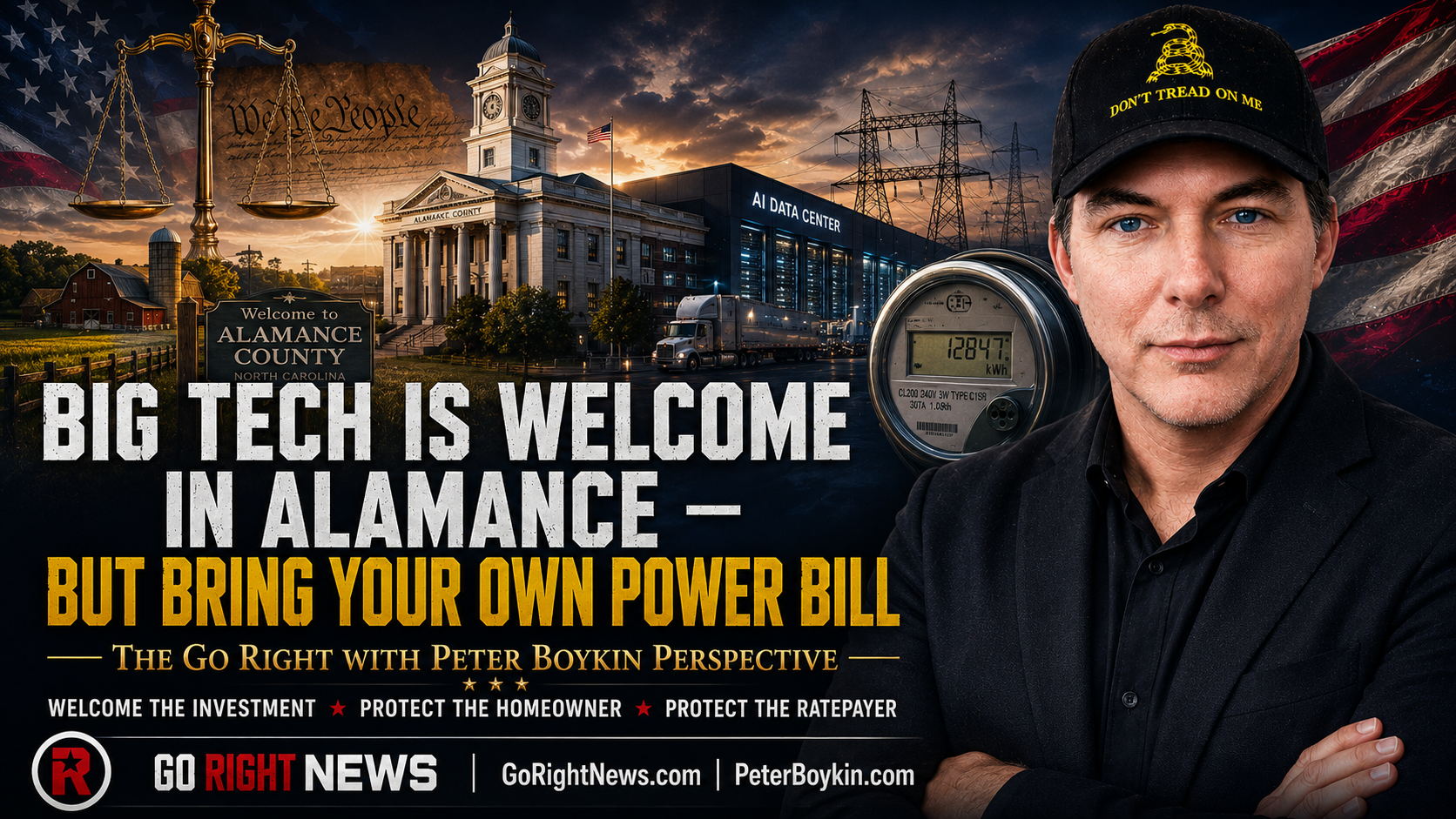 Big Tech Is Welcome in Alamance but Bring Your Own Power Bill
The Go Right with Peter Boykin Perspective
I am not anti-data center.
America needs these things.
Artificial intelligence is not going away.
Cloud computing is not going away.
The internet is not going away.
And I would much rather the infrastructure supporting America’s technology economy be built in North Carolina than handed to China or countries that do not share our interests.
So if Microsoft, Google, Amazon or another company wants to invest billions of dollars in Alamance County, I am willing to hear the pitch.
But here is my condition:
Bring the investment. Bring the jobs. Bring the tax base. And bring your own bill.
Do not show up with a billion-dollar project and hand the infrastructure costs to a grandmother paying her electric bill in Burlington.
Do not demand taxpayer incentives for a project you were already planning to build.
Do not place the burden of project-specific infrastructure onto ordinary families.
And government should not abuse the issue either.
A six-month pause can make sense.
A permanent ban disguised as an endless moratorium does not.
Property owners still have rights.
If somebody owns hundreds of acres and wants to sell it for lawful industrial development, government needs a legitimate reason before blocking that transaction.
That is why I prefer guardrails instead of prohibition.
Tell developers exactly what the rules are.
Noise standards.
Buffers.
Water disclosures.
Infrastructure responsibilities.
Emergency plans.
Ratepayer protections.
Transparent incentives.
Then let the market work.
There is also an important lesson in Alamance County’s resistance to countywide zoning.
For decades, many conservatives have viewed zoning as government intrusion.
I understand why.
Zoning can become an excuse for bureaucrats to tell people what color their fence can be or whether they can operate a small business on their own land.
But liberty is not anarchy.
There is a difference between government micromanaging your backyard shed and government deciding whether a hyperscale industrial complex drawing extraordinary power belongs beside a rural neighborhood.
Property rights work because your rights stop where somebody else’s rights begin.
Corporate property rights are not more sacred than homeowner property rights merely because one side has billions of dollars.
So take the six months if commissioners genuinely need it.
Study the power.
Study the water.
Study the noise.
Study the roads.
Study the taxes.
Study the incentives.
Talk to residents.
Talk to utilities.
Talk to developers.
Then write clear rules and get government back out of the way.
North Carolina should say:
Yes to technology.
Yes to investment.
Yes to American AI leadership.
But also:
No blank checks.
No hidden subsidies.
No surprise projects.
No shifting corporate costs onto ordinary citizens.
Economic development is supposed to make a community richer.
If taxpayers subsidize the company, utility customers finance the infrastructure, neighboring landowners absorb the consequences and government gives away the tax revenue, then citizens should at least ask who actually benefited from the deal.
Welcome Big Tech to Alamance County.
Just make sure the taxpayers are not carrying its luggage.
Let’s #GoRight not blindly right, but constitutionally right.
Alamance County is considering a temporary data-center moratorium before a hyperscale project arrives. The opportunity is unusual: write predictable rules protecting property owners, electric ratepayers and taxpayers before billions of dollars are on the table. Data centers can bring enormous investment, but government should make sure private development does not become a public subsidy.
#GoRight #GoRightNews #PeterBoykin #ConstitutionalistForLiberty #AlamanceCounty #BurlingtonNC #GrahamNC #NorthCarolina #DataCenters #ArtificialIntelligence #AI #PropertyRights #LocalControl #DukeEnergy #Ratepayers #TaxpayerAccountability #EconomicDevelopment #LimitedGovernment #NCPolitics #BigTech
Sources
WFDD — Greensboro, Alamance and Yadkin to Consider Data Center Moratoriums
https://www.wfdd.org/politics-government/2026-08-14/greensboro-alamance-and-yadkin-to-consider-data-center-moratoriums
Alamance News — Commissioners Appear Willing to Consider Data Center Moratorium
https://alamancenews.com/commissioners-appear-willing-to-consider-data-center-moratorium-still-to-be-decided-how-long/
Alamance News — Data Center Concerns Resurrect Issue of Countywide Zoning
https://alamancenews.com/data-center-concerns-resurrect-issue-of-countywide-zoning/
City of Greensboro — Data Center Moratorium Public Hearing Information
https://www.greensboro-nc.gov/Home/Components/News/News/22807/36
North Carolina General Assembly — Senate Bill 730, Ratepayer Protection Act
https://www.ncleg.gov/BillLookup/2025/S730
WUNC — North Carolina Bill Proposes Data Center Regulations
https://www.wunc.org/politics/2026-05-21/nc-bill-data-center-regulations-local-governments-incentives

Call to Action
For daily commentary grounded in liberty, justice, constitutional values, and common sense, visit
GoRightNews.com.
Subscribe to Go Right with Peter Boykin on
Rumble,
YouTube,
Spotify,
Apple Podcasts,
Amazon Music,
and
Spreaker.
Follow #GoRight with Peter Boykin across the major platforms.
Support the Platform
Go Right News is independent media. If you support commentary that holds power accountable and defends constitutional liberty, consider helping keep the platform going.
Donate through
Cash App $GoRightNews
or visit
GoRightNews.com Donations.
Stay informed. Stay free. It is time to #GoRight.
#GoRight: More Than Politics, A Way of Life
At Go Right News, we know many people judge the headline before reading the facts. That is why we focus on context, accountability, and constitutional principles instead of outrage for outrage’s sake.
We lean right, but we are not here to defend hypocrisy, extremism, or double standards from any side. We stand for truth, liberty, personal responsibility, and the rights of We the People.
#GoRight is not just about politics. It means doing right, thinking right, being right, and voting right. It is a call to build, not destroy. It is about working toward a better future together.

Official Links
Web:
GoRightNews.com |GoRightNC.com |PeterBoykin.com |GaysForLiberty.org
Video and Podcast:
Rumble |YouTube |Spreaker |Spotify |Apple Podcasts |Amazon Music
Social:
Facebook |X |Telegram |Instagram |Reddit
Kick:
PeterBoykin |GoRightNews |LuckyNLoose


Help Keep Go Right News Independent
Each month, Go Right News spends hundreds of dollars and many hours running this site, producing content, and keeping the podcast alive without corporate control. If you like the content, please consider supporting the platform.
#GoRightNews #GoRight #PeterBoykin #ConstitutionalistForLiberty #ConservativeVoice #LibertyPodcast #IndependentMedia #CitizenJournalist #ConservativeCommentary #ConstitutionalTalk #FreedomOfSpeech #AmericaFirst #NorthCarolina #NCPOL #NCPolitics #BoykinForNC #GoRightNC #GaysForLiberty
Shared by #GoRightNews
https://GoRightNews.com