




Greensboro Hits the Brakes on Mega Data Centers as North Carolina’s Growth Fight Moves Local
Go Right News Shared by Peter Boykin
American Political Commentator | Citizen Journalist | Activist | Constitutionalist for Liberty
Greensboro Hits the Brakes on Mega Data Centers as North Carolina’s Growth Fight Moves Local
North Carolina politics, Raleigh power, local accountability, and the Constitutionalist for Liberty perspective
By Peter Boykin
GoRightNC.com | GoRightNews.com | PeterBoykin.com
North Carolina’s biggest political story this Sunday is not coming from a new floor vote in Raleigh. It is coming from local government, where the debate over massive data centers, electricity demand, water, land use, and neighborhood impact is accelerating.
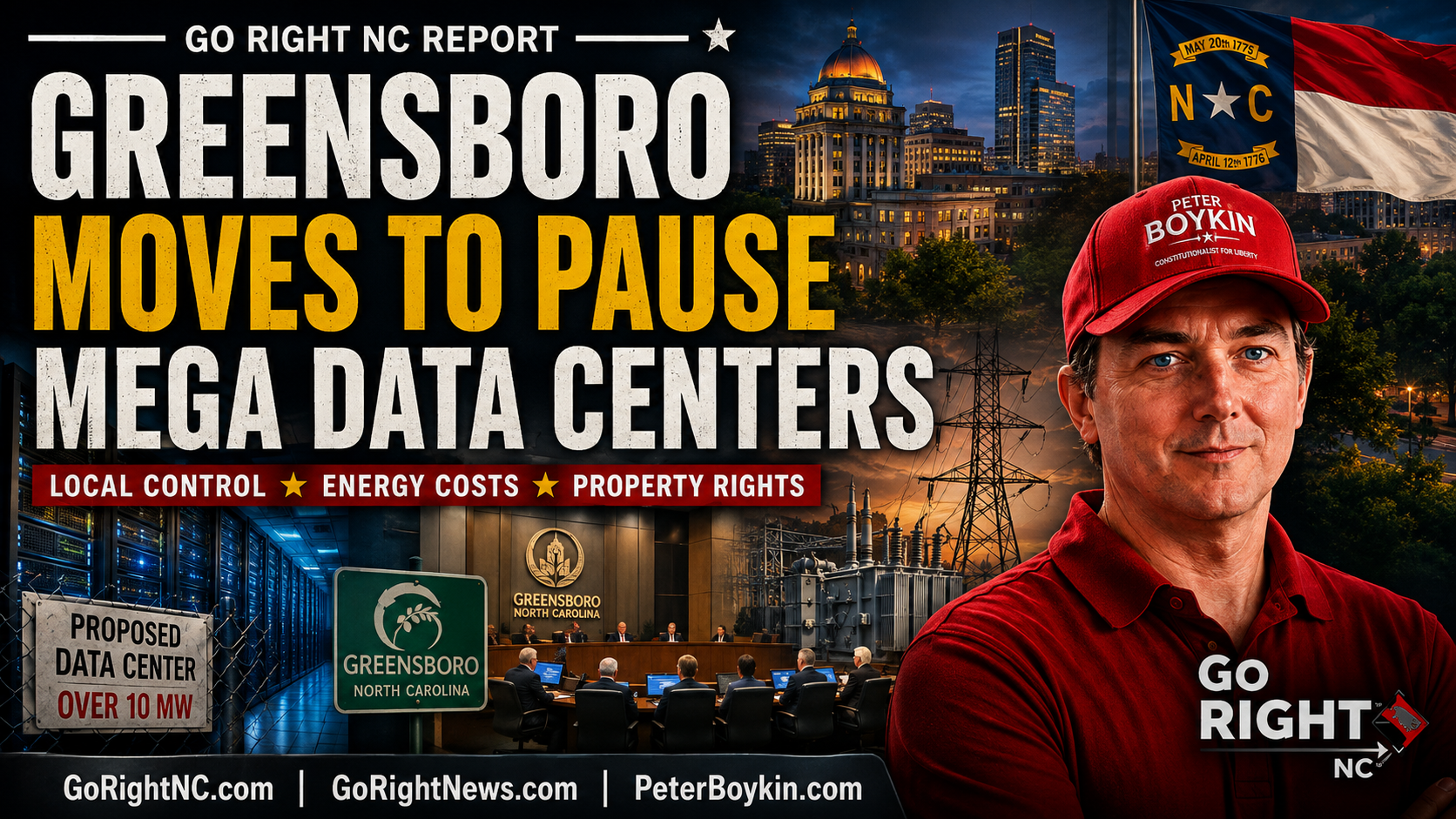
Greensboro City Council has now voted unanimously to begin the legal process that could produce a 120-day moratorium on new large data centers drawing more than 10 megawatts of electricity. That 9-0 decision reversed a 5-4 vote less than two weeks earlier against moving forward with a moratorium. Importantly, Greensboro has not enacted the moratorium yet. The city has started the process and scheduled a public hearing for August 17. (The Rhino Times of Greensboro)
The debate reaches far beyond one city. Data centers promise investment and a foothold in the artificial-intelligence economy, but they can also create substantial electricity, water, infrastructure, land-use, and noise demands. Greensboro officials say the proposed pause would give the city time to gather facts and examine those consequences before rewriting its development rules. (The Rhino Times of Greensboro)
That is precisely the kind of debate North Carolina should be having before the concrete is poured and the costs become difficult to reverse.

What Matters In North Carolina Before The Noise Takes Over
Greensboro’s decision deserves attention because the council did something government bodies are sometimes reluctant to do: it reconsidered an earlier position.
At its August 3 meeting, the council voted 9-0 to begin the process required under state law for a possible 120-day moratorium. The proposed restriction would apply to new data centers, data-storage facilities, and similar operations requiring more than 10 megawatts of electrical power. (The Rhino Times of Greensboro)
The city plans to study potential effects on its electrical grid, water system, public infrastructure, environment, and land-use policies. Officials also say they intend to hear from experts with differing views and examine how other communities regulate these facilities. (The Rhino Times of Greensboro)
That distinction matters.
This is not yet a ban.
It is not even yet a temporary moratorium.
It is a process that could lead to one after a public hearing.
That hearing is scheduled for Monday, August 17, at 4 p.m. in the Katie Dorsett Council Chamber at Greensboro’s Melvin Municipal Office Building. After the hearing, council members can decide whether to adopt the temporary pause. (The Rhino Times of Greensboro)
The strongest policy is not automatically pro-data-center or anti-data-center.
It is pro-information.
Before approving a massive facility, local officials should know its projected electricity load, water demand, backup-generation requirements, noise profile, road impact, tax treatment, incentives, emergency-service needs, and infrastructure costs.

Raleigh Watch
The General Assembly is not holding a major Sunday voting session, leaving this weekend’s immediate action outside the legislative chambers.
That does not mean Raleigh’s policy decisions have stopped affecting the rest of the state.
North Carolina’s data-center debate is inseparable from the larger question of electricity affordability. Duke Energy recently signed a Ratepayer Protection Pledge supporting policies intended to prevent households from bearing infrastructure costs caused by large-load customers such as data centers. (Carolina Journal)
The promise is significant, but a pledge and an enforceable rate structure are not the same thing.
North Carolina regulators and elected officials should make sure the principle becomes measurable in actual rate cases: if a large industrial customer creates the need for extraordinary generation, transmission, substations, or other infrastructure, ordinary households should not become its silent financing partner.
Governor Josh Stein’s office had not posted a new August 8 or August 9 press release when this report was researched. The latest release on the official page was dated August 6 and highlighted state funding for the SUN Bucks summer food program. (NC Governor)
That is worth stating because a Sunday report should not manufacture a Raleigh development simply to fill space.
When Raleigh is quiet, say Raleigh is quiet and look where government is actually moving.
Local Power And Taxpayer Accountability
Greensboro’s 120 Days Must Produce Answers
If Greensboro ultimately adopts the proposed moratorium, four months should not become four months of bureaucratic drift.
City officials should emerge with clear standards.
How much water can a facility consume?
What noise limits apply at neighboring property lines?
How are diesel generators regulated?
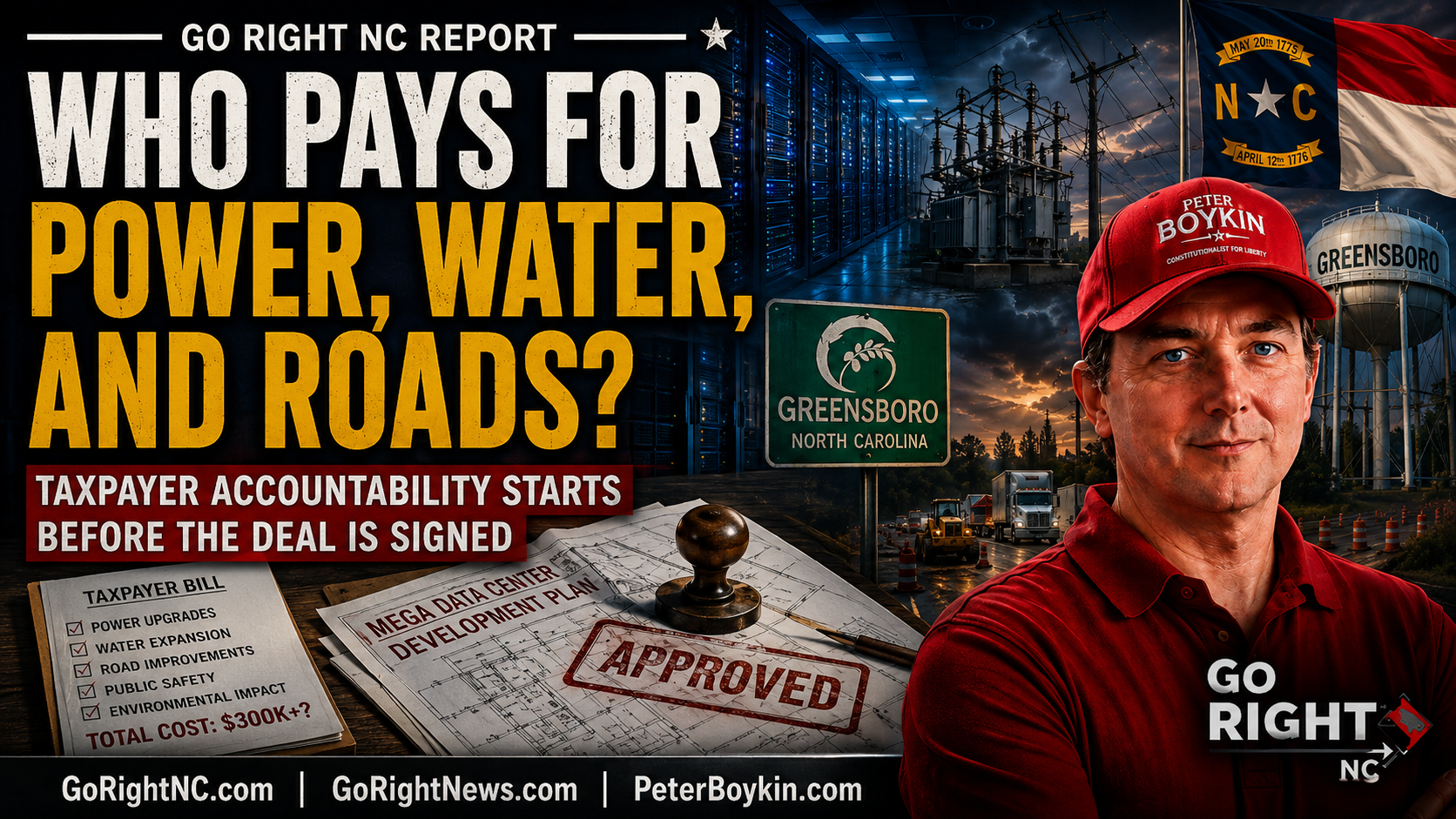
Who pays for electrical upgrades?
What buffers are required between industrial buildings and homes?
How are tax incentives disclosed?
What happens when the facility changes ownership?
What financial guarantees protect taxpayers if promised development does not materialize?
The city says the proposed ordinance is expected to identify the problems being addressed, approvals that would be suspended, a termination date, and the work the city intends to complete during the pause. (The Rhino Times of Greensboro)
That is the right framework. Residents should insist that those promises remain in the final ordinance if the moratorium passes.
Guilford County Has Seen This Movie Before
The Triad has experience with grand data-center promises.
In 2013, Guilford County officials promoted “Project Haystack,” a proposed 2,000-acre data-center and advanced-manufacturing development near the Guilford-Alamance county line. A feasibility study projected billions of dollars in investment and thousands of jobs.
The project never materialized. By 2017, Guilford County closed the remaining project fund after Greensboro and the county had spent roughly $80,000 on consulting and legal work. (The Rhino Times of Greensboro)
That history does not prove today’s proposals will fail.
It proves projections are not guarantees.
Economic-development forecasts should be treated as forecasts until the investment, jobs, tax revenue, and infrastructure actually exist.
Alamance County Should Watch Greensboro Closely
The same questions matter in Alamance County, where data-center regulation has also become part of the local-government conversation.
The Greensboro process can provide Alamance officials with a useful real-world comparison. Rather than every county reinventing the wheel, local governments should compare standards for water, electricity, noise, buffers, emergency response, road improvements, and financial guarantees.
Local control works best when local officials have good information.

Liberty In The Tar Heel State
Data centers present a genuine property-rights problem because legitimate rights exist on both sides of the property line.
A landowner has a right to pursue lawful development.
A company has a right to invest.
A county or city should not arbitrarily reject a project simply because it is large, unfamiliar, or politically unpopular.
Neighbors also have property rights.
They should not unexpectedly discover that a quiet parcel beside their home has become a massive industrial complex producing constant mechanical noise, heavy traffic, backup-generator testing, or infrastructure demands never contemplated when surrounding property was purchased.
Clear zoning rules protect both sides.
Government should establish those rules before an application becomes a political emergency.
The same principle applies to utility costs.
Economic liberty does not mean privatizing profits while socializing infrastructure costs.
If a private project creates an extraordinary public-system expense, the government and utility regulators should identify who caused that expense and assign costs accordingly.
Growth Without Guardrails Is Not A Free Market
The Go Right with Peter Boykin Perspective
North Carolina should want the technology economy.
We should want investment.
We should want advanced manufacturing, artificial intelligence, engineering, research, and good-paying jobs.
But wanting growth does not require surrendering common sense.
A company should not get a blank check because its project includes the words “artificial intelligence.”
A government should not promise billions in economic impact without explaining the assumptions.
A utility should not spread extraordinary industrial infrastructure costs across families who had nothing to do with creating them.
And local officials should not wait until a project is already approved to discover that their zoning ordinance was written for another era.
That is where local control matters.
Greensboro’s council changed direction after residents raised questions. Whether the eventual answer is a moratorium, new zoning standards, or approval with strict conditions, the process should produce evidence citizens can examine.
Property rights matter.
Economic growth matters.
Affordable electricity matters.
Reliable water matters.
Neighborhoods matter.
None of those principles has to cancel the others.
The Constitutionalist for Liberty approach is guardrails, not blank checks.
Let businesses build where they can meet reasonable, clearly written rules.
Protect surrounding property owners.
Make large users pay the extraordinary costs they create.
Publish incentives.
Measure promised jobs against actual jobs.
Then let the market work.
Greensboro data centers: City Council voted 9-0 to begin the process toward a possible 120-day moratorium on facilities requiring more than 10 megawatts of electricity. The moratorium itself has not been adopted. (The Rhino Times of Greensboro)
Public hearing: Greensboro’s hearing is scheduled for August 17 at 4 p.m. Afterward, council members may vote on whether to impose the temporary pause. (The Rhino Times of Greensboro)
Energy costs: Duke Energy has signed a pledge supporting protections intended to keep data-center infrastructure costs from being shifted to residential customers. (Carolina Journal)
Governor: The latest press release displayed on the Governor’s official page during today’s research is dated August 6 and concerns the SUN Bucks program. (NC Governor)
Elections: The State Board of Elections met August 6 with an agenda that included county-board vacancies, early-voting plans unanimously adopted by county boards, a declaratory-ruling request, and guidance to counties. (NCSBE)
Election calendar: North Carolina’s November general election is approaching, making county early-voting plans and election-administration guidance increasingly important as absentee voting nears.
Burlington: The city’s official calendar listed a Back-to-School Community Event for Saturday, August 8, another reminder that local government activity continues even during a relatively quiet Raleigh weekend. (Burlington NC)
What To Watch
Watch for Greensboro’s actual proposed moratorium ordinance and read the language rather than relying on political descriptions of it.
Watch the August 17 public hearing for specific evidence about water demand, electrical load, noise, infrastructure, and economic benefits.
Watch whether Greensboro establishes different standards for hyperscale facilities and smaller enterprise data centers.
Watch Alamance County’s continuing data-center discussion and whether officials borrow useful safeguards from neighboring jurisdictions.
Watch the North Carolina Utilities Commission for the practical implementation of protections intended to keep extraordinary data-center infrastructure costs away from residential bills.
Watch election officials as counties finalize preparations for the November general election.
Watch Raleigh for the next scheduled legislative action rather than treating political predictions as completed votes.
Final Word
North Carolina does not have to choose between becoming part of the next technological revolution and protecting the people who already live here.
We can do both.
Greensboro’s decision to slow the process long enough to ask questions is not inherently anti-business.
What matters is what happens during that pause.
If officials spend four months studying the issue and emerge with predictable rules, transparent costs, strong property protections, and a path for responsible investment, taxpayers and businesses both benefit.
If the moratorium becomes an excuse for indefinite delay or political favoritism, it will have failed.
Growth should create opportunity.
It should not create a hidden surcharge on somebody else’s electric bill.
Follow the money. Measure the promises. Protect property rights. Write the rules before making the deal.
That is how North Carolina can grow without handing anyone a blank check.

Greensboro has reversed course and begun the legal process toward a possible 120-day moratorium on large data centers, putting electricity costs, water use, property rights, infrastructure, and local control at the center of North Carolina’s growth debate.
#GoRightNC #GoRightNews #PeterBoykin #NorthCarolina #NCPolitics #Greensboro #GuilfordCounty #AlamanceCounty #DataCenters #ArtificialIntelligence #DukeEnergy #EnergyCosts #PropertyRights #TaxpayerAccountability #LocalControl #ConstitutionalistForLiberty
Sources
Greensboro data-center moratorium report, Rhino Times
North Carolina Governor Press Releases
North Carolina State Board of Elections, August 6 meeting notice
North Carolina State Board of Elections
North Carolina General Assembly

Call to Action
For daily commentary grounded in liberty, justice, constitutional values, and common sense, visit
GoRightNews.com.
Subscribe to Go Right with Peter Boykin on
Rumble,
YouTube,
Spotify,
Apple Podcasts,
Amazon Music,
and
Spreaker.
Follow #GoRight with Peter Boykin across the major platforms.
Support the Platform
Go Right News is independent media. If you support commentary that holds power accountable and defends constitutional liberty, consider helping keep the platform going.
Donate through
Cash App $GoRightNews
or visit
GoRightNews.com Donations.
Stay informed. Stay free. It is time to #GoRight.
#GoRight: More Than Politics, A Way of Life
At Go Right News, we know many people judge the headline before reading the facts. That is why we focus on context, accountability, and constitutional principles instead of outrage for outrage’s sake.
We lean right, but we are not here to defend hypocrisy, extremism, or double standards from any side. We stand for truth, liberty, personal responsibility, and the rights of We the People.
#GoRight is not just about politics. It means doing right, thinking right, being right, and voting right. It is a call to build, not destroy. It is about working toward a better future together.

Official Links
Web:
GoRightNews.com |GoRightNC.com |PeterBoykin.com |GaysForLiberty.org
Video and Podcast:
Rumble |YouTube |Spreaker |Spotify |Apple Podcasts |Amazon Music
Social:
Facebook |X |Telegram |Instagram |Reddit
Kick:
PeterBoykin |GoRightNews |LuckyNLoose

Help Keep Go Right News Independent
Each month, Go Right News spends hundreds of dollars and many hours running this site, producing content, and keeping the podcast alive without corporate control. If you like the content, please consider supporting the platform.
#GoRightNews #GoRight #PeterBoykin #ConstitutionalistForLiberty #ConservativeVoice #LibertyPodcast #IndependentMedia #CitizenJournalist #ConservativeCommentary #ConstitutionalTalk #FreedomOfSpeech #AmericaFirst #NorthCarolina #NCPOL #NCPolitics #BoykinForNC #GoRightNC #GaysForLiberty
Shared by #GoRightNews
https://GoRightNews.com