




Who Really Runs North Carolina? The State Supreme Court Is Set to Decide How Far Raleigh Can Reshape Executive Power
Go Right News Shared by Peter Boykin
American Political Commentator | Citizen Journalist | Activist | Constitutionalist for Liberty
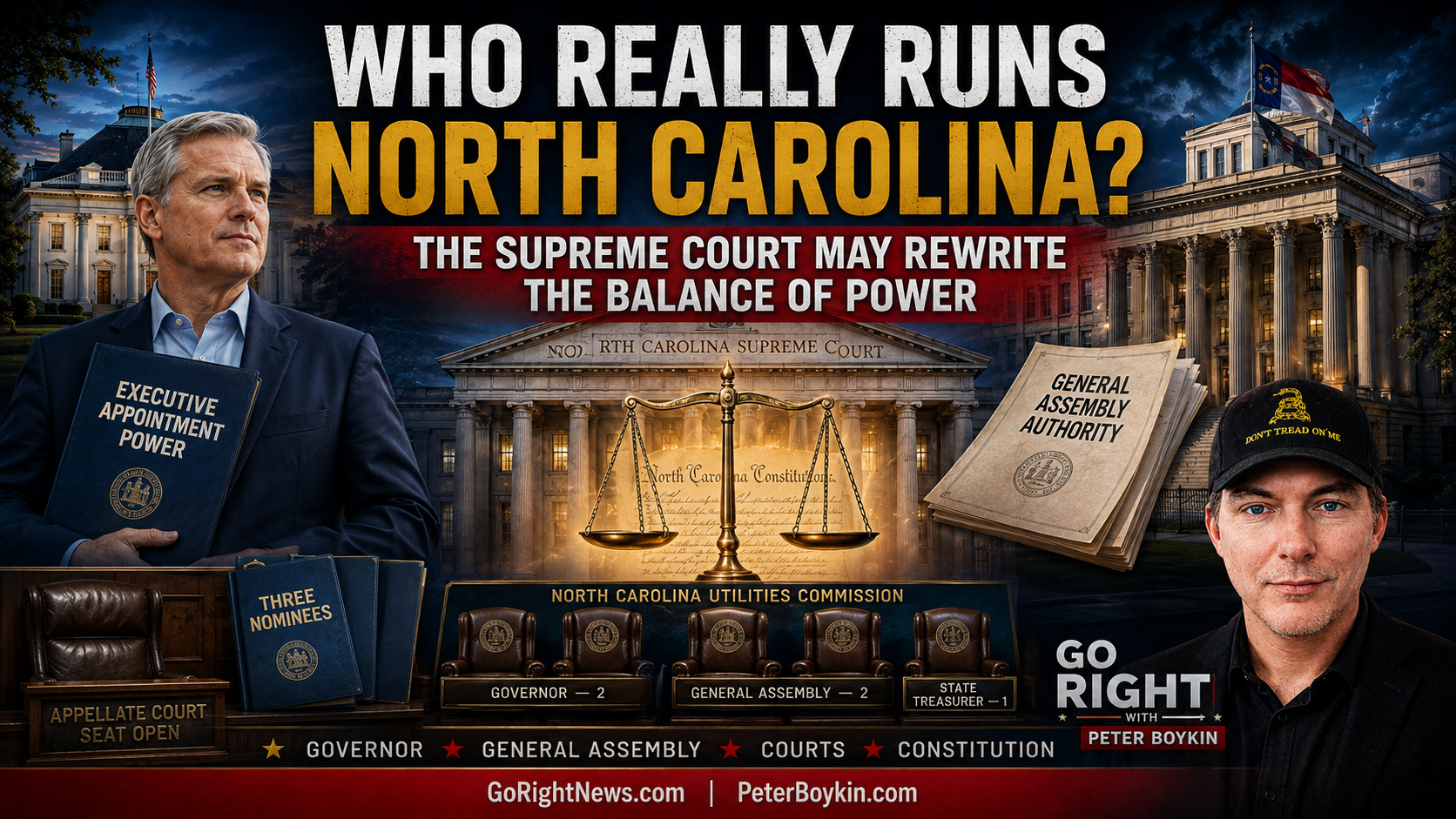
Who Really Runs North Carolina? The State Supreme Court Is Set to Decide How Far Raleigh Can Reshape Executive Power
North Carolina’s long-running battle over the balance of power in Raleigh is officially heading toward a major constitutional showdown.
The Supreme Court of North Carolina has scheduled November 10, 2026, for oral arguments in two cases involving Democratic Gov. Josh Stein and Republican legislative leaders Senate President Pro Tem Phil Berger and House Speaker Destin Hall.
The cases, Stein v. Berger and Stein v. Hall, will be consolidated for an unusually lengthy two-and-a-half hours of argument. The justices have agreed to divide the fight into two major constitutional questions: the governor’s authority to fill appellate judicial vacancies and the broader struggle over appointments to nine state boards and commissions. Opening briefs are due September 2, with final briefs due October 30.
This is no longer simply another skirmish between a Democratic governor and a Republican legislature.
The North Carolina Supreme Court could clarify — or substantially rewrite — the rules governing how executive power is divided inside state government.
And lawmakers have specifically asked the court to consider whether important separation-of-powers precedents known as McCrory and Cooper I should be overturned.
That raises a question constitutional conservatives should consider carefully:
If government can take power away from an officeholder you oppose today, are you prepared for the same rule to be used against an officeholder you support tomorrow?
This Is a Fight Over More Than Josh Stein
North Carolina’s government is structurally different from the federal executive branch.
The governor is an important executive officer, but he is not North Carolina’s only independently elected executive official.
Voters separately elect the lieutenant governor, attorney general, state auditor, treasurer, agriculture commissioner, insurance commissioner, labor commissioner, secretary of state and superintendent of public instruction. Together with the governor, those officials constitute the Council of State.
That matters because Republican lawmakers argue executive authority in North Carolina is deliberately distributed among multiple independently elected officers rather than concentrated entirely in the governor.
The Court of Appeals embraced much of that reasoning.
But North Carolina’s Constitution also contains an unusually direct separation-of-powers command:
“The legislative, executive, and supreme judicial powers of the State government shall be forever separate and distinct from each other.”
It also specifically requires that the governor “take care that the laws be faithfully executed.”
The constitutional dispute is therefore not whether the General Assembly has substantial authority.
It unquestionably does.
The question is where legislative power stops and constitutionally protected executive authority begins.
Republicans Won Most of the Fight at the Court of Appeals
The procedural history is important because the Supreme Court is not beginning with a blank slate.
In the broader Stein v. Berger appointments case, the North Carolina Court of Appeals reviewed changes involving seven state boards and commissions.
The appellate court upheld legislative changes affecting four bodies while finding restructuring of three others unconstitutional.
The measures allowed to stand involved the Coastal Resources Commission, Emergency Management Commission, Wildlife Resources Commission and Residential Code Council.
The court rejected changes involving the Board of Transportation, Economic Investment Committee and Commission for Public Health.
Then came Stein v. Hall.
There, a divided Court of Appeals upheld Republican-backed changes involving the Utilities Commission, Building Code Council and the process for filling appellate judicial vacancies.
Taken together, the Court of Appeals rulings left Republican lawmakers prevailing on six of the nine disputed board and commission structures, while Stein prevailed on three.
Lawmakers also prevailed on the separate judicial-vacancy issue.
Now both sides are taking their remaining arguments to the state’s highest court.
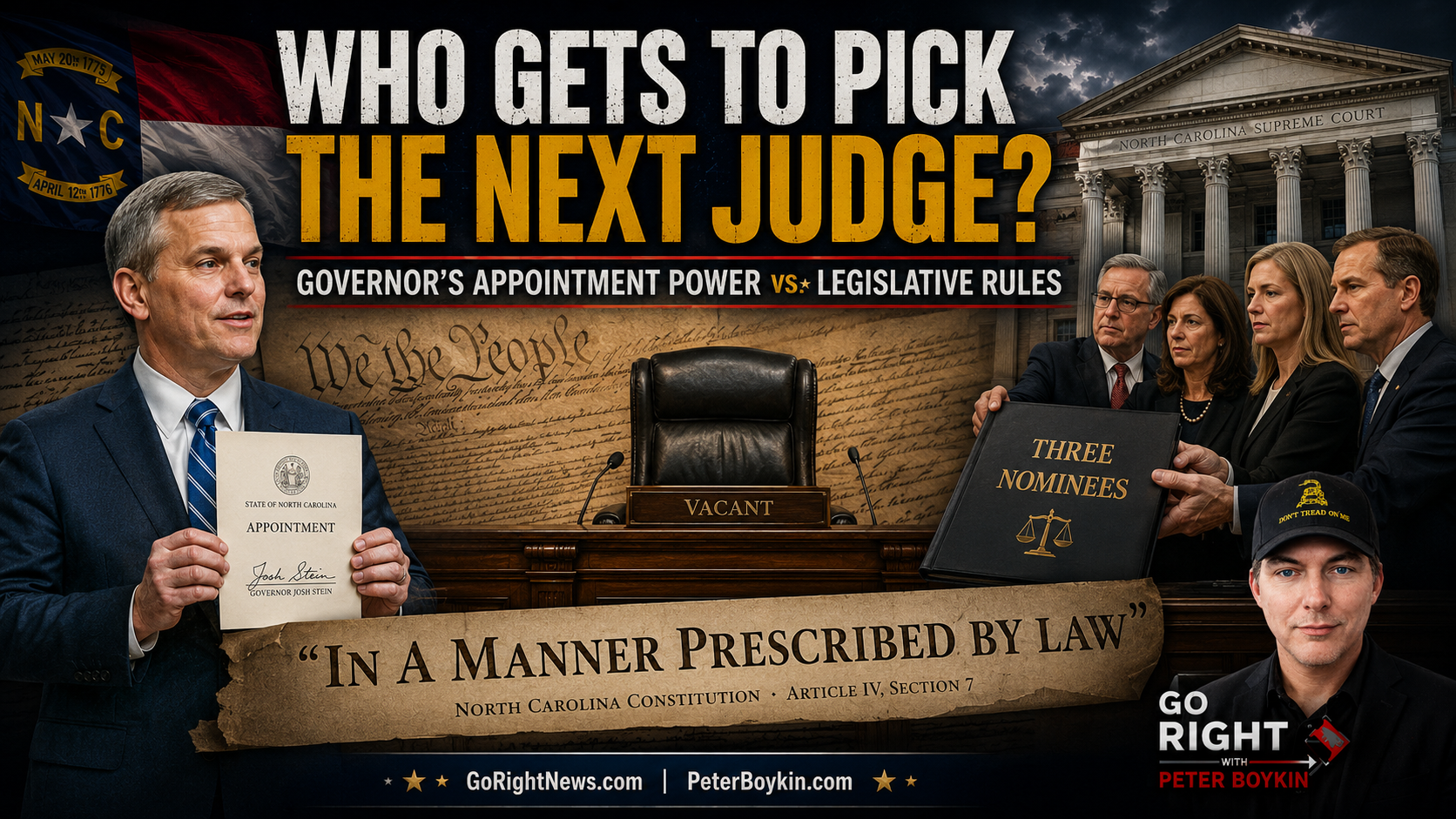
Who Gets to Pick the Next North Carolina Justice?
The judicial-vacancy dispute may be the cleanest constitutional question in the entire case.
Senate Bill 382 changed North Carolina law so that when a Supreme Court justice or Court of Appeals judge leaves office and was elected as a member of a political party, the governor must select a replacement from three qualified candidates submitted by that political party’s executive committee.
If the party fails to submit recommendations within the statutory period, or the departing judge was unaffiliated when elected, the governor can appoint another qualified person.
Stein argues that this improperly restricts an appointment authority assigned to the governor under Article IV, Section 19 of the North Carolina Constitution.
And the actual constitutional language deserves attention.
Article IV says that, unless otherwise provided in that article, vacancies in the covered judicial offices “shall be filled by appointment of the Governor.”
A three-judge Superior Court panel originally agreed with Stein and struck the restriction down.
The Court of Appeals reversed.
The appellate majority relied in significant part on the North Carolina Supreme Court’s earlier Baker decision, reasoning that lawmakers can have some role in establishing the method governing judicial appointments. It therefore concluded that requiring the governor to choose from a party-supplied list did not unconstitutionally eliminate his appointment authority.
The dissent saw the issue very differently.
That disagreement creates a constitutional question with consequences far beyond Josh Stein.
There is a legitimate argument for preserving the voters’ partisan choice.
If North Carolinians elect a Republican justice and that justice leaves office early, replacing that justice with another Republican could be viewed as respecting what voters originally selected.
The same principle would protect Democrats when a Democratic justice leaves office.
But there is another side.
The governor is elected statewide.
A political party’s executive committee is not.
If party officials determine the only three people from whom a governor may select a Supreme Court justice, an unelected political organization suddenly possesses considerable influence over a constitutional office.
That is something conservatives should examine based on constitutional principle rather than simply which party benefits today.
The Utilities Commission Fight Could Eventually Reach Your Wallet
Another part of the case involves one of the state’s most powerful regulatory bodies.
The North Carolina Utilities Commission regulates major public utilities and makes decisions involving electricity, natural gas, infrastructure and rates.
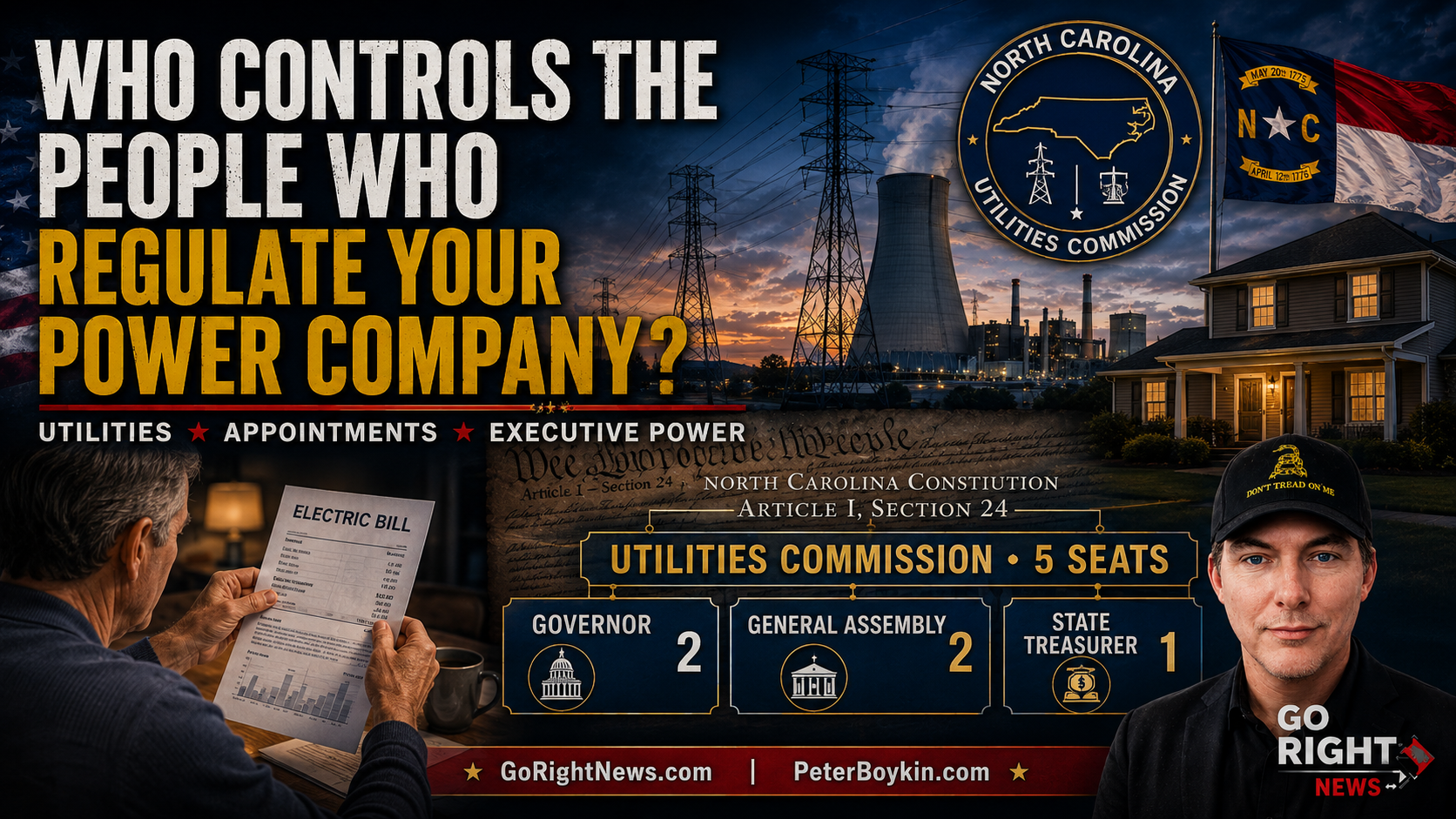
Under the challenged restructuring, the five-member commission is divided this way:
Governor — 2 appointments
General Assembly — 2 appointments
State Treasurer — 1 appointment
Before Senate Bill 382, the governor appointed three commissioners while the General Assembly appointed two. The legislation transferred one gubernatorial appointment to the independently elected state treasurer and also removed the governor’s authority to designate the commission chair.
Republican lawmakers have a substantial argument here.
The treasurer is an independently elected member of the executive branch.
The Court of Appeals majority concluded that when the governor’s two appointments are combined with the treasurer’s appointment, executive-branch officials still appoint three of the commission’s five members.
The majority emphasized that North Carolina does not have a completely unitary executive branch and that the governor’s faithful-execution responsibility does not necessarily mean every executive appointment belongs to the governor personally.
But the dissent identified the obvious complication:
The governor does not control the treasurer.
They are separately elected.
They can represent different political parties.
They can have completely different policy priorities.
And the General Assembly decided which executive officer would receive the commission’s potentially decisive third appointment.
The dissent argued that treating the governor’s appointments and the treasurer’s appointment as though they constitute unified gubernatorial control stretches the concept of executive control too far.
That question could become one of the most important issues the Supreme Court answers.
Can lawmakers satisfy the constitutional requirement for executive control simply by transferring authority from the governor to another independently elected executive officer?
If so, the legislature’s flexibility to restructure North Carolina government becomes considerably broader.
Nine Boards Could Produce One Huge Constitutional Rule
The Supreme Court is not reviewing every disputed board as though they were identical.
That distinction matters.
North Carolina precedent has traditionally examined several factors when deciding whether the governor retains constitutionally sufficient control over an executive body.
Those can include appointment authority, removal authority, supervision, agency structure and the practical ability to influence how the law is executed.
That is why the Court of Appeals reached different conclusions for different boards.
For example, restructuring that left the governor without sufficient influence over the Board of Transportation, Economic Investment Committee and Commission for Public Health failed at the appellate level.
Changes to other commissions survived because the court concluded enough executive-branch influence remained.
The Supreme Court could continue that board-by-board approach.
Or it could establish a broader rule.
That second possibility is what makes these cases especially consequential.
The General Assembly Has a Serious Constitutional Argument
This should not be reduced to a headline claiming Republicans simply “stole” the Democratic governor’s power.
North Carolina’s General Assembly possesses broad legislative authority.
Many of the boards involved in these cases exist because the legislature created them by statute.
The legislature writes their enabling laws.
It establishes their responsibilities.
It appropriates money.
And the North Carolina Constitution does not state that every appointment to every executive or regulatory board belongs exclusively to the governor.
The Court of Appeals emphasized another point often overlooked in national coverage: North Carolina’s executive branch is intentionally plural.
The governor is chief executive, but other Council of State officers are independently elected and possess their own statutory responsibilities.
That gives Republican legislators a reasonable constitutional argument that shifting some authority among executive officials can be a legitimate exercise of legislative power rather than an unconstitutional seizure of executive authority.
The real boundary appears when restructuring prevents another branch from carrying out a constitutional responsibility.
Finding that boundary is the Supreme Court’s job.
Even Republican Governors Have Fought the Legislature Over This Principle
Partisan narratives become even harder to sustain when you look at the history.
One of the key precedents now under scrutiny arose from a lawsuit by Republican Gov. Pat McCrory.
In State ex rel. McCrory v. Berger, the North Carolina Supreme Court held that legislative arrangements involving commissions could violate separation of powers when they deprived the governor of enough control to perform constitutional executive duties.
That rule did not originate as a Democratic weapon against Republicans.
A Republican governor used it.
Later cases involving Democratic Gov. Roy Cooper expanded the state’s modern body of separation-of-powers law.
Five former North Carolina governors — Republicans Jim Martin and Pat McCrory and Democrats Jim Hunt, Mike Easley and Beverly Perdue — even joined together in an amicus effort defending gubernatorial authority during earlier stages of this broader appointments fight.
That bipartisan history should matter.
Constitutional rules should not change merely because the party controlling an institution changes.
The Supreme Court Could Rewrite McCrory and Cooper
The November hearing became considerably more important when the parties agreed that briefing would address whether the Supreme Court should overturn two major separation-of-powers precedents commonly called McCrory and Cooper I.
That puts much more than nine commissions before the court.
If the justices reaffirm or strengthen those precedents, future General Assemblies could face tighter limits when transferring appointments or restructuring executive agencies.
If the court narrows or overturns them, lawmakers could gain substantially greater freedom to distribute executive authority among the legislature, governor and independently elected Council of State officials.
The effects could reach agencies dealing with transportation, utilities, public health, economic development, environmental regulation, wildlife, construction codes and other major areas of state government.
And Raleigh is not waiting for the Supreme Court to settle the question.
Raleigh Has Already Expanded the Appointment Fight
While these cases were moving toward the Supreme Court, North Carolina enacted its 2026 state budget.
Gov. Stein signed Senate Bill 257 into law in July, giving North Carolina its first full state budget in more than two years.
The legislation also contained another major restructuring of gubernatorial appointment authority.
The North Carolina Chamber Legal Institute reported that the budget removed gubernatorial authority over 84 appointments, while giving additional appointment authority to the General Assembly and various Council of State offices.
Those new changes are not automatically resolved by the cases now before the Supreme Court.
But they demonstrate why the constitutional doctrine being considered is no academic exercise.
Whatever rule the justices establish could influence battles over government appointments for years.
What We Know — And What We Still Don’t
Here is what is settled.
The North Carolina Supreme Court has agreed to hear Stein v. Berger and Stein v. Hall.
The cases will be consolidated for oral argument on November 10.
The court has allotted two-and-a-half hours.
One set of arguments will focus on appellate judicial vacancies.
Another will address the nine disputed boards and commissions, the political-question doctrine and whether the court should overturn important existing separation-of-powers precedents.
The Court of Appeals has already given Republican lawmakers substantial victories.
But those appellate rulings are now under review.
What we do not know is how broadly the Supreme Court will rule.
The justices could resolve the disputes narrowly.
They could establish different rules for different types of boards.
They could reaffirm existing precedent.
They could modify it.
Or they could fundamentally reconsider how North Carolina divides authority between its governor, Council of State and General Assembly.
The Supreme Court has agreed to decide the cases.
It has not decided them yet.

Don’t Hand Raleigh a Power You’ll Hate When the Parties Flip
The Go Right with Peter Boykin Perspective
This is exactly where being a Constitutionalist for Liberty matters more than simply cheering for a political team.
Republican lawmakers have legitimate arguments.
North Carolina’s General Assembly is constitutionally powerful.
It creates agencies.
It defines statutory duties.
It appropriates taxpayer money.
And the governor does not automatically own every government appointment merely because somebody calls a board “executive.”
I believe in checks on executive power.
I certainly do not want North Carolina creating an all-powerful governor.
But checks and balances have to remain checks and balances.
They cannot become a loophole allowing one branch to control another simply by rearranging enough chairs.
The Utilities Commission illustrates the danger perfectly.
Maybe assigning an appointment to the independently elected state treasurer is completely constitutional.
If that is what the Constitution permits, the court should uphold it.
But we should also understand the precedent we are creating.
If lawmakers can transfer appointments away from the governor whenever they prefer another Council of State official, that authority will not disappear when political control changes.
The judicial-vacancy issue deserves the same scrutiny.
I understand why Republicans want the replacement for a Republican justice to remain Republican.
There is democratic logic behind preserving the voters’ partisan choice until another election can be held.
But I am uncomfortable giving an unelected political party committee substantial control over who can become a Supreme Court justice.
Republicans should ask:
Would we support the exact same rule if Democrats controlled the legislature while a Republican governor occupied the Governor’s Mansion?
Democrats should ask the reverse:
Would they still demand expansive gubernatorial authority if Republicans controlled the governor’s office?
Those questions are why constitutions exist.
We do not write constitutional rules only for politicians we trust.
We write them knowing that eventually somebody we do not trust will inherit the same powers.
If the North Carolina Constitution gives the General Assembly authority to structure these appointments, the courts should enforce that authority even when Democrats dislike the outcome.
If the Constitution reserves authority to the governor that cannot be removed through ordinary legislation, the courts should enforce that limitation even when Republicans dislike the outcome.
And yes, courts can reconsider precedent.
Bad precedent should not become permanent merely because it is old.
But overturning major separation-of-powers decisions should require a convincing constitutional reason — not simply the political convenience of the moment.
Government has a ratchet problem.
Everybody wants another click of power when their side controls the handle.
Very few politicians voluntarily turn the ratchet backward.
North Carolina does not need a king in the Governor’s Mansion.
It also does not need a legislature capable of effectively operating the executive branch through enough creative appointment arrangements.
The Constitution says the legislative, executive and judicial powers are to remain separate and distinct.
Respect that command.
Let lawmakers legislate.
Let executive officers execute.
Let judges interpret.
And where North Carolina’s Constitution deliberately creates overlapping authority, follow the actual constitutional text.
Because Josh Stein will eventually leave office.
Phil Berger will eventually leave office.
Destin Hall will eventually leave office.
Every justice currently sitting on the Supreme Court will eventually leave too.
The politicians are temporary.
The constitutional precedent is what remains.
That is why the real question on November 10 is not simply:
Which political side wins?
The more important question is:
What kind of government will the winner leave behind for everybody else?
Let’s #GoRight — not blindly right, but constitutionally right.
The North Carolina Supreme Court has scheduled a major November 10 constitutional showdown between Gov. Josh Stein and Republican legislative leaders over judicial vacancies and control of powerful state boards and commissions. With two-and-a-half hours of arguments scheduled and major separation-of-powers precedents potentially on the line, the decision could redefine how much authority North Carolina’s General Assembly, governor and independently elected Council of State officials exercise for decades.
#GoRight, #GoRightNews, #PeterBoykin, #ConstitutionalistForLiberty, #NorthCarolina, #NCPolitics, #JoshStein, #PhilBerger, #DestinHall, #NCSupremeCourt, #SeparationOfPowers, #LimitedGovernment, #ExecutivePower, #GeneralAssembly, #JudicialAppointments, #UtilitiesCommission, #Constitution, #ChecksAndBalances, #RuleOfLaw, #StatesRights, #Federalism
Sources
Carolina Journal — “Stein, legislative leaders to clash in top NC court on Nov. 10”
Latest reporting confirming the November 10 oral-argument date, the two-and-a-half-hour consolidated hearing, briefing schedule, nine boards and commissions, judicial-vacancy issue and potential reconsideration of McCrory and Cooper I.
https://www.carolinajournal.com/stein-legislative-leaders-to-clash-in-top-nc-court-on-nov-10/
North Carolina Judicial Branch — Stein v. Hall
Official Court of Appeals case record covering gubernatorial appointments, the Building Code Council, Utilities Commission and appellate judicial vacancies.
https://www.nccourts.gov/documents/appellate-court-opinions/stein-v-hall
North Carolina Judicial Branch — Stein v. Berger
Official Court of Appeals record for the broader separation-of-powers dispute involving executive commissions and the General Assembly.
https://www.nccourts.gov/documents/appellate-court-opinions/stein-v-berger
North Carolina General Assembly — North Carolina Constitution
Official constitutional text covering separation of powers, the governor’s duty to faithfully execute the laws, the Council of State and judicial vacancies.
https://www.ncleg.gov/EnactedLegislation/Constitution/NCConstitution.html
North Carolina General Assembly — Senate Bill 382 / Session Law 2024-57
Official legislative record for the law containing the disputed judicial-vacancy and Utilities Commission provisions.
https://www.ncleg.gov/BillLookup/2023/S382
North Carolina Chamber Legal Institute — “NC Supreme Court to Hear Separation-of-Powers Cases”
Analysis of the institutional significance of Stein v. Berger and Stein v. Hall and the additional appointment changes enacted in the 2026 budget.
https://ncchamber.com/2026/07/15/nc-supreme-court-to-hear-separation-of-powers-cases/
Carolina Journal — Former governors back Cooper in appointments fight with legislative leaders
Reporting on the bipartisan group of five former North Carolina governors who supported gubernatorial authority in the earlier appointments litigation.
https://www.carolinajournal.com/former-governors-back-cooper-in-appointments-fight-with-legislative-leaders/

Call to Action
For daily commentary grounded in liberty, justice, constitutional values, and common sense, visit
GoRightNews.com.
Subscribe to Go Right with Peter Boykin on
Rumble,
YouTube,
Spotify,
Apple Podcasts,
Amazon Music,
and
Spreaker.
Follow #GoRight with Peter Boykin across the major platforms.
Support the Platform
Go Right News is independent media. If you support commentary that holds power accountable and defends constitutional liberty, consider helping keep the platform going.
Donate through
Cash App $GoRightNews
or visit
GoRightNews.com Donations.
Stay informed. Stay free. It is time to #GoRight.
#GoRight: More Than Politics, A Way of Life
At Go Right News, we know many people judge the headline before reading the facts. That is why we focus on context, accountability, and constitutional principles instead of outrage for outrage’s sake.
We lean right, but we are not here to defend hypocrisy, extremism, or double standards from any side. We stand for truth, liberty, personal responsibility, and the rights of We the People.
#GoRight is not just about politics. It means doing right, thinking right, being right, and voting right. It is a call to build, not destroy. It is about working toward a better future together.

Official Links
Web:
GoRightNews.com |GoRightNC.com |PeterBoykin.com |GaysForLiberty.org
Video and Podcast:
Rumble |YouTube |Spreaker |Spotify |Apple Podcasts |Amazon Music
Social:
Facebook |X |Telegram |Instagram |Reddit
Kick:
PeterBoykin |GoRightNews |LuckyNLoose


Help Keep Go Right News Independent
Each month, Go Right News spends hundreds of dollars and many hours running this site, producing content, and keeping the podcast alive without corporate control. If you like the content, please consider supporting the platform.
#GoRightNews #GoRight #PeterBoykin #ConstitutionalistForLiberty #ConservativeVoice #LibertyPodcast #IndependentMedia #CitizenJournalist #ConservativeCommentary #ConstitutionalTalk #FreedomOfSpeech #AmericaFirst #NorthCarolina #NCPOL #NCPolitics #BoykinForNC #GoRightNC #GaysForLiberty
Shared by #GoRightNews
https://GoRightNews.com