





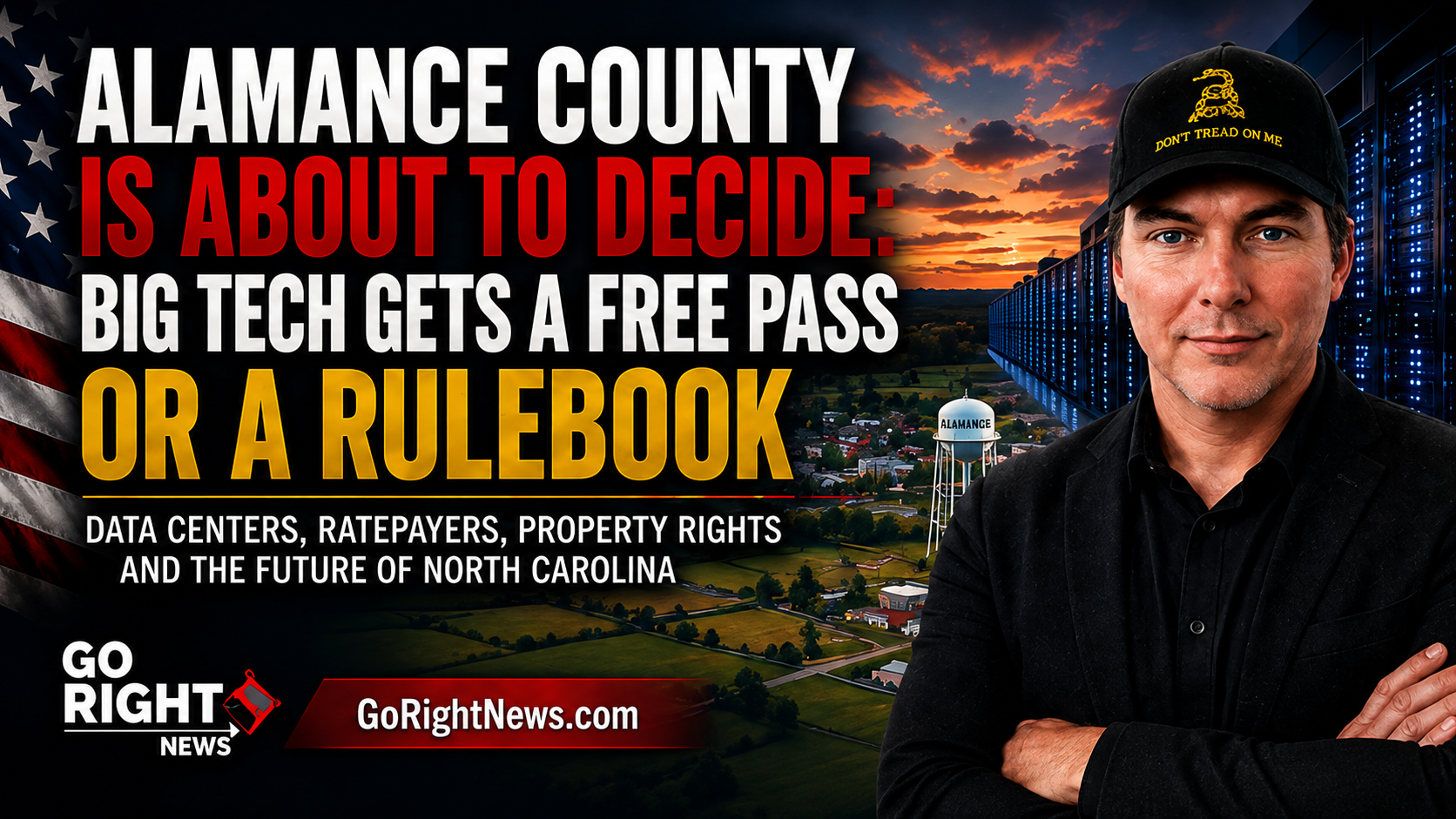
Alamance County North Carolina, Is About to Decide Whether Big Tech Gets a Free Pass or a Rulebook
Go Right News Shared by Peter Boykin
American Political Commentator | Citizen Journalist | Activist | Constitutionalist for Liberty
Alamance County North Carolina, Is About to Decide Whether Big Tech Gets a Free Pass or a Rulebook
Big Tech Is Welcome in Alamance Just Bring Your Own Power Bill
Alamance County is about to face a decision that could shape its rural landscape, electric infrastructure, water resources, property rights and tax base for decades.
County commissioners are preparing for a public hearing on a proposed temporary moratorium on new data-center development in unincorporated Alamance County. Regional reporting describes a six-month pause as the proposal under consideration, although local reporting says commissioners can still determine the final duration when they act. The public hearing is scheduled for August 17 at the Alamance County Historic Courthouse.
That distinction matters.
This is not a vote on whether Alamance County should permanently close its doors to artificial intelligence, cloud computing or major technology investment.
It is a debate over whether the county should write the rulebook before the first hyperscale project arrives.
And there is another fact worth emphasizing: local reporting says no data-center developer has publicly expressed interest in building one in rural Alamance County.
So this is not a battle against Microsoft, Google, Amazon, Meta, OpenAI or some unnamed corporation waiting outside the courthouse.
It is an opportunity to establish predictable rules before billions of dollars, hundreds of acres and potentially enormous electrical loads are attached to a specific proposal.
For a Constitutionalist for Liberty, the right question is not:
Are data centers good or bad?
The better question is:
How does North Carolina welcome the technology America needs without forcing homeowners, taxpayers and utility customers to subsidize somebody else’s investment?

North Carolina Is Already in the Middle of a Data-Center Reckoning
Alamance County is hardly alone.
Greensboro is considering a 120-day moratorium on data centers exceeding 10 megawatts of electrical demand, while Yadkin County is considering a one-year pause. WFDD reports that several other Piedmont jurisdictions have already adopted temporary moratoriums.
The point is not that every county should copy every other county.
It is that local governments across North Carolina are suddenly confronting an industry whose scale is very different from the traditional warehouse or industrial plant.
Modern data centers are physical infrastructure for artificial intelligence, cloud computing, financial services, streaming, cybersecurity and countless services Americans use every day.
America needs that infrastructure.
President Donald Trump has made American AI leadership a national priority, with his administration emphasizing innovation, domestic infrastructure, energy production and competition with China. The White House AI strategy specifically lists building American AI infrastructure as one of its central pillars.
That is the correct strategic direction.
The United States should not surrender the physical foundation of the AI revolution to foreign competitors.
But winning the AI race does not require writing Big Tech a blank check.
In fact, President Trump has now explicitly embraced the opposite principle.
Trump Has Already Put the Right Principle on the Table: Big Tech Should Pay Its Own Power Bill
This is one of the biggest developments since the original version of this article.
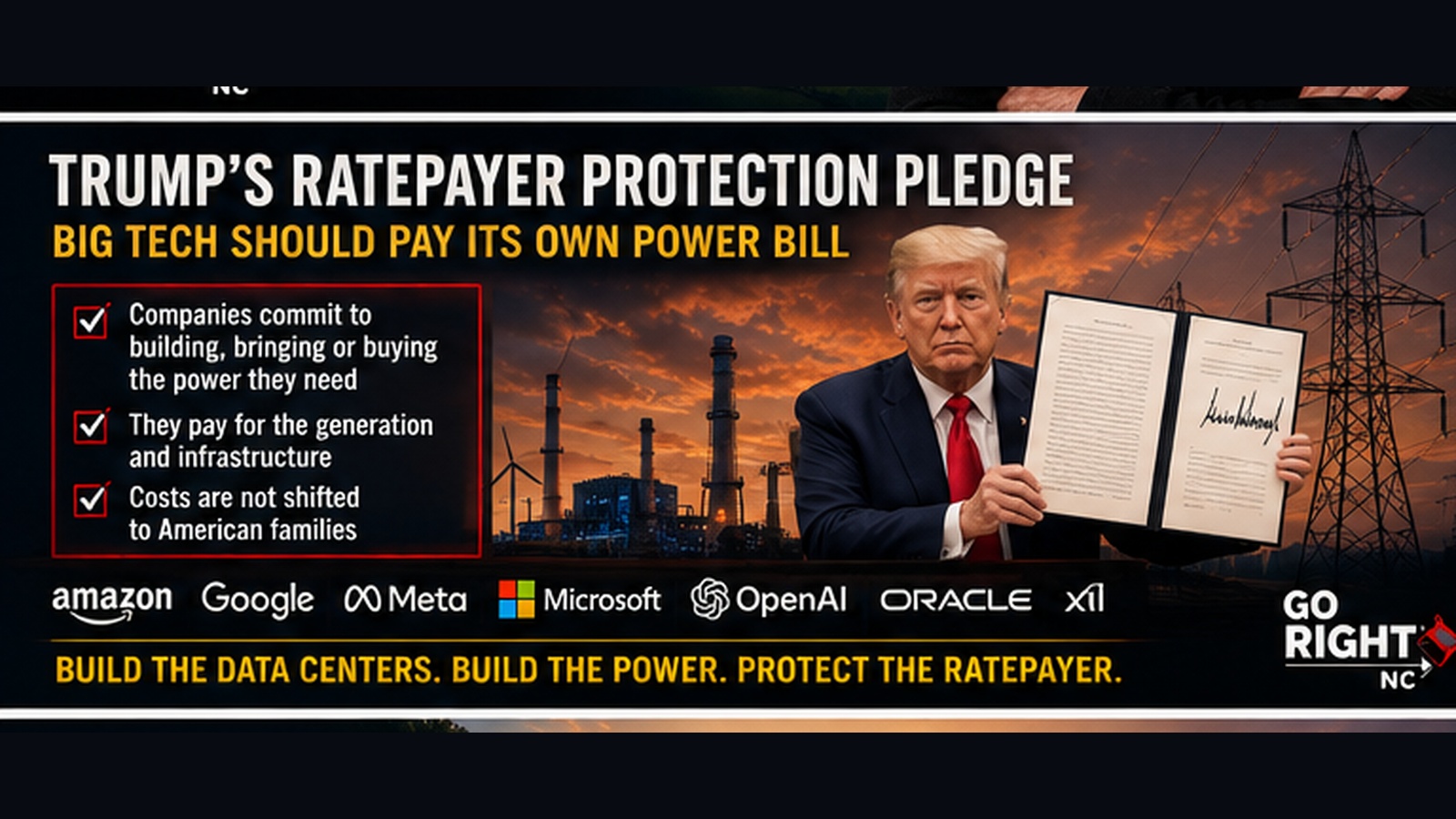
President Trump’s Ratepayer Protection Pledge says large technology companies increasing electricity demand for data centers should pay the full cost of the energy and infrastructure required to serve them rather than shifting those expenses to American households. Under the pledge, participating companies commit to building, bringing or buying the additional power they need and paying for new delivery infrastructure associated with their projects.
Amazon, Google, Meta, Microsoft, OpenAI, Oracle and xAI were among the initial companies identified by the White House as participating.
The administration subsequently expanded the initiative. The White House said in July that more than 200 additional utilities, developers, cooperatives and states had joined the broader commitment.
That gives Alamance County an important national policy principle to work from:
Build the data centers. Build the power. Create the investment. Protect the ratepayer.
Those goals are not contradictory.
That is considerably better than choosing between two extremes:
BAN EVERYTHING
or
LET BIG TECH SEND EVERYBODY ELSE THE BILL.
There is a third option.
Make development pay its own way.
Alamance County Has a Special Problem: Almost No Countywide Zoning Safety Net
The most unusual part of the Alamance County debate may have very little to do with artificial intelligence.
It has to do with zoning.
Much of unincorporated Alamance County operates without conventional countywide zoning. Instead, county government has assembled a collection of development and industrial ordinances governing different types of projects.
Commissioner Sam Powell has acknowledged that there are land-use problems the county may have difficulty addressing without some form of zoning authority, while Chairman Kelly Allen has suggested strengthening existing development rules may be faster than constructing an entirely new zoning system.
That should make conservatives uncomfortable in both directions.
Property owners have rights.
A citizen who owns land should generally have broad freedom to sell it, develop it and put it to productive use.
Government should not treat private ownership as though citizens merely rent their land from the planning department.
But property rights are not a license to transfer the costs of private development onto everybody else.
If an industrial project requires substantial transmission infrastructure, new substations, road improvements, emergency-response capabilities, water infrastructure or other public expenditures, taxpayers have every right to ask:
Who is paying for this?
And neighboring property owners have rights too.
If a project produces excessive noise, creates traffic problems or materially interferes with the use of nearby property, government has a legitimate role in establishing transparent rules before the conflict erupts.
A simple principle works:
Use your property. Make your investment. Pay your own way. Respect your neighbor’s property rights.
That is limited government with guardrails.
A Temporary Moratorium Is Not the Same Thing as a Ban
The language matters.
A moratorium should not become a backdoor method of permanently prohibiting lawful development.
Local reporting indicates a majority of Alamance commissioners have not presented themselves as fundamentally opposed to data centers. Chairman Kelly Allen has discussed buffers, traffic and noise. Commissioner Ed Priola has expressed skepticism toward the national campaign against data centers while still saying there is no harm in temporarily pausing applications long enough to study the issue. Vice Chairman Steve Carter has highlighted the potential tax benefits of attracting a large project.
That is a much healthier conversation than declaring an entire industry unwelcome.
A temporary pause says:
Before somebody spends billions of dollars, everybody should know the rules.
That can actually be more business-friendly than regulatory chaos.
Companies making enormous investments want predictability too.
A developer is better off knowing the requirements for noise, buffers, utilities, emergency plans and infrastructure before purchasing land than discovering halfway through development that political opposition has forced local government to invent restrictions on the fly.
Clear rules protect residents.
They also protect investors.

Raleigh Has Been Working on Its Own Rulebook — But It Is Not Law Yet
North Carolina lawmakers have been wrestling with many of the same questions.
The House-passed version of Senate Bill 730, the Ratepayer Protection Act, would create substantial requirements for data centers with peak monthly electricity demand of at least 100 megawatts.
Among other provisions, the House version would require a site assessment examining sound impacts on nearby homes and schools and would allow examination of groundwater, surface water, air quality, agricultural resources, parks, historic properties and forestland.
The bill would also require qualifying applicants to attest that facilities will use closed-loop water or liquid cooling designed to minimize water consumption. Its proposed water standards would allow the state to require closed-loop or reclaimed-water systems in areas with water-availability concerns and would prohibit evaporative cooling systems as defined by the bill.
On electricity, the legislation would require contracts structured to prevent ordinary residential and business customers from subsidizing the costs of serving large data centers. Those contracts would include minimum billing requirements, sufficient contract terms and protections if a customer defaults or cancels service.
The House version also contains provisions prohibiting the use of eminent domain to acquire land for a data center and prohibiting local economic-development incentives for qualifying data centers.
But those provisions are not currently law.
The North Carolina House passed the amended bill 69-44, and the measure was returned to the Senate, where the official General Assembly record still lists its latest action as referral to the Senate Rules and Operations Committee on June 8.
So Alamance County cannot simply shrug and assume Raleigh has already settled everything.
It has not.

North Carolina Just Changed One Major Data-Center Tax Break
There has, however, been a major state-level change that deserves more attention.
North Carolina previously exempted qualifying electricity purchases at certain certified data centers from sales and use taxes.
That electricity exemption has now been repealed.
The North Carolina Department of Revenue says Session Law 2026-41 ended the electricity exemption, with the repeal applying to qualifying billing periods beginning on or after August 6. Electricity sold to those facilities is now subject to the applicable sales and use tax.
Other exemptions for certain qualifying items used at certified data centers remain in place, according to NCDOR.
That is an important update because it shows North Carolina is already reconsidering how much special tax treatment the industry still needs.
There was a time when states competed aggressively to convince technology companies to build massive server campuses.
But when an industry is already searching aggressively for land, electricity and fiber connections, taxpayers should ask whether every incentive created years ago is still necessary.
Economic development incentives should accomplish something the market would not otherwise accomplish.
Government should not give away taxpayer money simply because a corporation knows how to ask for it.
 The Electric-Bill Question Now Has a Clear Standard
The debate over data centers and electricity sometimes becomes unnecessarily simplistic.
Opponents say:
Data center equals higher electric bill.
Supporters sometimes answer:
There is nothing to worry about.
Neither is a useful standard.
The better question is:
Who is contractually responsible for the incremental cost of serving the new load?
That is essentially the approach reflected both in President Trump’s Ratepayer Protection Pledge and in the House-passed North Carolina legislation.
If a massive data center requires new generation, transformers, substations or transmission upgrades, there should be clear financial arrangements determining who pays.
The developer should know.
The utility should know.
The Utilities Commission should know.
And the ordinary customer should not discover the answer three years later by opening a larger monthly bill.
This does not require attacking Big Tech.
It requires a contract.
Water Claims Need Numbers, Not Panic
Water may become the most emotionally charged part of the Alamance debate.
That makes factual discipline even more important.
Not every data center uses the same cooling technology.
Not every facility uses the same amount of water.
Some systems rely far more heavily on water than others.
Some can use closed-loop systems, reclaimed water or other technologies.
That means government should not approve a project based on vague promises.
But activists should not be allowed to replace evidence with scary assumptions either.
Require the applicant to answer the questions.
How much water will the facility consume?
Where will it come from?
Will it use municipal water, groundwater or reclaimed water?
What cooling technology will be used?
What happens during drought conditions?
Could neighboring wells be affected?
What wastewater will be produced?
What infrastructure must be constructed?
Put the numbers in the public record.
Then make the decision.
That is better than fear.
It is also better than blind faith.
The Tax-Base Argument Is Real — And Conservatives Should Admit It
Data centers can bring substantial taxable investment.
Vice Chairman Steve Carter has argued that a large data center could potentially expand Alamance County’s tax base enough to reduce pressure on household property taxes.
That possibility should not be dismissed just because opponents dislike data centers.
A multibillion-dollar industrial facility can place enormous taxable assets in a county without producing the same school-enrollment demands or residential service costs associated with thousands of new homes.
That can be attractive.
But the taxpayers deserve the net number, not just the ribbon-cutting number.
How much taxable value will actually remain after exemptions?
What incentives are being offered?
How much road construction is required?
How much electric infrastructure is required?
Who pays for water and sewer expansion?
How many permanent jobs will exist after construction?
How quickly does expensive computer equipment depreciate for tax purposes?
What obligations remain if the project is abandoned or downsized?
If the project still produces a strong return for taxpayers after those questions are answered, then say yes.
That is economic development.
If government has to subsidize every stage of the project to make the numbers work, then perhaps it was not such a great deal after all.
Local Control and National AI Leadership Can Coexist
President Trump’s administration is pushing aggressively for American AI leadership and faster construction of the physical infrastructure necessary to support it. The President has also directed federal agencies to reduce federal permitting obstacles for qualifying data-center and energy infrastructure.
At the same time, his administration has explicitly said households should not be stuck paying Big Tech’s energy costs.
Those ideas fit together.
America needs faster development where Washington has created unnecessary federal delays.
States need reliable electric systems.
Counties need reasonable authority over local land-use effects.
Developers need predictable rules.
Property owners need their rights protected.
And ratepayers should not become involuntary investors in somebody else’s data center.
The cleanest division of responsibility looks something like this:
Washington promotes American AI leadership and removes unnecessary federal barriers.
North Carolina protects the statewide electric customer and establishes broad infrastructure standards.
Alamance County addresses local land use, noise, setbacks, roads and emergency services.
The developer pays project-specific costs.
Private property remains private property.
That is not anti-business.
That is federalism and limited government functioning the way they are supposed to function.
A Moratorium Needs an Expiration Date — And a Job Description
Temporary government powers have an unfortunate tendency to stop being temporary.
If Alamance County adopts a six-month moratorium, that clock should mean something.
Government should not spend five months admiring the problem and then announce it needs another six months.
The county should use the pause to answer specific questions:
What legally qualifies as a data center?
Where can hyperscale facilities locate?
What setbacks and buffers are appropriate?
What noise standards apply?
What water-use disclosures are required?
What roads or infrastructure must developers finance?
What emergency-response capabilities are necessary?
How are neighboring property owners protected?
What financial guarantees protect taxpayers if the project fails?
What incentives, if any, can legitimately be justified?
How does the county prevent temporary restrictions from becoming a permanent prohibition?
Then write the rules.
Publish them.
End the moratorium.
Let property owners and developers operate under a predictable system.
A moratorium should purchase time for government to do its job.
It should never become government’s substitute for doing the job.
What We Know — And What We Do Not
Here is here the situation stands.
Alamance County commissioners are preparing to hear public input on a temporary moratorium covering new data-center development in unincorporated areas. Regional reporting describes the proposal as a six-month pause, while local reporting says commissioners retain discretion over the final duration.
No data-center developer has publicly expressed interest in an unincorporated Alamance County site in the local reporting reviewed.
The county does not have conventional countywide zoning in its unincorporated areas, which has made the data-center debate part of a larger discussion over Alamance County’s land-use rules.
Greensboro and Yadkin County are simultaneously considering temporary moratoriums of their own.
The North Carolina House has passed substantial proposed data-center protections in Senate Bill 730, but the legislation remains pending in the Senate.
North Carolina has already eliminated the sales-tax exemption previously available for electricity used by qualifying certified data centers.
And at the federal level, President Trump has established a Ratepayer Protection Pledge built around a simple principle: the technology companies creating enormous new power demands should pay for the generation and infrastructure needed to serve them rather than sending those costs to American families.
What we still do not know is whether Alamance commissioners will approve the moratorium, precisely how long it would last, what regulations would ultimately emerge from it, or whether a hyperscale developer will eventually seek a rural Alamance County site.
That is exactly why this moment matters.
The county has a chance to write its rules before a billion-dollar application is sitting on the desk.
 Trump Got the Big Principle Right: Build the AI but Make Big Tech Pay Its Own Way
The Go Right with Peter Boykin Perspective
I am not anti-data center.
Quite the opposite.
America needs this infrastructure.
Artificial intelligence is not disappearing.
Cloud computing is not disappearing.
Cybersecurity is not disappearing.
The digital economy is not disappearing.
And I would much rather see the infrastructure that powers America’s technological future built in North Carolina and across the United States than watch China dominate the next generation of computing.
President Trump is right to make American AI dominance a priority.
He is also right about something that should become the standard everywhere:
Big Tech should pay its own power bill.
That is why the Ratepayer Protection Pledge makes sense.
Bring the investment.
Bring the construction jobs.
Bring the permanent jobs.
Bring the servers.
Bring the tax base.
Bring the power generation.
And bring your own bill.
Do not arrive with a multibillion-dollar project and expect a grandmother in Burlington to finance your transformer.
Do not make families in Graham subsidize the transmission lines.
Do not make ordinary businesses absorb infrastructure costs simply because they were already connected to the grid before you arrived.
And do not demand taxpayer incentives for investments that market conditions already make profitable.
But government should not abuse this debate either.
A temporary pause can make sense.
A permanent ban disguised as one temporary moratorium after another does not.
Property owners have rights.
If somebody owns hundreds of acres and wants to sell that land for lawful industrial development, government should need a legitimate public purpose before interfering with that transaction.
That is why I support guardrails instead of prohibition.
Give developers the rules.
Noise standards.
Buffers.
Water disclosures.
Infrastructure responsibilities.
Emergency plans.
Ratepayer protection.
Taxpayer transparency.
Protection for neighboring property owners.
Then get government back out of the way.
There is also a bigger lesson here.
For years, conservatives have had legitimate concerns about zoning because zoning can become another excuse for bureaucrats to micromanage private property.
Those concerns are real.
Government should not need a committee meeting to decide what color somebody paints a shed.
But there is a difference between regulating somebody’s backyard fence and establishing reasonable standards for a hyperscale industrial complex that could consume hundreds of megawatts of electricity.
Liberty is not anarchy.
Property rights work because everybody has them.
The corporation buying 500 acres has property rights.
So does the homeowner next door.
So does the farmer whose family has owned the neighboring land for generations.
And corporate property rights do not suddenly become more important because one owner has a trillion-dollar market capitalization.
So if Alamance County needs a short pause, take the pause.
Study the electricity.
Study the water.
Study the noise.
Study the roads.
Study the taxes.
Study the emergency services.
Talk to residents.
Talk to property owners.
Talk to Duke Energy.
Talk to developers.
Look at what President Trump’s Ratepayer Protection Pledge is already trying to accomplish nationally.
Then write clear rules.
North Carolina should be able to say:
YES to technology.
YES to American AI leadership.
YES to private investment.
YES to new tax revenue.
YES to property rights.
But also:
NO blank checks.
NO hidden subsidies.
NO surprise industrial projects.
NO endless government moratoriums.
NO shifting private costs onto ordinary citizens.
That is not anti-growth.
That is responsible growth.
Economic development should make a community wealthier, not simply create a larger government invoice.
Welcome Big Tech to Alamance County.
Just do what President Trump’s national policy is already telling the industry to do:
Bring your own power bill.
Let’s #GoRight — not blindly right, but constitutionally right.
Alamance County is preparing to decide whether to temporarily pause new data-center development while officials establish rules governing power, water, property rights, infrastructure and taxpayers. The debate comes as President Trump’s Ratepayer Protection Pledge pushes Big Tech to pay the full energy costs of America’s AI boom and North Carolina lawmakers consider their own data-center safeguards. America can win the AI race without sending ordinary families the bill.
#GoRight, #GoRightNews, #PeterBoykin, #ConstitutionalistForLiberty, #AlamanceCounty, #BurlingtonNC, #GrahamNC, #NorthCarolina, #DataCenters, #ArtificialIntelligence, #AI, #DonaldTrump, #PresidentTrump, #RatepayerProtection, #PropertyRights, #LocalControl, #DukeEnergy, #Ratepayers, #TaxpayerAccountability, #EconomicDevelopment, #LimitedGovernment, #NCPolitics, #BigTech, #AmericanAI
Sources
WFDD — Greensboro, Alamance and Yadkin to consider data center moratoriums
Published August 14, 2026. Current regional reporting confirming consideration of a six-month Alamance County pause, a 120-day Greensboro moratorium and a one-year Yadkin County moratorium. (88.5 WFDD)
https://www.wfdd.org/politics-government/2026-08-14/greensboro-alamance-and-yadkin-to-consider-data-center-moratoriums
Alamance News — Commissioners appear willing to consider data center moratorium; still to be decided: how long
Local reporting on commissioners’ reasoning, the lack of specific county data-center regulations, possible tax benefits, development concerns and the public-hearing process. (alamancenews.com)
https://alamancenews.com/commissioners-appear-willing-to-consider-data-center-moratorium-still-to-be-decided-how-long/
Alamance News — Data center concerns resurrect issue of countywide zoning
Local reporting on the county’s absence of conventional countywide zoning and the debate over what regulatory tools Alamance needs for large industrial projects. (alamancenews.com)
https://alamancenews.com/data-center-concerns-resurrect-issue-of-countywide-zoning/
North Carolina General Assembly — Senate Bill 730, Ratepayer Protection Act
Official bill history and current legislative status. As currently listed by the General Assembly, the House-passed amended bill was referred to Senate Rules on June 8, 2026. (North Carolina General Assembly)
https://www.ncleg.gov/BillLookup/2025/S730
North Carolina General Assembly — Senate Bill 730, Fifth Edition
Official legislative text containing proposed data-center siting, energy and ratepayer provisions. (North Carolina General Assembly)
https://www.ncleg.gov/sessions/2025/bills/senate/html/s730v5.html
WUNC / NC Newsroom — NC bill proposes data center regulations, would keep local governments from offering incentives
Reporting on proposed closed-loop cooling requirements, site assessments, electric-service protections, incentive restrictions and Duke Energy’s projections for data-center demand. (WUNC)
https://www.wunc.org/politics/2026-05-21/nc-bill-data-center-regulations-local-governments-incentives
Haw River Assembly — Protect Alamance County’s Water: Ask for a Two Year Data Center Moratorium
Advocacy source documenting the argument for a longer moratorium and concerns involving water, land use and local planning. Its policy position is presented as advocacy rather than neutral reporting. (Haw River Assembly)
https://www.hawriver.org/news/protect-alamance-countys-water-ask-for-a-two-year-data-center-moratorium-monday-august-17-700-pm

Call to Action
For daily commentary grounded in liberty, justice, constitutional values, and common sense, visit
GoRightNews.com.
Subscribe to Go Right with Peter Boykin on
Rumble,
YouTube,
Spotify,
Apple Podcasts,
Amazon Music,
and
Spreaker.
Follow #GoRight with Peter Boykin across the major platforms.
Support the Platform
Go Right News is independent media. If you support commentary that holds power accountable and defends constitutional liberty, consider helping keep the platform going.
Donate through
Cash App $GoRightNews
or visit
GoRightNews.com Donations.
Stay informed. Stay free. It is time to #GoRight.
#GoRight: More Than Politics, A Way of Life
At Go Right News, we know many people judge the headline before reading the facts. That is why we focus on context, accountability, and constitutional principles instead of outrage for outrage’s sake.
We lean right, but we are not here to defend hypocrisy, extremism, or double standards from any side. We stand for truth, liberty, personal responsibility, and the rights of We the People.
#GoRight is not just about politics. It means doing right, thinking right, being right, and voting right. It is a call to build, not destroy. It is about working toward a better future together.

Official Links
Web:
GoRightNews.com |GoRightNC.com |PeterBoykin.com |GaysForLiberty.org
Video and Podcast:
Rumble |YouTube |Spreaker |Spotify |Apple Podcasts |Amazon Music
Social:
Facebook |X |Telegram |Instagram |Reddit
Kick:
PeterBoykin |GoRightNews |LuckyNLoose


Help Keep Go Right News Independent
Each month, Go Right News spends hundreds of dollars and many hours running this site, producing content, and keeping the podcast alive without corporate control. If you like the content, please consider supporting the platform.
#GoRightNews #GoRight #PeterBoykin #ConstitutionalistForLiberty #ConservativeVoice #LibertyPodcast #IndependentMedia #CitizenJournalist #ConservativeCommentary #ConstitutionalTalk #FreedomOfSpeech #AmericaFirst #NorthCarolina #NCPOL #NCPolitics #BoykinForNC #GoRightNC #GaysForLiberty
Shared by #GoRightNews
https://GoRightNews.com