




Trump Takes the Mail-Ballot Security Fight to the Supreme Court and the Stakes Are Bigger Than One Election
Go Right News Shared by Peter Boykin
American Political Commentator | Citizen Journalist | Activist | Constitutionalist for Liberty
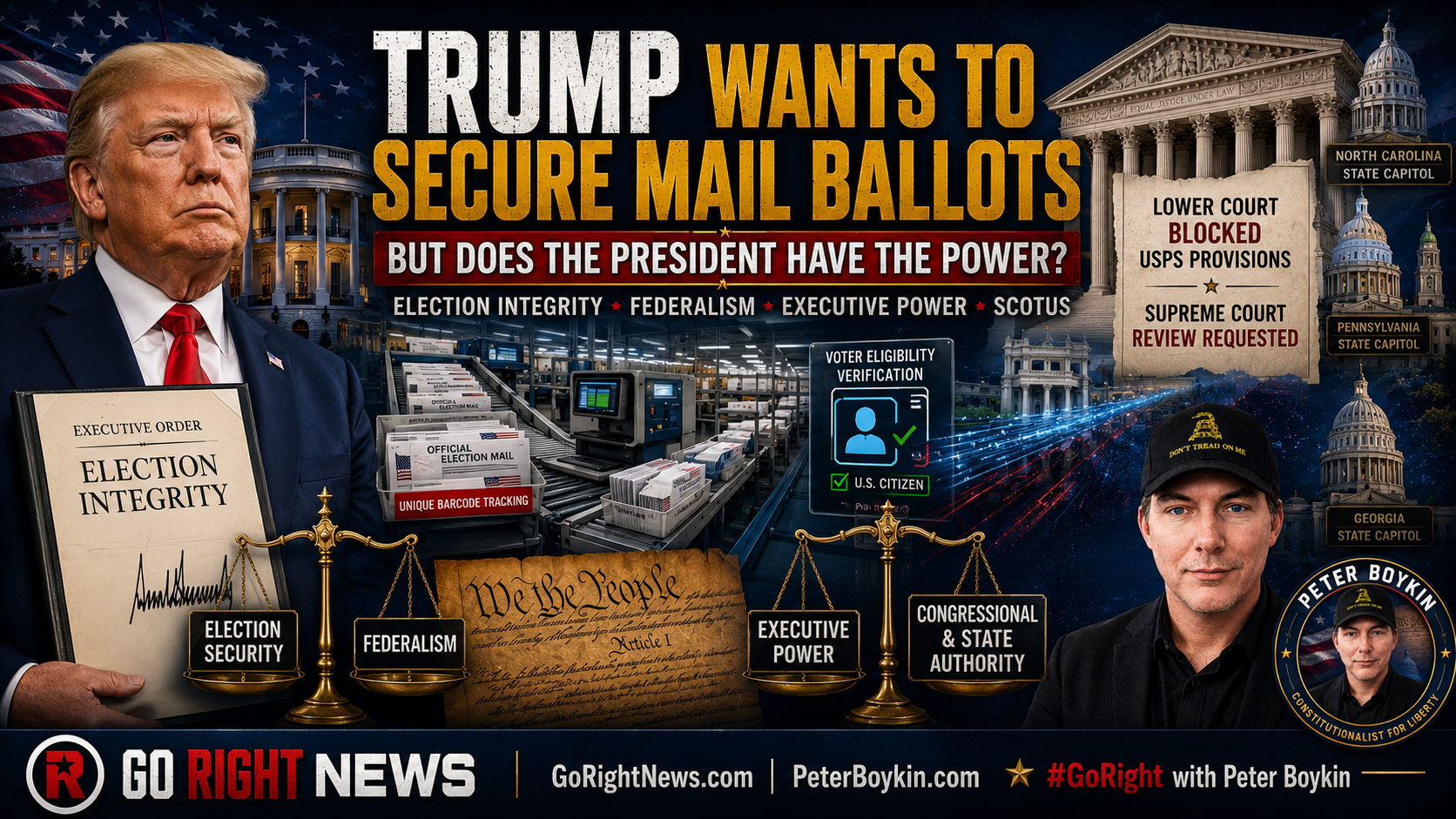
Trump Takes the Mail-Ballot Security Fight to the Supreme Court and the Stakes Are Bigger Than One Election
President Donald Trump’s push to strengthen citizenship verification and mail-ballot security is now sitting where major constitutional fights often end up: at the U.S. Supreme Court.
The administration is asking the justices to lift lower-court restrictions that have blocked key parts of Executive Order 14399, Trump’s March election-integrity directive. The order calls for stronger citizenship-verification systems and directs the U.S. Postal Service to modernize ballot-mail procedures with official election-mail markings, unique tracking barcodes, and state-specific lists identifying voters participating in mail or absentee voting.
The most important update is this: the Supreme Court has not yet ruled. The Court’s public docket shows the administration and the states filing supplemental briefs on August 12, with no later order resolving Trump’s emergency stay request listed as of publication.
That means this is still a live constitutional fight.
And the real argument is broader than whether someone likes President Trump, dislikes President Trump, supports absentee voting, or distrusts absentee voting.
Trump is making a serious election-integrity argument.
The states and voting organizations challenging the order are making a serious federalism argument.
Now the Supreme Court may have to decide how far a president can go in directing federal agencies to strengthen election safeguards before those actions become election rules that belong to Congress or the states.
Trump’s Goal Is Straightforward: Make Mail Ballots More Secure and More Traceable
The White House says Executive Order 14399 is designed to improve confidence in federal elections by verifying citizenship and modernizing the way absentee and mail ballots move through the postal system.
For mail ballots, the order directs USPS rulemaking involving secure ballot envelopes, the official Election Mail logo, automation-compatible design standards, and uniquely serialized Intelligent Mail barcodes that can help track ballot envelopes through the system. It also calls for ballots to be transmitted only to individuals appearing on state-specific mail and absentee participation lists.
Those ideas should not be dismissed merely because Donald Trump proposed them.
Ballot tracking is not extremism.
Accurate voter records are not extremism.
Making sure election mail can be identified and followed through the postal system is not extremism.
Preventing ineligible voting is not extremism.
And insisting that Americans should be able to trust the mechanics of an election is not an attack on democracy. Trust is one of the things that keeps a constitutional republic functioning.
USPS itself published a proposed rule on June 2 that would require uniform preparation standards for federal ballot mail, including use of the official Election Mail logo, automation-compatible envelopes, and uniquely serialized Intelligent Mail barcodes. The proposal said these standards would improve visibility of ballots in the mailstream and assist lawful postal and election operations.
A final-rule package was submitted for federal regulatory review on July 27.
So this is not merely political rhetoric. Federal agencies had begun the regulatory process.
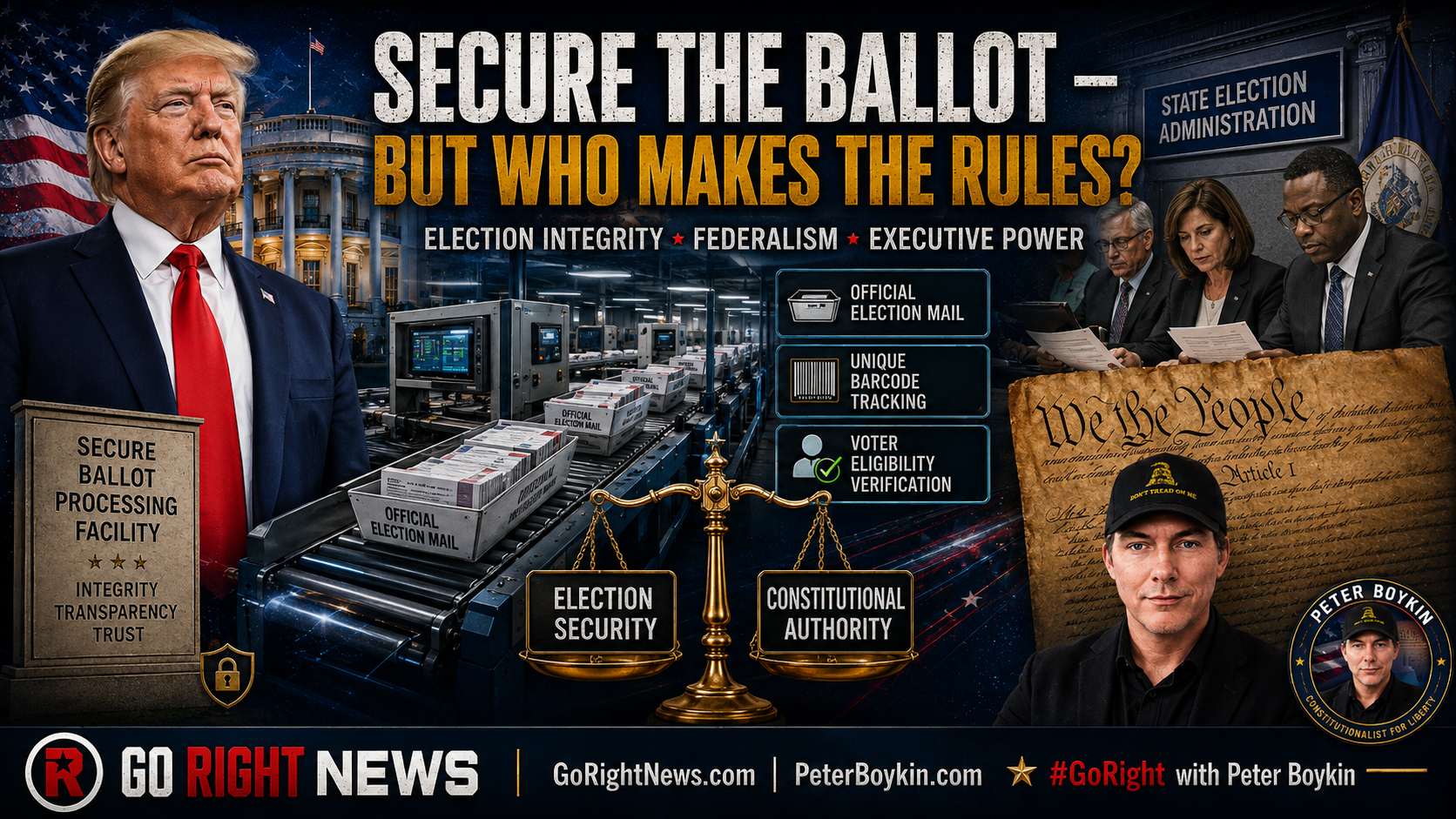
What Changed: A Nationwide Injunction Now Blocks the USPS Provisions for the 2026 Election
The earlier version of this legal fight involved an injunction protecting 23 states and the District of Columbia from portions of the order.
Then the case escalated.
On August 11, U.S. District Judge Indira Talwani issued a separate preliminary injunction in League of Women Voters of Massachusetts v. Trump blocking USPS nationwide from implementing Section 3 of Executive Order 14399 for the November 3, 2026 election or any earlier federal election. The order also prevents USPS from completing the specific rulemaking contemplated by that section for those elections.
The following day, Solicitor General D. John Sauer filed a supplemental brief with the Supreme Court arguing that the new nationwide order made prompt Supreme Court action even more important. The administration argues that courts stepped in too early because the executive order directs agencies to pursue policy consistent with applicable law while leaving important implementation details to agency rulemaking.
That is an important part of the administration’s position that deserves more attention.
Trump’s lawyers are not simply telling the Supreme Court, “The president can do whatever he wants with elections.”
Their emergency argument is that the lawsuits are premature because agencies had not completed the final implementation process and the lower courts should not block a presidential policy before concrete agency actions create an actual legal injury. The government says preventing the agencies from completing that work before the November election causes irreparable harm to its election-integrity efforts.
Whether the Supreme Court agrees remains unresolved.
The Constitutional Question Is About the Line Between Election Administration and Postal Administration
The challengers argue that the Constitution leaves primary responsibility for administering federal elections with the states while giving Congress authority to override state rules in areas covered by the Elections Clause.
That is why the most controversial part of Trump’s policy is not the barcode.
It is not the Election Mail logo.
It is the possibility that USPS could refuse to transmit certain state-issued ballots based on federally required participation lists.
The more USPS is regulating how an envelope moves through the mail, the stronger the argument that it is exercising traditional postal authority.
The more USPS is determining which voter may receive a state-issued ballot through the mail, the more the policy begins to resemble election administration.
That distinction is now at the heart of the case.
The administration, meanwhile, points to the president’s constitutional authority to supervise lawful executive-branch activity and to statutes giving USPS broad power over the collection, handling, transportation, delivery and regulation of mail. The government argues the lower courts should have allowed the agencies to finish determining what lawful implementation would actually look like before declaring the policy invalid.
That is a much more serious constitutional debate than the usual cable-news version of “Trump versus mail voting.”
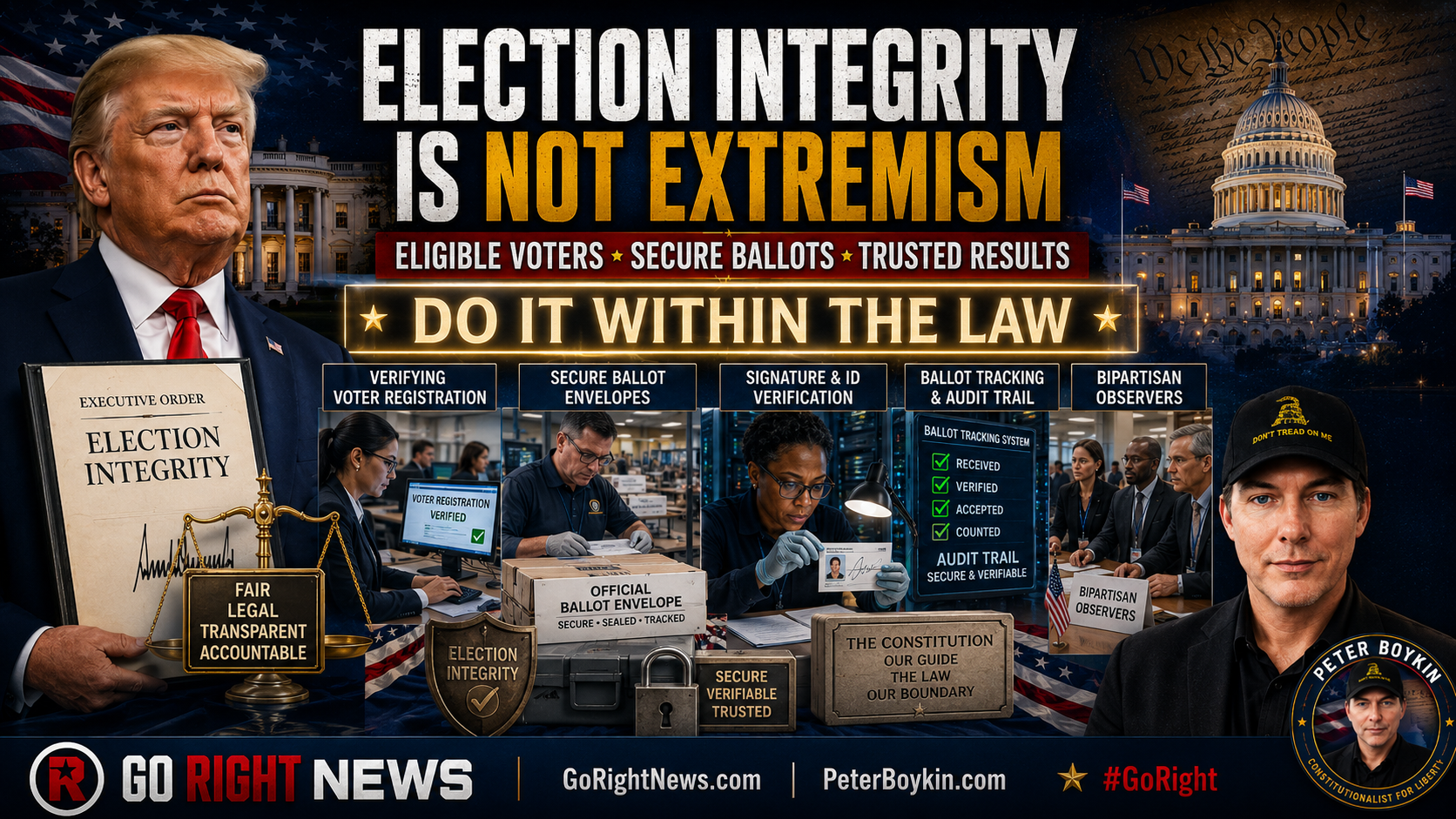
Trump Is Right About One Thing That Should Not Be Controversial: Election Systems Need Modern Security
Even people who oppose parts of this executive order should be able to agree on several principles.
Election mail should be trackable.
Voter-registration records should be accurate.
Eligible citizens should be able to vote without unnecessary obstacles.
Ineligible ballots should not be counted.
Election officials should know where ballots are in the process.
Government databases should have procedures for correcting errors.
And election rules should be understandable before voters begin casting ballots.
The White House says its citizenship-list system would allow individuals and states to access, update, or correct records, an important safeguard if federal information is being used to verify eligibility.
That matters because election integrity is not simply about catching unlawful activity.
It is also about making sure lawful voters are not wrongly excluded because a government database contains old, incomplete, or mismatched information.
Security and due process are not enemies.
A good election system needs both.
North Carolina Has a Direct Stake in This Fight
North Carolina voters already operate under a detailed state absentee-ballot system.
Any registered North Carolina voter may request an absentee-by-mail ballot for the 2026 elections, but the voter must affirmatively request one through the state process.
County boards are scheduled to begin mailing requested absentee ballots for the November general election on September 4, with Election Day set for November 3.
North Carolina also requires absentee voters to follow specific identity and ballot-security procedures. The state’s current instructions require an official request form, identity information on that request, either two witnesses or a notary when completing the ballot, and a copy of an eligible photo ID or an approved ID-exception form with the returned ballot. Absentee ballots must be received by the county board of elections by 7:30 p.m. on Election Day; the old three-day postmark grace period is no longer in effect.
North Carolina also offers BallotTrax so voters can track absentee ballots from printing through acceptance.
In other words, North Carolina already combines access with safeguards.
That makes the federal dispute especially relevant here.
North Carolinians can support stronger national election-security tools while still asking exactly how those tools should interact with state law.
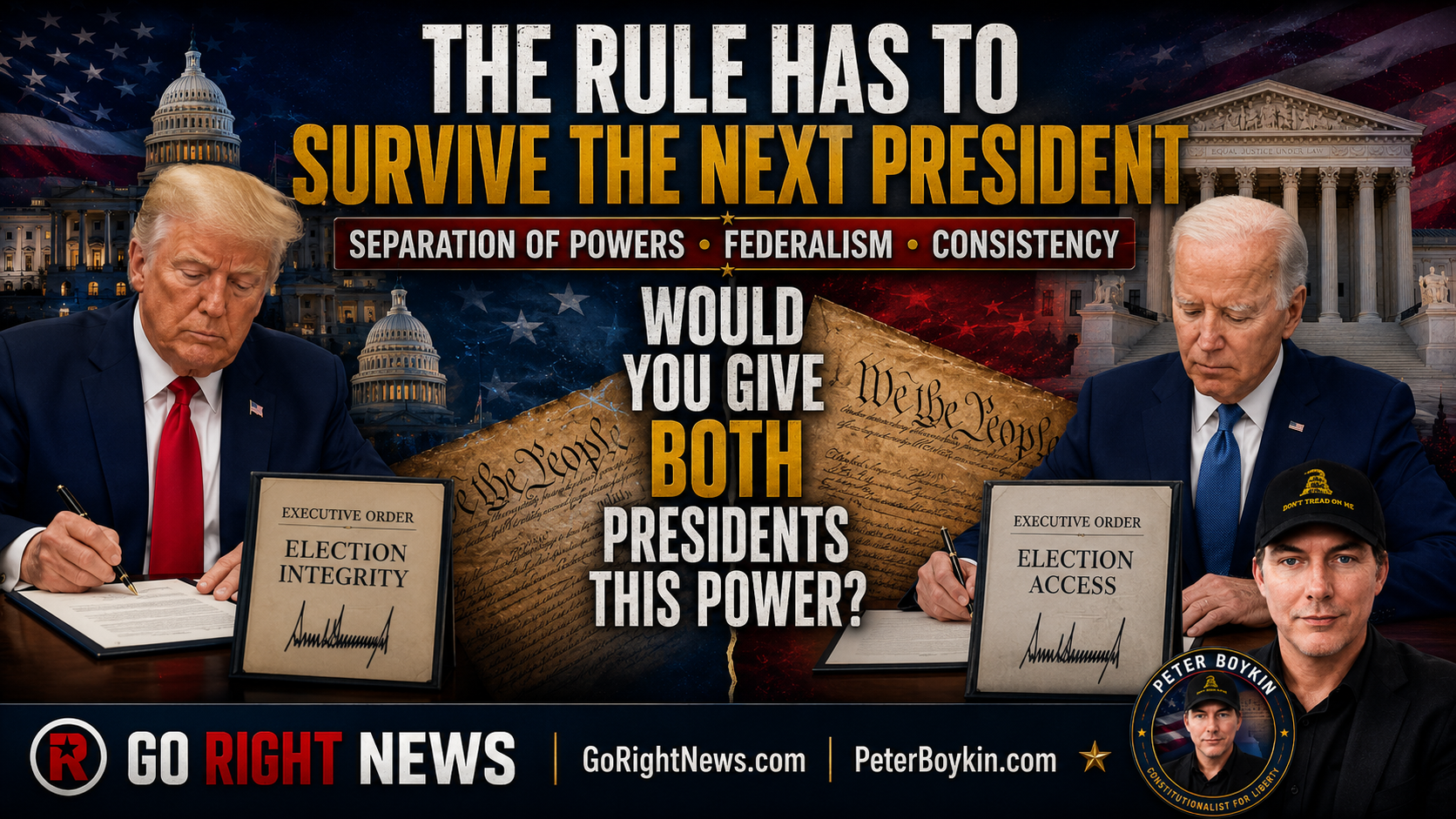
The Strongest Path Forward May Be to Turn Trump’s Security Goals Into Durable Law
There is a way to take much of the temperature out of this fight.
Congress can legislate.
If Congress wants official Election Mail markings and standardized ballot-tracking technology for federal elections, put it into statute.
If Congress wants stronger citizenship-verification systems, establish them through legislation with clear privacy rules, correction procedures and due-process protections.
If Congress wants states to provide specific information before federal ballot mail is accepted, debate the requirement publicly and define exactly what authority USPS possesses.
President Trump has repeatedly called on Congress to enact broader election-integrity legislation, including the SAVE America Act.
That is important because legislation would make the reform more durable.
An election-security system written into law after congressional debate is harder for the next president to erase with another executive order.
It also gives the courts a clearer statute to interpret.
That does not mean Trump was wrong to use presidential authority to push agencies toward stronger safeguards.
It means the strongest possible victory for his election-integrity agenda would be one that survives not only this lawsuit, but future presidents, future Congresses and future courts.
The Other-Party Test Still Matters
Constitutional conservatives should always ask one question before defending executive power:
Would I be comfortable giving this same power to the next Democratic president?
That question does not require attacking Trump.
It is actually one of the best ways to protect what Trump is trying to accomplish.
If the Supreme Court concludes that the president and USPS already have statutory authority for these measures, that creates one kind of precedent.
If the Court says Congress must authorize some of them first, then Congress should do its job and put the strongest defensible safeguards into law.
Either way, the objective remains the same:
Secure the ballot.
Verify eligibility.
Protect legitimate voters.
Track election mail.
Punish actual fraud.
And build a system Americans can trust.
What We Know and What Is Still Developing
We know President Trump signed Executive Order 14399 on March 31, directing federal agencies to strengthen citizenship verification and modernize mail-ballot procedures.
We know USPS published a proposed federal ballot-mail rule on June 2 and later submitted a final-rule package for regulatory review.
We know lower courts have blocked major parts of the order for the 2026 election, including an August 11 nationwide preliminary injunction against USPS implementation of Section 3.
We know the Trump administration responded on August 12 by urging the Supreme Court to act promptly and lift the restrictions.
And we know the Supreme Court’s public docket still lists the application as pending, with the August 12 supplemental filings as the latest docket activity shown at publication.
What we do not know is how the justices will rule.
They could grant Trump’s requested stay.
They could leave the injunctions in place while the normal appeals continue.
They could issue a narrower order.
Or they could use this dispute to clarify the boundary between lawful presidential supervision of federal agencies and election rules that require congressional or state authority.
Until the Court acts, anyone claiming Trump has already won or already lost this Supreme Court fight is getting ahead of the facts.
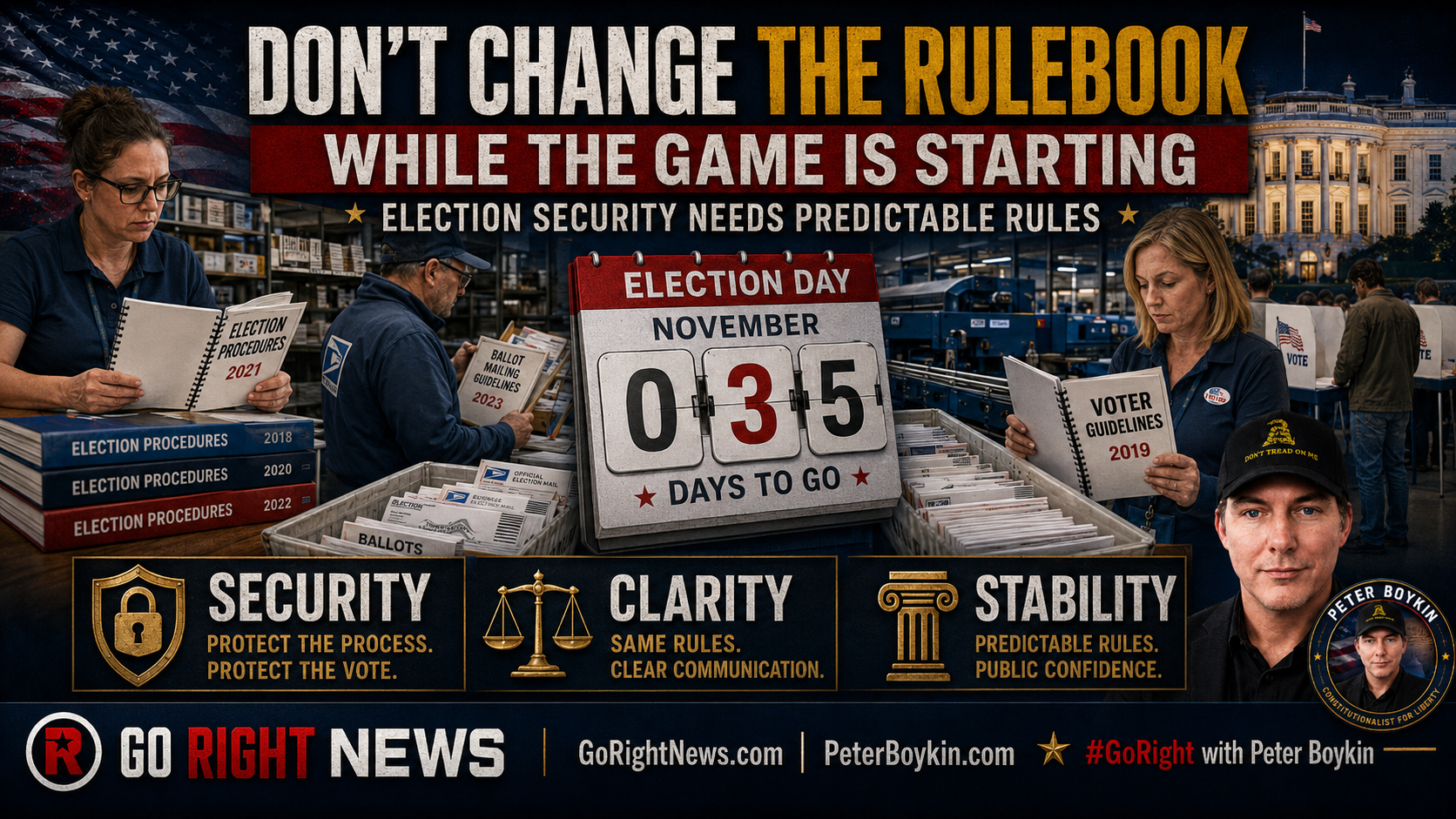
Trump Is Right to Demand Election Integrity, Now Make the Victory Constitutional and Permanent
The Go Right with Peter Boykin Perspective
I support what President Trump is trying to accomplish.
Secure elections should not be a partisan issue.
If an absentee ballot is moving through the United States mail, we should be able to track it.
If the government is maintaining voter rolls, those records should be accurate.
If somebody is not legally eligible to vote in a federal election, that person should not be voting in it.
If actual election fraud occurs, prosecute it.
And if states are using mail voting, they should use modern systems that give voters and election officials confidence that legitimate ballots move securely from voter to election office.
Trump is right to force this conversation.
The mistake conservatives should avoid is allowing Trump’s opponents to redefine the debate as though wanting stronger election security is somehow sinister.
It is not.
But constitutional government gives us another responsibility: make the reform strong enough to survive the courts and permanent enough to survive the next president.
The administration has a legitimate argument that the lower courts moved too soon.
The president issued policy directions.
USPS began rulemaking.
The agency had not yet completed the final rule.
Trump’s lawyers are asking why courts should kill a policy before the agencies finish determining how to implement it lawfully.
That is a fair question, and the Supreme Court should answer it.
At the same time, I want the strongest possible legal foundation underneath every election-integrity reform.
If current law gives President Trump and USPS the authority, then identify that authority clearly, win the case, and implement the safeguards.
If some parts require Congress, then send Congress the bill.
Make lawmakers vote.
Put citizenship verification into durable law.
Put ballot tracking into durable law.
Protect voter information.
Create a process for fixing government database errors.
Give states clear standards instead of last-minute uncertainty.
Then the next administration cannot simply erase the entire system with a pen.
That is not weakening Trump’s agenda.
That is Trump-proofing the reform against the people who come after Trump.
North Carolina is a good example of why details matter.
We already require absentee voters to request ballots.
We already require identification procedures.
We already require witnesses or a notary.
We already have ballot tracking.
And we already require ballots to arrive by Election Day.
Those safeguards can coexist with legitimate absentee voting.
The federal government should be looking for ways to reinforce security without creating unnecessary confusion between federal and state systems.
The final principle is simple:
Election integrity should be strong.
Presidential authority should be respected.
State authority should be respected.
Congress should do its job.
The courts should define the lines honestly.
And every reform should be designed not merely to win the next election argument, but to strengthen public trust for decades.
President Trump put election integrity back at the center of the national debate.
Now the goal should be to turn the strongest parts of that agenda into constitutional, transparent and lasting law.
That is how you secure the ballot without surrendering federalism.
That is how you protect Trump’s election-integrity legacy from being dismantled by the next administration.
And that is how we #GoRight — constitutionally right.
President Trump’s mail-ballot security and citizenship-verification agenda is now before the Supreme Court after a federal judge expanded an injunction nationwide against key USPS provisions for the 2026 election. The administration says courts moved too early and blocked lawful executive-branch work before agencies finished implementation. The larger fight is about election security, federalism, postal authority and whether Trump’s reforms can be turned into durable law that survives future administrations.
#GoRight #GoRightNews #PeterBoykin #ConstitutionalistForLiberty #DonaldTrump #PresidentTrump #ElectionIntegrity #SecureElections #MailBallots #AbsenteeVoting #SCOTUS #SupremeCourt #Federalism #StatesRights #USPS #VoterID #CitizenshipVerification #NorthCarolina #NCPolitics #Constitution #SeparationOfPowers
Sources
U.S. Supreme Court — Docket, Trump v. California, No. 26A124
https://www.supremecourt.gov/docket/docketfiles/html/public/26a124.html
U.S. Supreme Court — Trump Administration Application for Stay
https://www.supremecourt.gov/DocketPDF/26/26A124/417370/20260727144320600_Trump%20v.%20California%20Application%20and%20Appendix.pdf
U.S. Supreme Court — Trump Administration Supplemental Brief, August 12, 2026
https://www.supremecourt.gov/DocketPDF/26/26A124/418732/20260812103120524_Trump%20v.%20California%20stay%20supp%20brief%20and%20appendix.pdf
The White House — Executive Order 14399: Ensuring Citizenship Verification and Integrity in Federal Elections
https://www.whitehouse.gov/presidential-actions/2026/03/ensuring-citizenship-verification-and-integrity-in-federal-elections/
The White House — Fact Sheet on Citizenship Verification and Mail-Ballot Security
https://www.whitehouse.gov/fact-sheets/2026/03/fact-sheet-president-donald-j-trump-ensures-citizenship-verification-and-voter-eligibility-in-federal-elections/
Federal Register — Ballot Mail for Federal Elections, Proposed Rule
https://www.federalregister.gov/documents/2026/06/02/2026-10968/ballot-mail-for-federal-elections
Reginfo.gov — Conditions on the Preparation of Ballot Mail for Federal Elections, Final Rule Review
https://www.reginfo.gov/public/do/eoDetails?rrid=1485175
Reuters — Judge Blocks U.S. Postal Service From Restricting Mail-In Voting, August 11, 2026
https://www.reuters.com/world/judge-blocks-us-postal-service-restricting-mail-in-voting-2026-08-11/
Reuters — Trump Administration Again Urges U.S. Supreme Court Intervention on Mail Ballots, August 12, 2026
https://www.reuters.com/legal/government/trump-administration-again-urges-us-supreme-court-intervention-mail-ballots-2026-08-12/
North Carolina State Board of Elections — Vote By Mail
https://www.ncsbe.gov/voting/vote-mail
North Carolina State Board of Elections — Detailed Instructions to Vote By Mail
https://www.ncsbe.gov/voting/vote-mail/detailed-instructions-vote-mail
North Carolina State Board of Elections — Absentee Voting Begins, November 2026 General Election
https://www.ncsbe.gov/news/events/absentee-voting-begins-november-2026-general-election

Call to Action
For daily commentary grounded in liberty, justice, constitutional values, and common sense, visit
GoRightNews.com.
Subscribe to Go Right with Peter Boykin on
Rumble,
YouTube,
Spotify,
Apple Podcasts,
Amazon Music,
and
Spreaker.
Follow #GoRight with Peter Boykin across the major platforms.
Support the Platform
Go Right News is independent media. If you support commentary that holds power accountable and defends constitutional liberty, consider helping keep the platform going.
Donate through
Cash App $GoRightNews
or visit
GoRightNews.com Donations.
Stay informed. Stay free. It is time to #GoRight.
#GoRight: More Than Politics, A Way of Life
At Go Right News, we know many people judge the headline before reading the facts. That is why we focus on context, accountability, and constitutional principles instead of outrage for outrage’s sake.
We lean right, but we are not here to defend hypocrisy, extremism, or double standards from any side. We stand for truth, liberty, personal responsibility, and the rights of We the People.
#GoRight is not just about politics. It means doing right, thinking right, being right, and voting right. It is a call to build, not destroy. It is about working toward a better future together.

Official Links
Web:
GoRightNews.com |GoRightNC.com |PeterBoykin.com |GaysForLiberty.org
Video and Podcast:
Rumble |YouTube |Spreaker |Spotify |Apple Podcasts |Amazon Music
Social:
Facebook |X |Telegram |Instagram |Reddit
Kick:
PeterBoykin |GoRightNews |LuckyNLoose


Help Keep Go Right News Independent
Each month, Go Right News spends hundreds of dollars and many hours running this site, producing content, and keeping the podcast alive without corporate control. If you like the content, please consider supporting the platform.
#GoRightNews #GoRight #PeterBoykin #ConstitutionalistForLiberty #ConservativeVoice #LibertyPodcast #IndependentMedia #CitizenJournalist #ConservativeCommentary #ConstitutionalTalk #FreedomOfSpeech #AmericaFirst #NorthCarolina #NCPOL #NCPolitics #BoykinForNC #GoRightNC #GaysForLiberty
Shared by #GoRightNews
https://GoRightNews.com