When the Cloud Comes for the Farm
Written by Peter Boykin on July 13, 2026






When the Cloud Comes for the Farm
Go Right News Shared by Peter Boykin
American Political Commentator | Citizen Journalist | Activist | Constitutionalist for Liberty
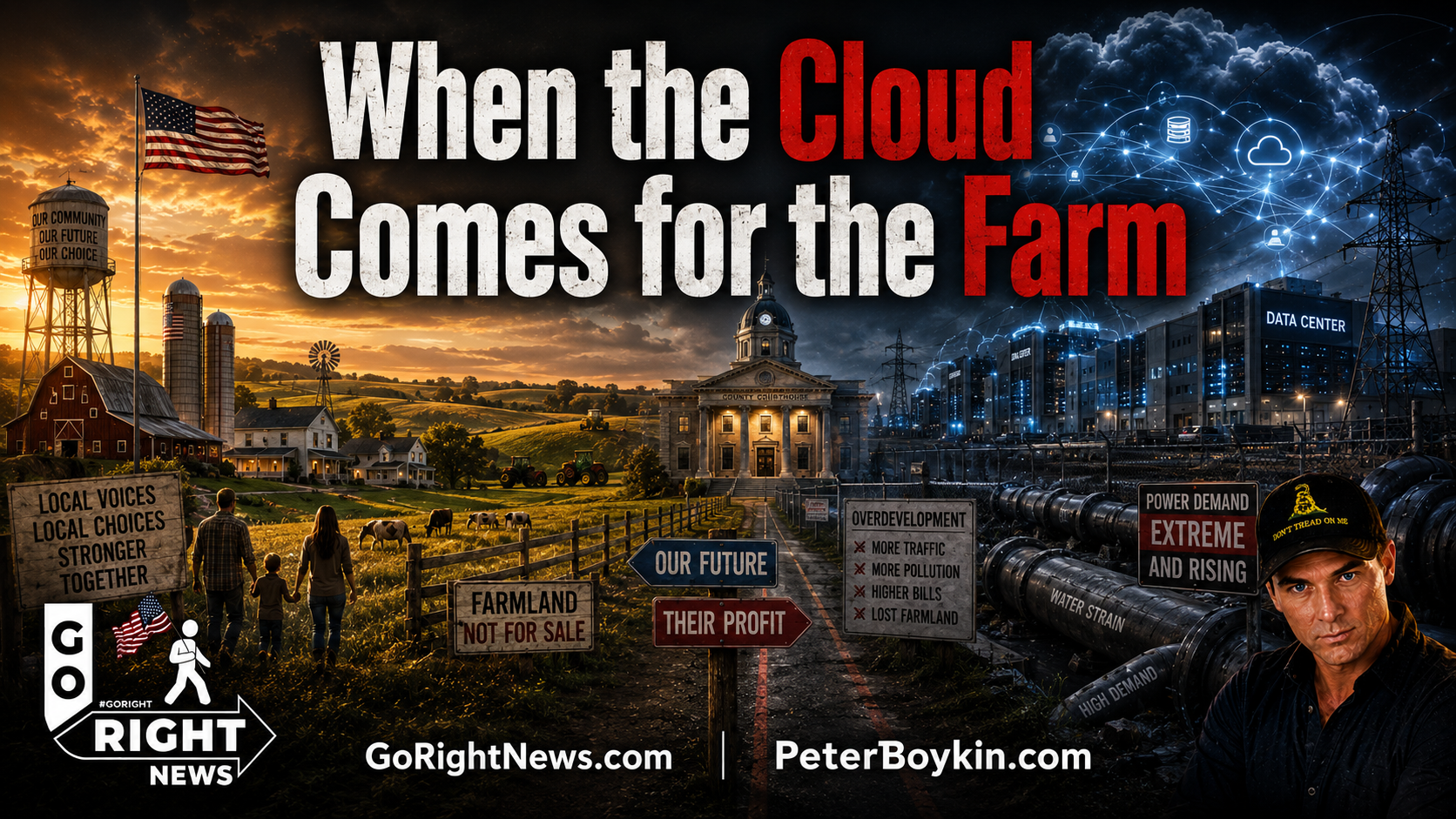
Data centers can bring investment, but counties should not trade land, water, and power for promises without asking what the long-term bill will be.
There is nothing wrong with technology. There is nothing wrong with progress. There is nothing wrong with building the digital infrastructure America needs to compete in the future.
But there is something wrong with local communities being rushed into massive land-use decisions without being given the full picture.
Data centers are becoming one of the biggest economic development fights in America. They are sold as the backbone of artificial intelligence, cloud computing, national security, business growth, and the future digital economy. In many cases, that is true. The internet does not run on magic. AI does not float in the sky. The cloud is not really a cloud. It is a building somewhere, filled with servers, cooling systems, backup generators, security fences, power lines, water systems, and infrastructure demands.
The question is not whether data centers are good or bad.
The question is whether counties are making wise decisions, or whether they are being dazzled by big promises before asking the hard questions.
The New Factory Town
For generations, local leaders chased factories because factories brought workers, payroll, suppliers, diners, homes, schools, and Main Street growth. A factory could change the life of a town because it put people to work.
Data centers are different.
They can bring construction jobs. They can bring tax revenue. They can help pay for schools, emergency services, and infrastructure. They can make a county look like it is plugged into the future. Industry advocates in North Carolina have argued that data centers contributed billions to the state economy and supported thousands of jobs statewide. In a state trying to grow, that matters. (WRAL News)
But the permanent local job numbers are often not what people imagine. A data center can be enormous and still operate with a relatively small staff once construction is finished. The World Resources Institute noted that even large data centers can employ fewer than 150 permanent workers, and sometimes as few as 25. (wri.org)
That does not mean they have no value. It means local leaders must compare the promised benefit with the permanent cost.
If a county gives up farmland, forestland, road capacity, water capacity, electric capacity, and future housing land, the return had better be real, measurable, enforceable, and long-term.
The Water Warning From Wyoming
A recent case in Cheyenne, Wyoming shows why communities should be careful before assuming every data center is just another clean warehouse.
According to reporting on the Cheyenne incident, a contractor connected to Meta’s data center project discharged bacteria-contaminated water into public sewers during construction. Officials said the contamination involved Cupriavidus gilardii, a rare bacterium, and that the incident affected reclaimed water systems used for irrigation, not the public drinking-water supply. Cheyenne officials responded by tightening wastewater rules and prohibiting certain data center discharges from closed-loop cooling and fill-and-flush systems into municipal sewers. (The Guardian)
That distinction matters. It would be wrong to say the city’s drinking water was contaminated if the reports say it was not. But it would also be wrong to dismiss the story as nothing.
The warning is simple: data centers are not just buildings. They are industrial-scale infrastructure projects. They involve water systems, chemical systems, cooling systems, wastewater systems, electric systems, backup systems, and contractors that local governments must be ready to regulate.
If a community does not understand what is being flushed, cooled, discharged, stored, powered, or promised, then that community is not ready to approve the project.
North Carolina Is Already in This Fight
This is not just a Wyoming issue. North Carolina is already dealing with the same debate.
Residents across North Carolina have packed public meetings from Apex to Edgecombe County with concerns about water use, noise, electric demand, transparency, and community impact. An Elon University poll cited by WRAL found only 24 percent of North Carolinians supported a data center being built in their own community. (WRAL News)
In Stokes County, a proposed data center rezoning involved 1,844 acres near farms, homes, and culturally sensitive land. The approval triggered a lawsuit from residents and environmental groups who argued that the county acted on incomplete or inaccurate claims about jobs, tax revenue, noise, and protections for sensitive areas. (Inside Climate News)
This is exactly where the debate belongs. Not in secret rooms. Not hidden behind non-disclosure agreements. Not in a last-minute vote where citizens are treated like obstacles.
Counties should welcome investment, but they should not surrender their future.
The Mainframe Lesson
Technology changes fast.
There was a time when computing power required giant mainframes, special rooms, huge cooling systems, and expensive infrastructure. Today, the average phone has more practical computing power than many of the machines that once filled rooms.
That does not mean data centers will disappear tomorrow. In fact, AI demand is driving massive growth right now. The International Energy Agency projects that global data center electricity use could roughly double from 485 terawatt-hours in 2025 to 950 terawatt-hours in 2030, with AI-focused data centers growing even faster. (IEA)
But technology also becomes more efficient over time. Chips change. Cooling changes. Storage changes. Computing density changes. Workloads move. Companies consolidate. Demand shifts. What looks essential today may look oversized tomorrow.
That is the long-term question counties must ask.
What happens if a county allows thousands of acres to be converted into a giant data center campus, builds roads and utility capacity around it, strains local water and power systems for it, and then the company needs less space ten or twenty years from now?
What happens if the technology evolves and the land is left with giant empty shells instead of farms, housing, or mixed-use development?
What happens if the tax deal looked good on paper, but the county is stuck maintaining infrastructure built for a project that no longer delivers what was promised?
WRI warned that communities can be left paying for infrastructure sized for a facility that downsizes, relocates, or no longer exists before costs are recovered. (wri.org)
That should be enough to make every county commissioner slow down.
Farmland Is Not Just Empty Space
Too many developers look at rural land and see cheap square footage. But farmland is not empty land. Forestland is not wasted land. Open space is not meaningless land.
It is food production. It is water absorption. It is family heritage. It is wildlife habitat. It is future housing capacity. It is local character. It is the difference between a community that grows with intention and a community that gets carved up by whoever shows up with the biggest check.
The American Farm Bureau Federation has warned that farmland conversion is generally permanent, making site selection and land-use policy critical for long-term agricultural viability. It also notes that data centers create both economic opportunities and resource pressures around land, water, and energy. (Farm Bureau)
That is the balance.
Nobody should pretend there are no benefits. But nobody should pretend the costs are imaginary either.
Smarter Growth, Not Anti-Tech Panic
America needs data centers. North Carolina needs technology. Rural counties deserve investment. The right answer is not to say no to everything.
The right answer is to be smarter.
First, counties should require full public disclosure of projected water use, electric demand, backup generator use, wastewater handling, noise levels, road impacts, and emergency service demands before approval.
Second, data center companies should pay for the infrastructure they require. Existing residents should not be forced to subsidize the grid upgrades, water upgrades, sewer upgrades, or road upgrades needed by billion-dollar corporations.
Third, counties should consider existing industrial sites, abandoned commercial properties, closed manufacturing spaces, and smaller distributed data centers before converting farmland or forestland into one massive campus.
Fourth, local governments should require decommissioning plans. If the data center closes, downsizes, or becomes obsolete, there should already be a funded plan for reuse, removal, redevelopment, or restoration.
Fifth, communities need technology-literate people at the table. Not just lawyers. Not just developers. Not just politicians. Counties should consult people who understand infrastructure, computing trends, cybersecurity, power systems, cooling systems, and how quickly technology changes.
A commissioner may understand zoning. A developer may understand land acquisition. A utility may understand capacity. But someone also needs to ask: what will this technology look like in 10 years, 20 years, or 30 years?
That question can save a county from making a permanent mistake based on a temporary boom.
Liberty Requires Local Control
The Go Right with Peter Boykin Perspective
This is where a Constitutionalist for Liberty perspective matters.
Local communities have the right to grow. They also have the right to say no. They have the right to demand answers. They have the right to protect land, water, taxpayers, and future generations from bad deals wrapped in futuristic language.
Being pro-technology does not mean being pro-corporate blank check.
Being pro-growth does not mean letting outsiders turn a county into an experiment.
Being pro-business does not mean ignoring property owners, farmers, families, and ratepayers who will still be there long after the press conference is over.
The conservative answer should be simple: protect property rights, protect taxpayers, protect local control, protect the land, protect the water, and make the deal prove itself.
If a data center is truly good for a county, it should survive public questions.
If the economics are truly strong, they should survive independent review.
If the environmental impact is truly manageable, it should survive transparency.
If the company is truly a good neighbor, it should not need secrecy, pressure, or rushed votes to get approval.
Technology is moving fast. Government usually moves slow. That gap is dangerous when counties are making decisions that can reshape land use for generations.
So yes, build the future. But build it wisely.
Use existing buildings where possible. Break up the footprint where practical. Require the company to pay its own way. Protect farmland. Protect water. Protect ratepayers. Demand decommissioning plans. Bring technology experts into the room before the vote, not after the mistake.
The future should not be built by strip-mining the present.
And local communities should never be asked to trade their land, water, and liberty for a promise they are not allowed to fully inspect.

Data centers may bring investment and tax revenue, but communities must weigh the long-term costs to farmland, water, electricity, infrastructure, and local control before approving massive projects.
#GoRightNews #PeterBoykin #DataCenters #AI #NorthCarolina #LocalControl #PropertyRights #Farmland #WaterRights #ConstitutionalistForLiberty
Sources:
The Guardian, reporting on Cheyenne, Wyoming wastewater rules after the Meta contractor incident. (The Guardian)
Brookings, “The local implications of data centers for rural communities in the US.” (Brookings)
World Resources Institute, “7 Ways Data Centers Affect US Communities.” (wri.org)
WRAL, “Inside North Carolina’s data center boom: Where does the water go?” (WRAL News)
Inside Climate News, reporting on the Stokes County data center rezoning lawsuit. (Inside Climate News)
International Energy Agency, “Key Questions on Energy and AI.” (IEA)
American Farm Bureau Federation, “Balancing Data Center Growth with American Agriculture.” (Farm Bureau)

Call to Action
For daily commentary grounded in liberty, justice, constitutional values, and common sense, visit
GoRightNews.com.
Subscribe to Go Right with Peter Boykin on
Rumble,
YouTube,
Spotify,
Apple Podcasts,
Amazon Music,
and
Spreaker.
Follow #GoRight with Peter Boykin across the major platforms.
Support the Platform
Go Right News is independent media. If you support commentary that holds power accountable and defends constitutional liberty, consider helping keep the platform going.
Donate through
Cash App $GoRightNews
or visit
GoRightNews.com Donations.
Stay informed. Stay free. It is time to #GoRight.
#GoRight: More Than Politics, A Way of Life
At Go Right News, we know many people judge the headline before reading the facts. That is why we focus on context, accountability, and constitutional principles instead of outrage for outrage’s sake.
We lean right, but we are not here to defend hypocrisy, extremism, or double standards from any side. We stand for truth, liberty, personal responsibility, and the rights of We the People.
#GoRight is not just about politics. It means doing right, thinking right, being right, and voting right. It is a call to build, not destroy. It is about working toward a better future together.

Official Links
Web:
GoRightNews.com |GoRightNC.com |PeterBoykin.com |GaysForLiberty.org
Video and Podcast:
Rumble |YouTube |Spreaker |Spotify |Apple Podcasts |Amazon Music
Social:
Facebook |X |Telegram |Instagram |Reddit
Kick:
PeterBoykin |GoRightNews |LuckyNLoose


Help Keep Go Right News Independent
Each month, Go Right News spends hundreds of dollars and many hours running this site, producing content, and keeping the podcast alive without corporate control. If you like the content, please consider supporting the platform.
#GoRightNews #GoRight #PeterBoykin #ConstitutionalistForLiberty #ConservativeVoice #LibertyPodcast #IndependentMedia #CitizenJournalist #ConservativeCommentary #ConstitutionalTalk #FreedomOfSpeech #AmericaFirst #NorthCarolina #NCPOL #NCPolitics #BoykinForNC #GoRightNC #GaysForLiberty
Shared by #GoRightNews
https://GoRightNews.com
[/vc_column_text][/vc_column][/vc_row]