




Trump’s Mail Ballot Security Plan Hits a Nationwide Injunction, but USPS Has the Rules Ready to Go
Go Right News Shared by Peter Boykin
American Political Commentator | Citizen Journalist | Activist | Constitutionalist for Liberty
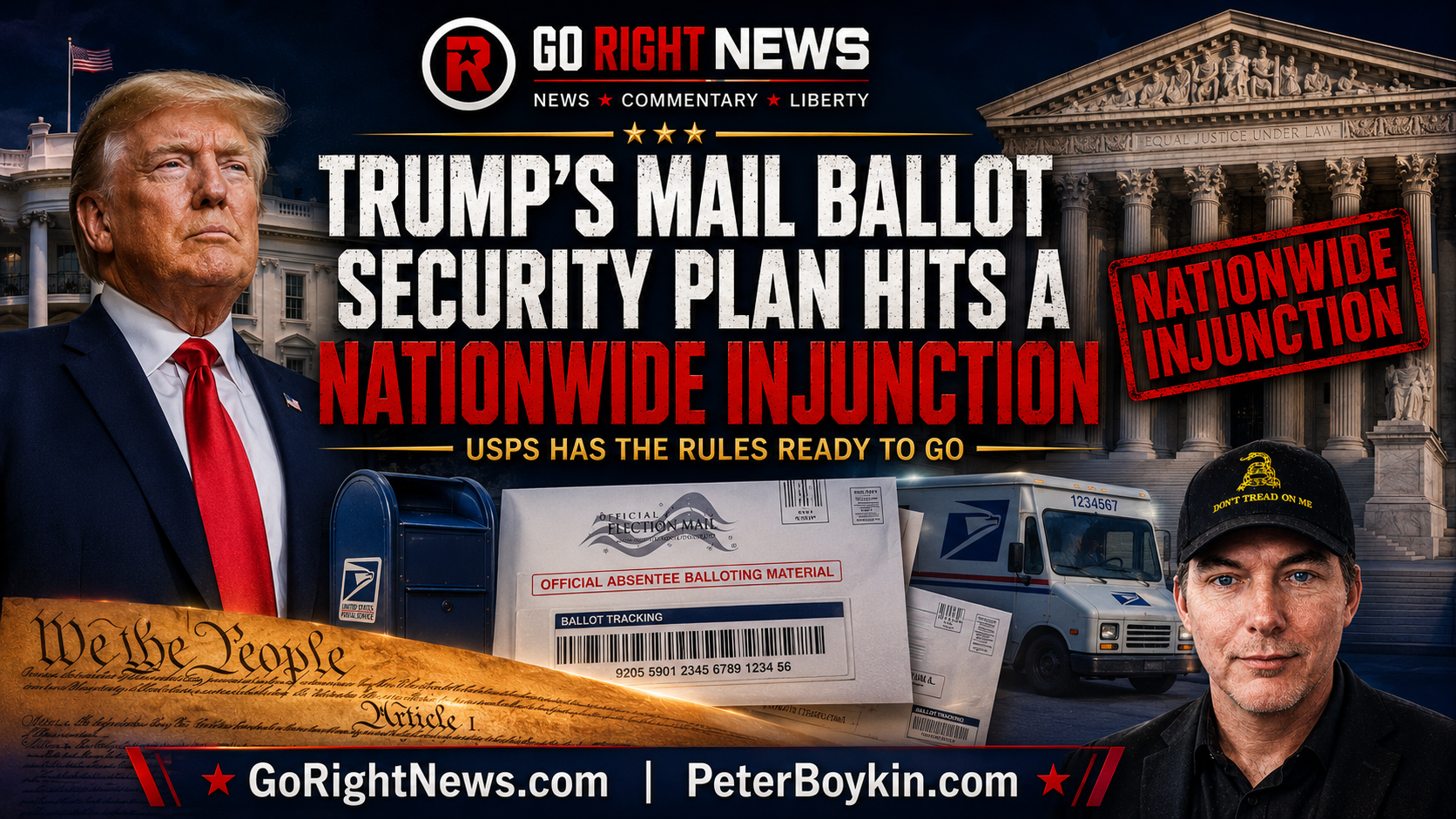
Trump’s Mail Ballot Security Plan Hits a Nationwide Injunction, but USPS Has the Rules Ready to Go
President Donald Trump has made election integrity one of the central themes of his political movement, and his administration is now attempting to create a new federal layer of security around mail voting. The goal is straightforward: only eligible citizens should participate in federal elections, ballots moving through the mail should be traceable, and government should have better tools to detect fraud or administrative failures.
A federal court, however, has concluded that the administration may be trying to accomplish those goals through powers that do not belong to the president alone.
The dispute became even more significant when the United States Postal Service finalized a detailed 95-page rule establishing new federal standards for ballot mail. The rule has been completed even though a nationwide injunction currently prevents the disputed provisions from taking effect.
USPS has moved forward with the regulatory work so the agency can implement the system quickly if the courts ultimately allow it. That means the federal government now has a detailed mail ballot framework largely ready to launch while the judiciary decides whether the executive branch has the legal authority to use it.
This is no longer simply another disagreement about absentee voting. It has become a broader constitutional fight involving election integrity, presidential authority, Congress, federalism, state election power and the proper role of the Postal Service.
Trump’s objective deserves to be taken seriously. Election systems should be secure, voter eligibility rules should be enforced, ballots should have reliable chains of custody, and election officials should be able to identify where failures occur. At the same time, a legitimate policy objective does not automatically create a new presidential power.
That is the constitutional question now sitting at the center of the dispute.
Trump Wants a New Federal Security Layer Around Mail Ballots
Trump signed Executive Order 14399, titled Ensuring Citizenship Verification and Integrity in Federal Elections, directing several federal agencies to strengthen citizenship verification and federal election procedures.
The administration says the order is intended to help states identify ineligible voters, improve ballot security and create more reliable procedures for absentee and mail voting in federal elections.
The order also directed USPS toward new standards for election mail. Those standards include the use of Official Election Mail markings, automation-compatible envelopes and unique Intelligent Mail barcodes.
There is a strong practical argument for those requirements.
A ballot envelope with a unique barcode can be tracked more accurately. Election officials can document when ballot mail enters the postal system, USPS can identify where delivery problems occurred, and investigators can have a better factual record if election mail is stolen, redirected or improperly handled.
Those improvements could protect legitimate voters just as much as they could help expose wrongdoing.
The constitutional controversy begins when ballot tracking becomes something more than ballot tracking.
The administration’s approach also envisions state-specific lists of voters participating in mail or absentee voting, with USPS using information provided by election officials when determining how federal ballot mail should be handled.
Under the disputed provisions, USPS could refuse to handle certain federal ballot mail if the state or ballot did not satisfy the new federal requirements.
That is where the Postal Service begins to move away from being simply the carrier of election mail and closer to becoming a federal gatekeeper.
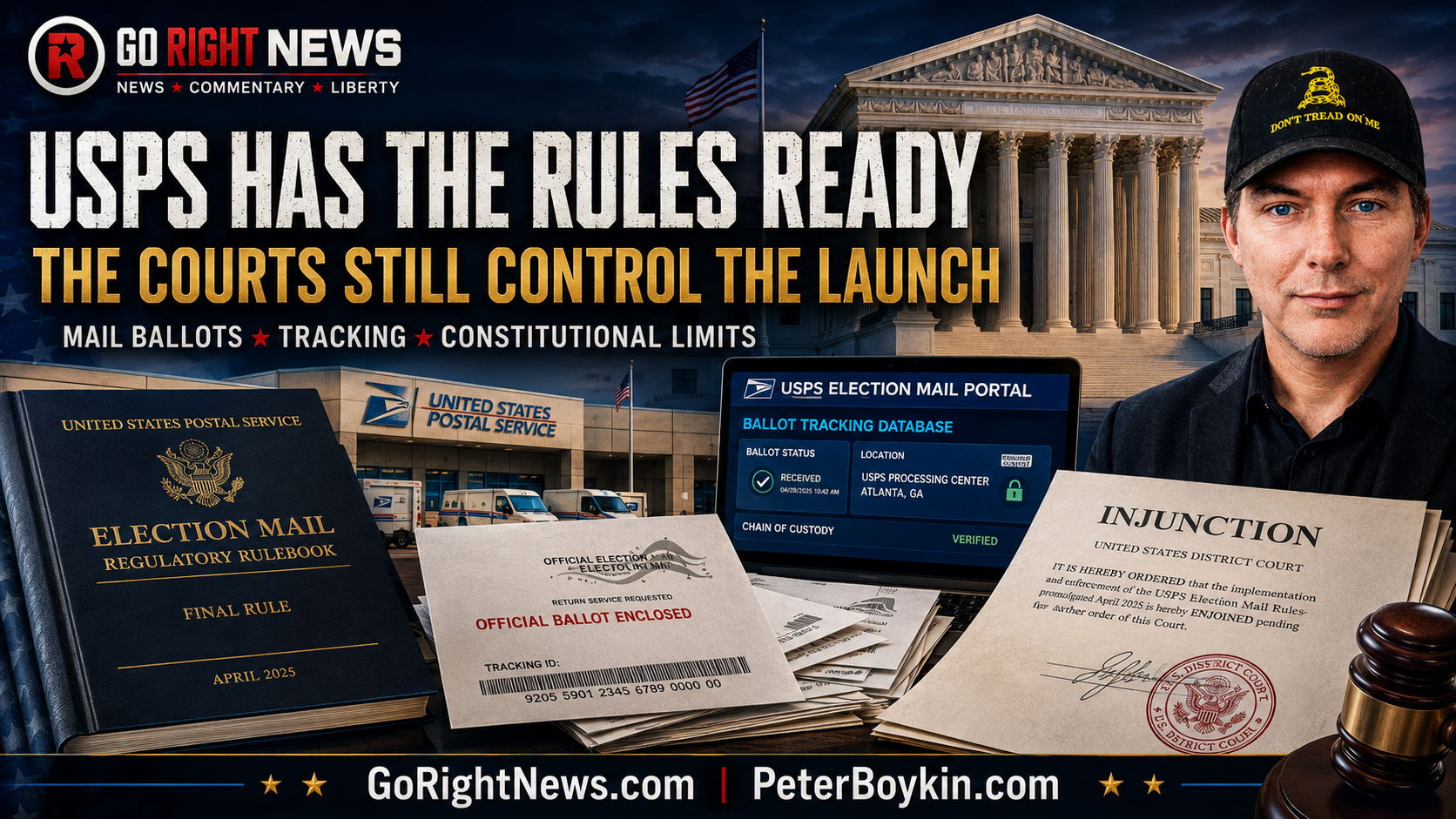
USPS Has Now Finished the Rulebook
USPS has moved beyond the proposal stage and finalized the regulatory framework for the system.
Under the rule, states using mail voting for federal elections would provide the Postal Service with information associated with people receiving ballots. That information would include unique barcodes connected to outgoing ballot envelopes and the envelopes used to return them.
The Postal Service would then compare state election information with ballot mail entering the postal system.
USPS says the system would rely on information appearing on the outside of election mail, including addresses and barcode data. Postal employees would not be authorized to open ballots, inspect how anyone voted or collect voters’ party preferences.
That distinction matters because the proposal is not a system for examining ballots. It is a system for tracking and controlling election mail.
The more difficult question is what happens when the information does not match.
If a state fails to participate in the federal system, or if the necessary records do not satisfy USPS requirements, the Postal Service could potentially refuse to transmit affected federal ballot mail if the rule is eventually allowed to take effect.
The administration views that as an enforcement mechanism.
Critics view it as federal interference with elections.
Both descriptions help explain why the dispute has become constitutionally important.
The Real Question Is Whether USPS Tracks Ballots or Controls Access to the Mail
There is a meaningful difference between saying that USPS should securely track election mail and saying that USPS should determine whether election mail is entitled to travel through the postal system.
The first is primarily an operational security function. The second can become an election administration function.
Imagine that a state lawfully determines that a voter is eligible to receive an absentee ballot. The ballot is issued correctly, the voter is properly registered, and the state election office has done everything required under law.
Now imagine that the federal database contains an outdated address, a different spelling of the voter’s name, an improperly synchronized barcode or another administrative error.
If USPS refuses to handle that ballot because the federal system does not match the state’s records, then a federal database error has effectively interfered with a state election decision.
That is why the controversy cannot be reduced to whether people support secure elections.
Most Americans support secure elections.
The dispute concerns who possess the authority to make the rules and what happens when federal administrative requirements collide with a lawful state election process.
A Federal Judge Put Up a Nationwide Stop Sign
U.S. District Judge Indira Talwani has blocked implementation of the disputed USPS provisions while the litigation continues.
Her ruling prevents the challenged federal mail ballot system from being used in upcoming federal elections and expands protections beyond the jurisdictions that initially challenged Trump’s order.
The court concluded that the executive branch was attempting to exercise election authority that does not independently belong to the president.
The administration strongly disagrees with that conclusion.
Justice Department lawyers have argued that the executive branch possesses substantial authority to enforce federal election laws and supervise federal agencies such as USPS. During earlier stages of litigation, the administration also argued that some of the challenges were premature because the agencies had not yet completed the regulations necessary to implement the executive order.
That argument is now much weaker because USPS has finished the rulemaking process.
There is no longer simply an executive order describing what the administration might someday do.
There is now a detailed regulatory system waiting for judicial permission to operate.
The Supreme Court Could Decide How Far Presidential Election Authority Goes
The administration has asked the Supreme Court to intervene in the broader dispute.
If the justices ultimately take up the constitutional question, the case could reach far beyond the Postal Service.
The larger issue is whether a president may use existing executive agencies to establish national election procedures that Congress itself has not specifically enacted.
The Constitution gives the federal government meaningful authority over federal elections, but it does not place all of that power in the presidency.
Article I gives state legislatures initial authority over the times, places and manner of congressional elections. It also gives Congress the authority to alter those regulations.
That distinction is fundamental.
Congress can write national election laws.
The president’s constitutional responsibility is to faithfully execute those laws.
This does not mean the president is powerless. Federal law already gives the executive branch numerous election-related responsibilities, including prosecuting federal election crimes, enforcing certain voting statutes and operating the Postal Service.
The question is whether those existing powers are broad enough to support the federal ballot system Trump has ordered.
That is why this has become a separation-of-powers case rather than merely a policy debate about mail voting.
Trump Has a Strong Argument for Better Ballot Security
The legal controversy should not cause people to dismiss the security concerns behind the administration’s proposal.
Mail voting creates logistical challenges that do not exist in exactly the same way with in-person voting.
Election officials need to know how many ballots were issued, when they entered the postal system and whether they were successfully delivered. They also need procedures for handling missing ballots, damaged ballots, replacement ballots and ballots that arrive after statutory deadlines.
USPS needs to identify election mail accurately and process it reliably.
A modern tracking system could improve all of those functions.
Unique barcodes could provide better chain-of-custody records. Standardized envelopes could reduce postal errors. Better coordination between USPS and election offices could allow officials to identify problems earlier and determine whether a failure occurred at the election office, inside the postal system or after delivery.
Those are serious reforms that deserve consideration.
The constitutional mistake would be assuming that because several parts of Trump’s proposal are sensible, every method used to impose them must therefore be lawful.
Good policy still has to travel through constitutional channels.
Election Integrity Also Means Protecting Lawful Ballots
The election debate has become unnecessarily divided into competing political slogans.
Republicans often emphasize election integrity. Democrats often emphasize voting access.
A legitimate election system requires both.
A fraudulent ballot that is improperly counted damages election integrity.
A lawful ballot that is improperly rejected also damages election integrity.
A ballot stolen from the mail damages election integrity.
A duplicate ballot damages election integrity.
A federal database error that prevents an eligible voter from using a lawful ballot damages election integrity too.
The goal should therefore be simple and consistent.
Every lawful vote should be counted exactly once, and every unlawful vote should be rejected.
Technology should help government achieve that goal. It should not create a new category of bureaucratic mistakes that determine whether legitimate voters can participate.
Congress Could Turn the Best Parts of Trump’s Plan Into Law
There is a practical way to preserve the strongest parts of Trump’s proposal while reducing the constitutional concerns.
Congress could establish national standards for federal election mail through legislation.
Lawmakers could require unique ballot tracking barcodes for federal elections. They could require election offices to document when ballots are transferred to USPS. They could establish national standards for secure election envelopes and require USPS to provide tracking information to election officials.
Congress could also impose strong privacy rules governing the voter information used in these systems.
It could create criminal penalties for intentionally altering ballot tracking information or stealing election mail.
It could require post-election reconciliation comparing the number of ballots issued, mailed, returned and counted.
Most importantly, Congress could establish a clear fail-safe rule stating that USPS is responsible for transporting and tracking election mail while lawful election officials remain responsible for determining whether a voter or ballot satisfies election requirements.
That would improve election security without turning postal employees or postal databases into election judges.
It would also force lawmakers to put their names behind the policy.
The House would debate it. The Senate would debate it. Amendments could be proposed. The public could see what Congress was doing. The president could sign or veto the final legislation.
That process is slower than governing by executive order.
The Constitution was designed that way intentionally.
Federalism Still Matters When Republicans Control Washington
Conservatives should take the federalism question seriously because the precedent created today will not remain exclusively in Republican hands.
Federalism cannot mean that Washington should respect the states only when Democrats occupy the White House.
If conservatives believe state authority matters in education, policing, firearms policy, land use and numerous other areas, then the division of power over elections deserves the same careful treatment.
A Republican president might use centralized federal election power to establish policies conservatives strongly support.
A future Democratic president could inherit the same authority and use it for very different purposes.
That is why constitutional authority matters more than personal trust in the president.
Trump should possess every lawful power belonging to the presidency. He should not be denied legitimate authority merely because political opponents dislike his policies or personality.
At the same time, his supporters should be careful about creating executive precedents they would consider dangerous if exercised by another administration.
Constitutional limits protect the country precisely because political control changes.
What We Know and What Remains Unresolved
The basic facts of the dispute are now clear.
Trump signed Executive Order 14399 directing federal agencies to strengthen citizenship verification and election procedures.
USPS subsequently developed a federal election mail system involving voter information, new ballot mail standards and unique tracking barcodes.
Judge Indira Talwani blocked implementation of the disputed USPS provisions while the litigation continues.
An appellate court has also refused to allow related portions of the administration’s election order to take effect during the case.
The Trump administration has asked the Supreme Court to intervene.
USPS has now finalized the detailed regulatory framework so it can move quickly if the courts eventually allow implementation.
The largest question, however, remains unresolved.
The Supreme Court has not issued a final decision explaining how much independent authority the executive branch possesses to establish a federal election mail system of this scope without Congress first passing specific legislation.
Trump has suffered a serious legal setback.
He has not necessarily lost the final constitutional argument.
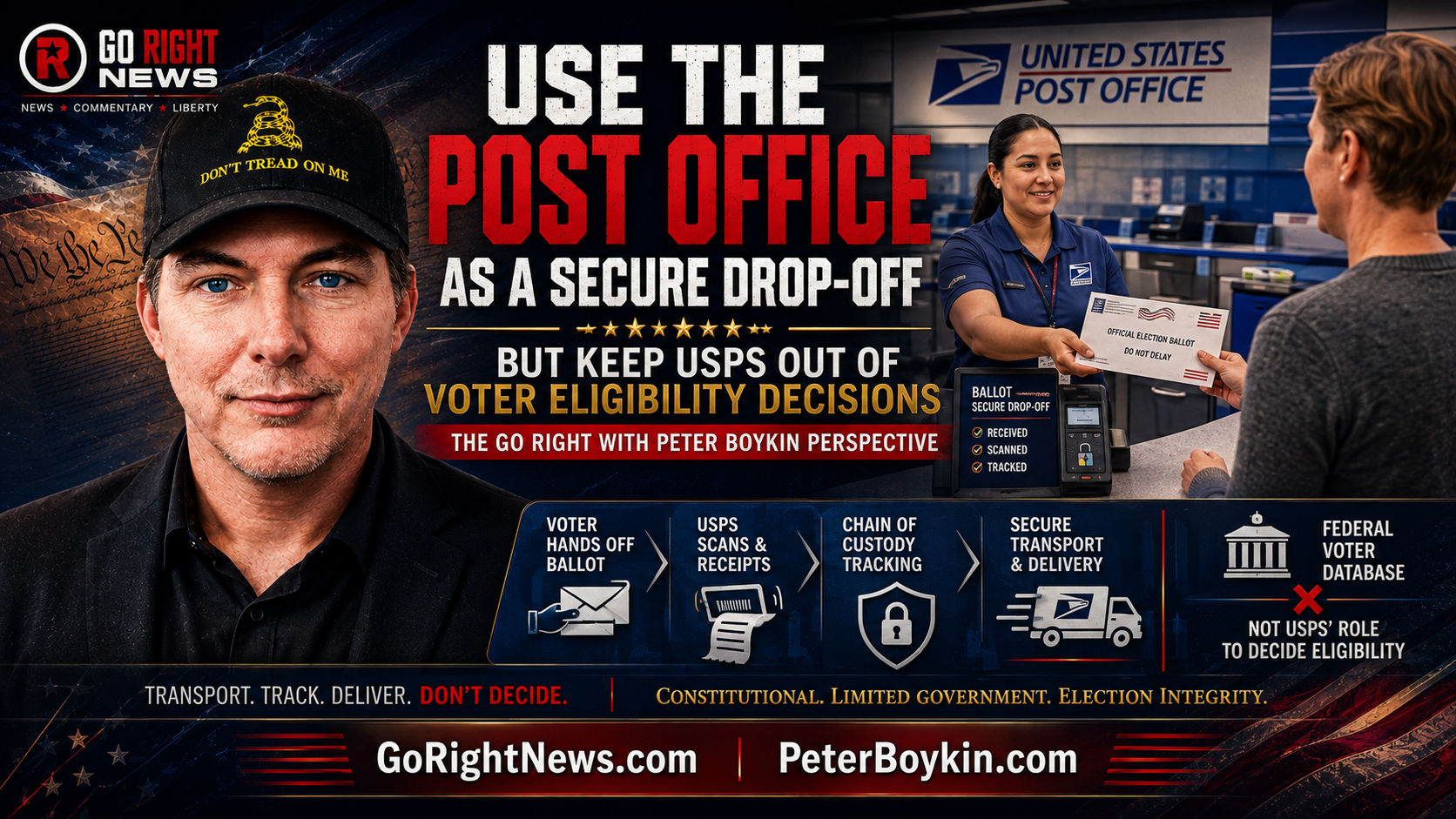
Secure Every Ballot, Use the Post Office as a Secure Drop-Off, but Keep USPS Out of Voter Eligibility Decisions
The Go Right with Peter Boykin Perspective
I want Americans to have confidence that their elections are secure, transparent and legitimate. That means voter rolls should be accurate, citizenship requirements should be enforced, election officials should be accountable, mail ballots should be trackable, and genuine election crimes should be prosecuted when the evidence supports prosecution.
President Trump is right that election security matters. He is also right that we should be using modern technology and stronger procedures to make mail voting easier to audit and harder to manipulate.
But I want to make one important distinction about the role of the United States Postal Service.
I do not believe the Post Office should become the government agency deciding whether someone is eligible to vote.
I do believe the Post Office can be one of the most useful places in America for the secure drop-off and handling of mail ballots.
That is an important difference.
The Postal Service already has thousands of established facilities across the country. Americans know where their local post offices are. USPS already handles registered mail, certified mail, government documents, passports, tax filings and other important material requiring reliable processing.
Why not take advantage of that existing infrastructure?
Instead of telling voters simply to place an absentee ballot into any ordinary mailbox and hope everything works correctly, we could create a secure election mail process allowing voters to bring completed mail ballots directly to designated Post Office locations.
A voter could walk into a participating Post Office, hand over the sealed ballot envelope, and have that ballot immediately scanned into the election mail tracking system.
The voter could receive a receipt confirming that USPS accepted the ballot.
The barcode could record the date, time and location where the ballot entered federal custody.
The voter could then track the envelope until it reaches the appropriate election office.
That would create a much stronger chain of custody than simply dropping a ballot into a street mailbox and wondering what happened next.
I think that could actually strengthen Trump’s election integrity goals while avoiding some of the constitutional problems that arise when USPS begins deciding whose ballot it is willing to carry.
There is nothing wrong with asking the Postal Service to become a secure custodian of election mail.
The problem comes when it becomes an election eligibility authority.
Those are two very different responsibilities.
USPS employees should not be determining whether Peter Smith is properly registered to vote.
They should not be deciding whether someone’s identification satisfies state election law.
They should not be deciding whether an absentee ballot application was valid.
They should not be determining whether the voter is a citizen.
Those decisions belong to the election officials legally responsible for administering elections.
But once the lawful election authority has issued the ballot, the Post Office can provide a secure and transparent way of getting that ballot from the voter back to the election board.
In fact, I would argue that this could be one of the strongest arguments for keeping USPS involved in mail voting.
Think about how it could work.
A voter receives an absentee ballot from their state or county election office.
The voter completes the ballot according to state law and seals it inside the required return envelope.
Instead of simply throwing that envelope into a neighborhood mailbox, the voter could take it to a designated Post Office counter.
USPS scans the official election mail barcode.
The system records that the sealed ballot was accepted.
The voter receives a receipt.
The voter can later check the tracking number and see when the ballot reaches the election office.
The election office then scans the same barcode when it receives the envelope.
At that point, there is a documented chain of custody from voter drop-off to election office receipt.
That is the kind of transparency that could improve confidence in mail voting.
It gives the voter proof.
It gives USPS accountability.
It gives election officials better records.
And it gives investigators better evidence if something goes wrong.
If thousands of ballots disappear between one postal facility and an election office, we know where to start looking.
If a ballot is delayed, we can see where the delay happened.
If a voter says they mailed a ballot and the election office says it never arrived, there is an independent tracking record.
That protects legitimate voters.
Election integrity should not only be about catching fraud after the fact.
It should also be about designing systems that make fraud harder, mistakes easier to detect and legitimate participation easier to verify.
I also think secure Post Office drop-off locations could answer some of the concerns Americans have about private ballot drop boxes.
There has been significant political disagreement about unsupervised drop boxes, who monitors them, how frequently ballots are collected, whether surveillance exists and how chain of custody is documented.
A Post Office already has trained federal employees, controlled facilities, surveillance in many locations, established mail-handling procedures and federal criminal penalties for tampering with the mail.
That does not mean USPS is perfect.
No government institution is.
But it provides an existing nationwide infrastructure that could be strengthened specifically for election mail.
Congress could establish clear national standards for this.
Designate official election mail drop-off counters at Post Offices during early voting and absentee voting periods.
Require immediate barcode scanning.
Provide the voter with a receipt.
Require secure storage until transportation.
Require documented transfer between postal facilities.
Require an electronic record when the election office receives the ballot.
Protect voter privacy.
Never record how anyone voted.
Never allow postal employees to open ballot envelopes.
And create serious criminal penalties for intentionally stealing, destroying or altering election mail.
That would be a meaningful security reform.
It would also preserve the constitutional distinction I care about.
USPS transports, tracks and protects the ballot.
Election officials determine whether the voter and ballot are lawful.
That division makes sense.
I want the Post Office helping secure mail voting.
I just do not want it deciding voting eligibility.
There is another reason I like this approach.
It gives voters a choice.
If somebody trusts normal mail delivery, they can use it according to state law.
If somebody wants greater certainty, they could physically take the ballot to the Post Office and receive proof that the federal mail system accepted it.
That is empowerment rather than restriction.
You are not telling the voter, “Trust us.”
You are giving the voter evidence.
Here is your receipt.
Here is the tracking number.
Here is when the ballot entered the system.
Here is when it reached the election office.
That kind of transparency can reduce conspiracy theories because people no longer have to rely entirely on politicians telling them everything worked.
They can see part of the process themselves.
That is what election integrity should look like.
We should be building systems where Republicans, Democrats, independents and everyone else can verify enough of the process to trust it.
Election security should not be designed to guarantee a Republican victory.
Voting access should not be designed to guarantee a Democratic victory.
The system should be designed so that lawful voters can vote, unlawful votes are rejected, and the public can audit the process.
I think Trump is right to push this conversation.
Mail voting should not operate like a black box.
If millions of ballots are moving through the postal system during a national election, we should know where those ballots are.
We should have clear records.
We should have secure procedures.
And voters should have confidence that once they hand over their ballot, somebody is accountable for it.
But I still want Congress involved in establishing any national system.
If we are going to create federal standards for election mail, let lawmakers debate them and put them into law.
Congress could create a nationwide secure Post Office ballot drop-off program specifically for federal elections while allowing states to maintain their own lawful election procedures.
Congress could establish tracking standards.
Congress could establish privacy protections.
Congress could establish chain-of-custody requirements.
Congress could require receipts for in-person postal ballot drop-offs.
Congress could make election mail tampering subject to strong federal penalties.
And Congress could make one thing unmistakably clear: the Postal Service’s job is custody and delivery, not determining voter eligibility.
That would give Trump many of the election security improvements he wants while respecting federalism and separation of powers.
And conservatives should insist on those constitutional guardrails.
We have to remember that every new federal election power created under Donald Trump will eventually belong to another president.
Maybe that president is a Democrat conservatives strongly oppose.
Maybe that administration wants USPS to enforce completely different election policies.
The best protection against future abuse is not trusting today’s president.
It is defining the power correctly from the beginning.
That is why I want the line drawn here.
I am comfortable with the Post Office saying:
We received this sealed ballot at 2:43 p.m. on October 20.
We scanned it.
We transported it securely.
The county election office received it at 10:17 a.m. the next morning.
That is exactly the kind of accountability I want.
I am much less comfortable with the Post Office saying:
Our federal database does not think you qualify, so we are refusing to carry the ballot your state lawfully issued.
That is when transportation becomes election administration.
So I would take Trump’s basic idea and make it better.
Use USPS.
Use its nationwide network.
Use secure Post Office locations.
Use tracking technology.
Use unique election mail barcodes.
Give voters receipts.
Create a documented chain of custody.
Protect every legitimate ballot.
Investigate tampering.
Prosecute actual fraud.
But keep voter eligibility decisions where the Constitution and election laws place them.
That gives us security without unnecessarily concentrating power.
It gives voters confidence without forcing them to trust an invisible system.
And it turns the Post Office into something useful in the election process rather than something constitutionally controversial.
Secure the ballot.
Let voters drop mail ballots securely at the Post Office.
Scan every official election envelope.
Give voters a receipt.
Track the chain of custody.
Protect voter privacy.
Prosecute anyone who intentionally tampers with election mail.
Let election officials decide eligibility.
And make Congress establish the national rules.
That is the balance I want.
Election integrity and voting access do not have to fight each other.
Federalism and national election security do not have to fight each other either.
We can use the Postal Service as part of the solution without turning it into the agency that determines who is allowed to vote.
That is stronger election security.
That is better accountability.
And that is much closer to the constitutional balance America should be trying to achieve.
Let’s #GoRight, not blindly right, but constitutionally right.
President Trump’s effort to tighten mail ballot security has hit a nationwide federal injunction, but USPS has finalized the regulations needed to launch the administration’s new election mail system if courts eventually allow it. The proposal could improve ballot tracking and chain-of-custody protections, but it also raises a larger constitutional question about whether the Postal Service should simply secure and transport election mail or become a federal gatekeeper over which ballots it will carry.
#GoRight #GoRightNews #PeterBoykin #ConstitutionalistForLiberty #DonaldTrump #PresidentTrump #ElectionIntegrity #SecureElections #MailBallots #AbsenteeVoting #USPS #BallotSecurity #ElectionSecurity #VoterEligibility #Federalism #StatesRights #Congress #SupremeCourt #SCOTUS #ExecutivePower #Constitution #ArticleI #RuleOfLaw #LimitedGovernment #ChecksAndBalances
Sources
The White House, Executive Order 14399: Ensuring Citizenship Verification and Integrity in Federal Elections
Official executive order establishing the administration’s citizenship verification and federal ballot mail policy.
https://www.whitehouse.gov/presidential-actions/2026/03/ensuring-citizenship-verification-and-integrity-in-federal-elections/
The White House, Fact Sheet: President Donald J. Trump Ensures Citizenship Verification and Voter Eligibility in Federal Elections
The administration’s explanation of the election security objectives behind the executive order.
https://www.whitehouse.gov/fact-sheets/2026/03/fact-sheet-president-donald-j-trump-ensures-citizenship-verification-and-voter-eligibility-in-federal-elections/
U.S. Postal Service, Federal Register Notices
Official USPS rulemaking materials concerning federal ballot mail.
https://pe.usps.com/FederalRegisterNotice
Federal Register, Ballot Mail for Federal Elections
Official rulemaking material detailing ballot mail standards and barcode requirements.
https://www.govinfo.gov/content/pkg/FR-2026-06-02/pdf/FR-2026-06-02.pdf
Reuters, U.S. Postal Service Issues Rules to Tighten Mail-In Voting if Court Gives OK
Published August 22, 2026. Reporting on the finalized USPS regulations and the continuing injunction.
https://www.reuters.com/world/us-postal-service-issues-rules-tighten-mail-in-voting-if-court-gives-ok-2026-08-22/
Reuters, Judge Blocks U.S. Postal Service From Restricting Mail-In Voting
Reporting on Judge Indira Talwani’s nationwide injunction against implementation of the disputed USPS provisions.
https://www.reuters.com/world/judge-blocks-us-postal-service-restricting-mail-in-voting-2026-08-11/
Reuters, Trump Administration Again Urges U.S. Supreme Court Intervention on Mail Ballots
Reporting on the administration’s request for Supreme Court intervention.
https://www.reuters.com/legal/government/trump-administration-again-urges-us-supreme-court-intervention-mail-ballots-2026-08-12/
Associated Press, Appeals Court Upholds Injunction Blocking Federal Election Order
Independent reporting on the appellate litigation involving Trump’s election executive order.
https://apnews.com/article/8bfb1f787f84fc60f9b6b284794b18b5
Associated Press, Judge Again Blocks Trump Mail Voting Order
Independent reporting on the nationwide injunction and separation-of-powers dispute.
https://apnews.com/article/159c192e48670a8740a6a378c683cb61

Call to Action
For daily commentary grounded in liberty, justice, constitutional values, and common sense, visit
GoRightNews.com.
Subscribe to Go Right with Peter Boykin on
Rumble,
YouTube,
Spotify,
Apple Podcasts,
Amazon Music,
and
Spreaker.
Follow #GoRight with Peter Boykin across the major platforms.
Support the Platform
Go Right News is independent media. If you support commentary that holds power accountable and defends constitutional liberty, consider helping keep the platform going.
Donate through
Cash App $GoRightNews
or visit
GoRightNews.com Donations.
Stay informed. Stay free. It is time to #GoRight.
#GoRight: More Than Politics, A Way of Life
At Go Right News, we know many people judge the headline before reading the facts. That is why we focus on context, accountability, and constitutional principles instead of outrage for outrage’s sake.
We lean right, but we are not here to defend hypocrisy, extremism, or double standards from any side. We stand for truth, liberty, personal responsibility, and the rights of We the People.
#GoRight is not just about politics. It means doing right, thinking right, being right, and voting right. It is a call to build, not destroy. It is about working toward a better future together.

Official Links
Web:
GoRightNews.com |GoRightNC.com |PeterBoykin.com |GaysForLiberty.org
Video and Podcast:
Rumble |YouTube |Spreaker |Spotify |Apple Podcasts |Amazon Music
Social:
Facebook |X |Telegram |Instagram |Reddit
Kick:
PeterBoykin |GoRightNews |LuckyNLoose


Help Keep Go Right News Independent
Each month, Go Right News spends hundreds of dollars and many hours running this site, producing content, and keeping the podcast alive without corporate control. If you like the content, please consider supporting the platform.
#GoRightNews #GoRight #PeterBoykin #ConstitutionalistForLiberty #ConservativeVoice #LibertyPodcast #IndependentMedia #CitizenJournalist #ConservativeCommentary #ConstitutionalTalk #FreedomOfSpeech #AmericaFirst #NorthCarolina #NCPOL #NCPolitics #BoykinForNC #GoRightNC #GaysForLiberty
Shared by #GoRightNews
https://GoRightNews.com