When The Cloud Comes for the Farm
Written by Peter Boykin on June 10, 2026






When The Cloud Comes for the Farm
#GoRightNews Shared by Peter Boykin
American Political Commentator / Citizen Journalist / Activist / Constitutionalist for Liberty

When The Cloud Comes for the Farm
Data Centers, Farmland, Water, Jobs, And the Fight for Local Control
There is a fight growing across America that many people ignored until it showed up beside their homes, farms, rivers, and power bills.
That fight is over data centers.
For years, most Americans heard the word “cloud” and pictured something clean, invisible, and weightless. Our photos were in the cloud. Our emails were in the cloud. Our businesses ran on the cloud. Artificial intelligence now lives in the cloud.
But the cloud is not in the sky.
The cloud is land. It is water. It is electricity. It is concrete, diesel backup generators, transmission lines, cooling systems, security fences, substations, noise, tax deals, zoning fights, and sometimes farmland that will never grow another crop again.
Data centers are not automatically bad. Modern life depends on them. Banking, hospitals, emergency services, small businesses, government records, artificial intelligence, streaming, phones, websites, and even local news all rely on digital infrastructure.
The real question is not whether America needs data centers.
The question is whether local communities should be forced to surrender land, water, power, and future flexibility so massive companies can build enormous industrial server farms wherever land is cheapest and political resistance is weakest.
The Taylor, Texas Warning
A recent case out of Taylor, Texas shows why people are angry.
In 1999, a farmer donated 87.97 acres for what was supposed to be public parkland. The land was reportedly transferred for only $10 with the understanding that it would be preserved for public use.
Decades later, the city sold the land for $10 million to a data center developer. Officials have pointed to projected tax revenue, including an estimated $30 million over the next decade.
To city leaders, that may look like economic development.
To residents, it looks like a broken promise.
When land is donated for children, parks, and community use, then later turned into a cash asset for industrial development, people have every right to ask who government is really serving.
That is not just a data center controversy.
That is a trust controversy.
North Carolina Is in The Fight Too
This issue is not limited to Texas.
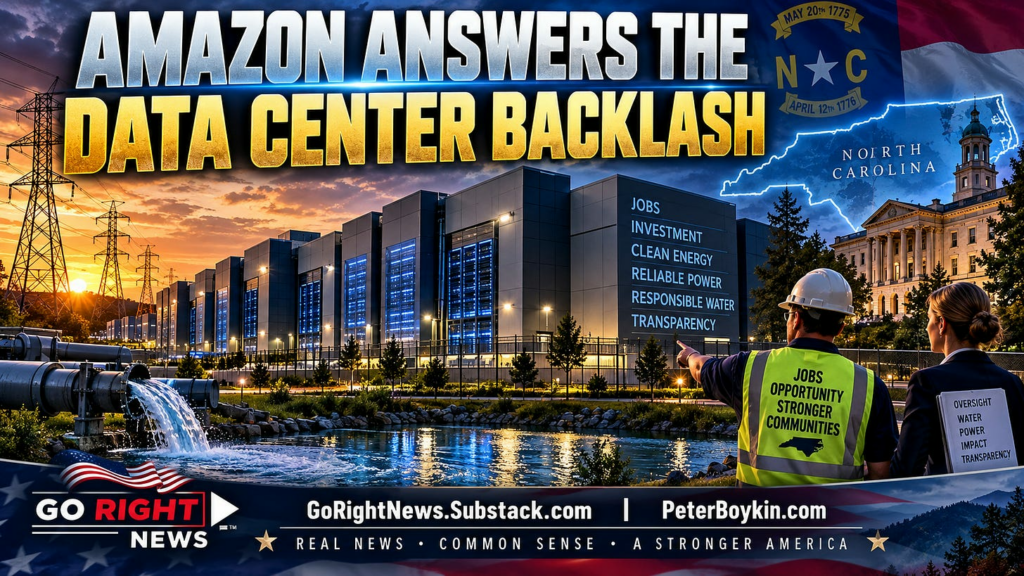
North Carolina is now in the middle of its own data center fight. Communities in Stokes County, Apex, Vance County, Orange County, Durham, Charlotte, Statesville, Richmond County, Person County, and elsewhere have raised concerns about where these facilities belong and what they cost the public.
In Stokes County, residents and community groups challenged a massive data center rezoning near Walnut Cove and the Dan River. The proposed project involved roughly 1,845 acres of residential and agricultural land being opened to heavy industrial use. Opponents raised concerns about farms, forests, rural communities, burial grounds, air quality, water quality, and whether the county followed the proper legal process.
That matters.
When a government rezones rural or agricultural land for a hyperscale data center, it is not simply approving another warehouse. It is changing the character of a place.
In Statesville, officials approved a large data center project on hundreds of acres of farmland despite local opposition. Supporters pointed to economic benefits. Residents warned about noise, pollution, lost rural character, and the permanent loss of farmland.
Charlotte, Orange County, Durham, and other communities have considered pauses or moratoriums so officials can study the impact before approving more projects.
That is not anti-technology.
That is responsible government.
The Real Cost of The Cloud
Data centers consume enormous amounts of electricity. Some use large amounts of water for cooling, depending on design. Even facilities with closed-loop cooling systems can still require major energy loads.
Backup generators can raise air-quality concerns. Large buildings can create constant low-frequency noise. Transmission upgrades can reshape landscapes. New substations and power infrastructure can place burdens on the grid.
Then there is the land.
America needs technology, but America also needs farms. We cannot eat computer chips. We cannot replace food security with server racks.
Farmland is not just dirt waiting for a developer.
Farmland is food independence. It is local economy. It is family inheritance. It is open space. It is drainage. It is wildlife habitat. It is culture. It is memory.
Once farmland is scraped, graded, paved, fenced, and industrialized, it is not easily restored.
The Resource Question: Water, Power, And Who Gets Priority
One of the biggest questions surrounding data centers is not just where they are built, but what they consume after they are built.
Some large data centers use evaporative cooling systems, which can require enormous amounts of water. Environmental and infrastructure reports have warned that larger facilities can use up to 5 million gallons of water per day. That is not a small number. That is comparable to the daily water needs of a small city, depending on local usage rates and population size.
The U.S. Environmental Protection Agency says the average American uses about 82 gallons of water per day at home. At that rate, 5 million gallons of water could equal the daily household water use of more than 60,000 people. Even using broader municipal estimates that include commercial and public use, this can still represent the water demand of a town or small city.
That should stop every local government in its tracks.
Before approving a project, officials should ask whether the water supply can handle it during droughts, dry summers, and future growth. They should ask whether farmers, homeowners, and small businesses will be expected to conserve while a massive facility continues drawing water to cool machines.
Water is not the only issue.
Data centers also place major strain on the electric grid. These facilities can require enormous and constant power loads, especially as artificial intelligence increases demand for high-performance computing. That means more transmission lines, more substations, more grid upgrades, and potentially higher costs for ordinary ratepayers.
If a data center needs the power of a small city, then the public deserves to know who pays for the infrastructure.
Will the company pay?
Will taxpayers pay?
Will working families see it buried in higher utility bills?
These questions cannot be treated as afterthoughts.
A community cannot responsibly approve a massive data center without a full resource impact review. That review should include water demand, energy demand, drought impact, emergency backup systems, grid upgrade costs, wastewater impact, and long-term resource planning.
Technology needs resources.
So do people.
So do farms.
So do future generations.
If local leaders are going to approve projects that consume city-sized amounts of water and power, they must prove that residents will not be left paying the price.
Sources to support this section: larger data centers have been reported to use up to 5 million gallons of water per day, and EESI compares that scale to town-sized water demand. EPA says the average American uses about 82 gallons of water daily at home. WRI has also warned that data center growth can affect energy prices, water use, air quality, and local infrastructure. (EESI)
The Jobs Question
Supporters of data centers often point to jobs.
That argument deserves scrutiny.
Data centers can create real construction jobs. Electricians, plumbers, welders, concrete workers, equipment operators, security contractors, engineers, and technicians may all benefit during the building phase.
There may also be permanent jobs after the facility opens.
But the job numbers must be examined honestly.
A massive data center may occupy hundreds or thousands of acres while employing far fewer permanent local workers than a factory or manufacturing plant. The construction phase may be busy, but once the buildings are complete, many data centers operate with a limited long-term workforce.
That does not mean there are no benefits.
A data center can grow the tax base. It can provide revenue for schools, public safety, roads, and county services if the deal is structured correctly.
But there is a difference between revenue and value.
If local government gets more tax money while residents get higher utility bills, lost farmland, water stress, noise, lower quality of life, and a permanently changed landscape, then the community has a right to ask whether the deal was worth it.
Who Pays for the Infrastructure?
This is where incentives become a serious problem.
If state or local governments offer major tax breaks to attract data centers, the public deserves to know who pays the difference.
Are ordinary ratepayers subsidizing grid upgrades?
Are taxpayers losing sales tax revenue?
Are schools and counties getting the full benefit, or are politicians promising a windfall while quietly giving away the store?
If a data center uses the power of a small city, it should not be treated like a small business.
If a data center requires major infrastructure upgrades, working families should not be forced to carry that cost through higher utility bills.
If a data center needs major water access, residents should know that before zoning is approved, not after the deal is already done.
What Happens When Technology Changes?
Another question deserves more attention.
What happens if these massive data centers are no longer needed in the same way twenty or thirty years from now?
Technology changes fast. Computing may become smaller, more efficient, more decentralized, or completely different from what we use today.
America has already seen empty malls, empty big-box stores, empty factories, and abandoned office parks that were once sold as the future.
Do we really want to create the next generation of empty industrial shells on land that used to grow food?
Once farmland is paved and industrialized, it does not simply return to what it was.
There are Better Alternatives
There are better ways to meet America’s digital needs.
Before taking farmland, developers and local governments should be required to consider existing empty buildings, abandoned malls, old factories, vacant office parks, brownfields, and underused industrial sites.
Not every empty building can become a data center. These facilities need strong electric service, fiber access, cooling capacity, structural strength, security, and room for mechanical equipment.
But some can be reused.
Smaller regional data centers, edge computing facilities, and adaptive reuse projects could reduce pressure on farmland and rural communities.
Why not use smaller existing buildings where possible?
Why not spread some of the demand across mini data centers instead of concentrating everything into massive rural campuses?
Why not prioritize brown fields before green fields?
Why not require a farmland impact review before agricultural land is rezoned?
Why not require a decommissioning plan so communities are not left with dead server warehouses if technology changes?
Why not make developers pay for water, power, road, and emergency-service impacts up front?
Why not protect donated land, parkland, historical land, and prime farmland from being flipped into industrial development without overwhelming public consent?
These are not radical questions.
They are responsible questions.
Transparency Must Come First
Local governments should require full disclosure before approval.
How much land will be cleared?
How much water will be used daily and annually?
What cooling system will be used?
Will water be recycled?
How much power will be required?
Will new transmission lines or substations be needed?
How many backup generators will be installed?
What fuel will they use?
What noise level will nearby homes experience?
How many permanent jobs will be created?
What wages will they pay?
What tax incentives are being offered?
What happens if the facility closes?
A balanced policy would not ban all data centers. It would separate necessary infrastructure from reckless land grabs. It would welcome technology while defending local communities.
Say yes where the location makes sense.
Say no where the cost is too high.

Growth Without Wisdom Becomes Destruction
The Go Right with Peter Boykin Perspective
This should not be a left or right issue.
This is a local control issue. It is a property rights issue. It is a food security issue. It is a water issue. It is a ratepayer issue. It is a trust issue.
As a Constitutionalist for Liberty, I believe government should protect citizens first, not clear the path for the biggest bidder.
Conservatives should care about stewardship, property rights, limited government, rural communities, and honest local decision-making. We should not blindly cheer every massive corporate development just because someone calls it economic growth.
The fight over data centers is not really a fight against technology.
It is a fight over whether growth should serve the people or whether the people are expected to get out of the way for growth.
That is the distinction too many local leaders miss.
A data center may bring tax revenue. It may bring construction jobs. It may bring headlines about investment and economic development. But none of that answers the deeper question.
What did the community have to give up to get it?
If farmland is lost, if water demand rises, if power infrastructure is strained, if local ratepayers are left covering the cost, if rural roads are changed forever, and if residents are treated like obstacles instead of citizens, then that is not responsible progress.
That is government selling the future one zoning vote at a time.
The Taylor, Texas parkland controversy should be a warning to every community in America. When land given for public use can later be turned into a private development deal, trust is broken. It reminds us that land is not just a line item. It is a promise. It is history. It is public memory.
North Carolina should pay close attention.
From Stokes County to Charlotte, Durham, Orange County, Statesville, Apex, Vance County, Richmond County, Person County, and beyond, citizens are asking questions that deserve real answers. They want to know how much water will be used. They want to know how much electricity will be required. They want to know how many permanent jobs will actually be created. They want to know who pays for the roads, power lines, substations, emergency services, and long-term impacts.
That is not anti-business.
That is accountability.
As a Constitutionalist for Liberty, I believe local communities have the right to demand transparency before their land, water, and power are committed to projects that may permanently change the place they call home.
We can support innovation without surrendering common sense.
We can build the digital infrastructure America needs without sacrificing every farm, every rural community, and every quiet road in the process.
Before we pave over farmland, we should ask why empty buildings, old malls, unused industrial sites, and brownfields are not being considered first. Before we hand out incentives, we should ask whether ordinary taxpayers and ratepayers are being forced to subsidize billion-dollar companies. Before we celebrate promised jobs, we should demand honest numbers on how many permanent local workers will actually be employed.
Growth is not automatically good just because it is expensive.
Progress is not automatically wise just because it is high-tech.
And tax revenue is not automatically worth the cost if the price is ruined land, strained resources, and broken public trust.
America needs data centers.
But America also needs farms.
America needs technology.
But America also needs water, food security, property rights, and local control.
We cannot eat computer chips. We cannot drink tax projections. We cannot replace rural heritage with a server rack and call it a fair trade.
The future should be built with wisdom, not just speed.
Because growth without wisdom does not become progress.
Growth without wisdom becomes destruction.
This is Go Right with Peter Boykin, the Constitutionalist for Liberty.

#GoRight, #GoRightNews, #PeterBoykin, #ConstitutionalistForLiberty, #DataCenters, #NorthCarolina, #NCPolitics, #Farmland, #SaveOurFarms, #WaterRights, #EnergyGrid, #Ratepayers, #LocalControl, #PropertyRights, #FoodSecurity, #RuralAmerica, #LandUse, #Zoning, #ResponsibleGrowth, #TechnologyWithAccountability, #GrowthWithoutWisdom, #AmericaFirst
The cloud is not invisible. It is land, water, electricity, power lines, cooling systems, and sometimes farmland that will never grow another crop again.
In this article, I break down the growing controversy over data centers, their impact on farmland, water use, energy demand, jobs, and local control, including the fights happening here in North Carolina. America needs technology, but we also need farms, water, and honest government.
Read more at GoRightNews.com
Sources And Source Data
- Taylor, Texas parkland/data center controversy
Tom’s Hardware reported that 87.97 acres donated in 1999 for public parkland for $10 were later sold for $10 million to a data center developer, with city officials projecting about $30 million in tax revenue over the next decade.
Source: Tom’s Hardware, “Farmer donates land for a park, city sells it for data center development”
https://www.tomshardware.com/tech-industry/farmer-donates-land-for-a-park-city-sells-it-for-data-center-development-usd10-gift-became-usd10m-for-city-government-with-usd30m-tax-expected-over-next-decade - Additional reporting on the Taylor, Texas project
Chron reported that the Taylor site was originally donated for public park use, later moved through public entities, and sold for a proposed $1 billion data center project. The report also notes projected revenue of about $30 million for the city and up to $20 million for local schools over the next decade.
Source: Chron, “Land once intended as Texas parkland now slated for $1B data center”
https://www.chron.com/texas/article/taylor-texas-park-data-center-22295703.php - North Carolina data center opposition
WUNC reported that opposition to data centers is expanding across North Carolina, including Stokes County, Apex, Vance County, Orange County, Durham, Charlotte, Statesville, Richmond County, Person County, and other areas. The report also covered political pushback, moratorium discussions, water concerns, power demand, and local zoning fights.
Source: WUNC, “Opposition to data centers is ‘catching a fire’ across North Carolina, spurring political challenges”
https://www.wunc.org/environment/2026-04-10/opposition-to-data-centers-is-catching-a-fire-across-north-carolina-spurring-political-challenges - National impacts on land, water, energy, air quality, and communities
The World Resources Institute reported that data center growth is reshaping local energy grids, water systems, land use, air quality, health impacts, jobs, and community costs across the United States.
Source: World Resources Institute, “7 Ways Data Centers Affect US Communities”
https://www.wri.org/insights/us-data-center-growth-impacts - Water use: up to 5 million gallons per day
The Environmental and Energy Study Institute reported that large data centers can consume up to 5 million gallons of water per day, which it compares to the water use of a town of roughly 10,000 to 50,000 people.
Source: Environmental and Energy Study Institute, “Data Centers and Water Consumption”
https://www.eesi.org/articles/view/data-centers-and-water-consumption - EPA household water-use benchmark
The U.S. Environmental Protection Agency states that the average American family uses more than 300 gallons of water per day at home, and other EPA water-use materials commonly estimate household use around 82 gallons per person per day. This helps translate data center water demand into household and community-scale comparisons.
Source: U.S. EPA, WaterSense, “Statistics and Facts”
https://www.epa.gov/watersense/statistics-and-facts - Energy strain and North Carolina ratepayer concerns
WFAE/WUNC reporting through VPM covered concerns that data center growth in North Carolina could drive demand for new power generation and grid upgrades, including public concern that residents may be asked to pay for infrastructure tied to AI/data center demand.
Source: VPM/WFAE/WUNC, “Developers are moving NC data center projects forward at hyperspeed”
https://www.vpm.org/news/2026-05-12/wfae-wunc-data-center-duke-energy-demand-load-north-carolina - Adaptive reuse as an alternative
DLR Group outlined strategies for converting existing buildings into data centers when conditions allow, including evaluation of power capacity, fiber access, structural loads, cooling requirements, security, and operational constraints.
Source: DLR Group, “Data Center Adaptive Reuse: 5 Strategies for Existing Buildings”
https://www.dlrgroup.com/idea/data-center-adaptive-reuse-strategies/ - Water-capacity research and future demand
A 2026 research paper found that data center water demand can place major pressure on public water systems, especially during peak heat periods, and recommended reporting peak water use, coordinated water-power planning, and community protections.
Source: Han, Li, Wierman, Ren, “Small Bottle, Big Pipe: Quantifying and Addressing the Impact of Data Centers on Public Water Systems”
https://arxiv.org/abs/2603.02705

Call to Action
For daily commentary grounded in liberty, justice, and constitutional values, visit GoRightNews.com
Subscribe at Rumble.com/GoRightNews and Go Right with Peter Boykin Podcast – YouTube
📢 Listen and Subscribe:
Rumble | YouTube | Spotify | Apple Podcasts | Amazon | Truth Social | X | Facebook | GAB | TikTok
Follow #GoRight with Peter Boykin on
Go Right with Peter Boykin GoRightNews.com | Podcast on Spotify
and every major platform
SUPPORT THE PLATFORM
If you support independent media that holds power accountable, consider a donation at Cash App $GoRightNews.
Help us stay fiercely independent.
Donate at Cash App $GoRightNews
All donation links are at GoRightNews.com and PeterBoykin.com
Stay informed. Stay free. It is time to #GoRight.
At Go Right News, we know most critics won’t even read past the headline. Quick to judge, quicker to dismiss, just like the very bureaucrats we expose. Sure, we expect that from the Left. But too often, even conservatives skip the facts, shouting “fake news” without a second thought.
We’re not here to play into false binaries. Go Right News always stands to defend the Constitution, truthfully, unapologetically, and without fear of offending either side. We lean right, but we’re not afraid to call out extremism, hypocrisy, or double standards wherever they hide.
We give you the facts, the contrast, and the Constitutional context, because this is more than politics. It’s a movement.
It’s Time To #GoRight
#GoRight: More Than Politics: A Way of Life

#GoRight: More Than Politics, A Way of Life
#GoRight isn’t just about politics: it’s about doing what’s right in every aspect of life.
It’s about making choices that uplift, strengthen, and unite our communities.
It means:
✅ Doing Right: Standing for truth, integrity, and accountability.
✅ Thinking Right: Using logic, common sense, and fairness in decision-making.
✅ Being Right: Living with honor, respect, and responsibility.
✅ Voting Right: Electing leaders who put We the People first.
#GoRight is a direction: a call to action for all who believe in building, not destroying.
It’s about working toward a better future, together.
This Article is brought to you by Go Right News and edited by Peter Boykin
Visit GoRightNews.com for More Articles, and visit PeterBoykin.com to Learn more about Peter Boykin
 At Go Right News, we stand for facts, not fear. We believe in preserving our history, focusing on real policy, and cutting through the noise. The truth doesn’t need to be edited—it just needs to be heard. And if we’re going to win for America, it’s time to stop running to the sidelines and start charging down the field toward unity, prosperity, and liberty for all.
Web:

Kick:

Rumble:
https://rumble.com/c/GoRightNews
https://rumble.com/c/GoRightNewsVideos
https://rumble.com/c/GoRightNewsPodcast
https://rumble.com/c/GaysForTrump
https://rumble.com/c/PeterBoykin
YouTube:
https://youtube.com/@PeterBoykinForAmerica
https://www.youtube.com/@GoRightNews
https://www.youtube.com/@GoRightNewsChannel
https://www.youtube.com/@gorightnewsvideos
https://www.youtube.com/@gorightnc
https://www.youtube.com/@PeterBoykinForLiberty
https://www.youtube.com/@gaysfortrumporganization
https://www.youtube.com/@QiewNews
https://www.youtube.com/@GoForwardNews
Facebook:
https://www.facebook.com/boykin4congress
https://www.facebook.com/groups/gorightnews
https://www.facebook.com/GoRightNewsOfficial
https://www.facebook.com/PeterRBoykin
https://www.facebook.com/BoykinForNC
https://www.facebook.com/Boykin4NC
https://www.facebook.com/groups/boykinfornc
https://www.facebook.com/groups/PeterBoykinForCongress
https://www.facebook.com/groups/boykin4nc
https://www.instagram.com/peterboykin/
https://www.instagram.com/gorightnews/
https://www.instagram.com/boykin4congress/
https://www.instagram.com/march4trump/
https://www.instagram.com/peterboykinsings/
Twitter:
Telegram:
https://t.me/NorthCarolinaRedWave
https://t.me/BoykinForCongress
https://t.me/NorthCarolinaFirst
https://www.reddit.com/r/GoRightNews/
https://www.reddit.com/r/GoRight/
https://www.reddit.com/r/Peter_Boykin/
https://www.reddit.com/r/PeterBoykin/
https://www.reddit.com/r/MagaFirstNews/
https://www.reddit.com/r/GayConservatives/
https://www.reddit.com/r/GaysForTrump_Org/
https://www.reddit.com/r/AskGayConservatives/
Each Month, Go Right News Spends Hundreds of Dollars and Hours to Run This Site and Podcast,
with no sponsors or ads. This comes out of our pockets. If you like what you see, consider donating to the podcast. Thanks!
Like the Content? Please Support!
Stripe: https://gorightnews.com/donations/support-gorightnews/
Cash App: https://cash.app/$GoRightNews
Tags:
#GoRightNews, #GoRight, #PeterBoykin, #ConservativeVoice, #LibertyPodcast, #MakeAmericaRightAgain, #GOPPodcast, #RightWingTalk, #ConservativeTalk, #ConstitutionalTalk, #NewsForTheRight, #RightSideOfHistory, #AmericaFirstPodcast, #ConservativeCommentary, #PatriotPodcast, #FreedomOfSpeech, #RightViews, #TrumpSupportersPodcast, #ConservativeInsider, #RightSideNews
#ncpol #NCpolitics #Boykin4NC #BoykinFor2024 #BoykinForNC
#Android #Apple #Trump #trumptrain #Trump2024 #TRUMP2024ToSaveAmerica #2024Election #election #election2023 #electionchallenge #ElectionIntegrity #ElectionsMatter #ElectionCommission #GoRightNews #GaysForTrump #tuesday #GoRight #ihatemondays #applemusic #applewatch #applepodcasts #ApplePay #appleiphone #bidenisnotmypresident #BIDENSAMERICA #BidenBorderCrisis #Bidenflation #Biden #BidenCrimeFamily #northcarolina #government #Governor #politics #political #politicians #politicalchallenge #politicalmeme
#MakeAmericaHealthyAgain, #RFKJr, #HealthFreedom, #TransparencyInHealthcare, #BigPharmaWatch, #TrumpHealthAgenda, #VaccineSafety, #HealthReform, #EndTheCorruption, #GoldStandardScience, #J6Pardon, #TrumpJustice, #EqualJusticeUnderLaw, #PoliticalPrisoners, #CapitolCases, #LegalDelay, #TrumpInauguration, #PardonPower, #JusticeForJ6, #AwaitingJustice, #FloridaVsFEMA, #PoliticalDiscrimination, #DisasterReliefBias, #HurricaneVictims, #EqualAid, #FEMAControversy, #NoPoliticalAid, #JusticeForAllFloridians, #FEMAInvestigation, #TrumpSupportersRights
Shared by
#GoRightNews https://GoRightNews.com
[/vc_column_text][/vc_column][/vc_row]